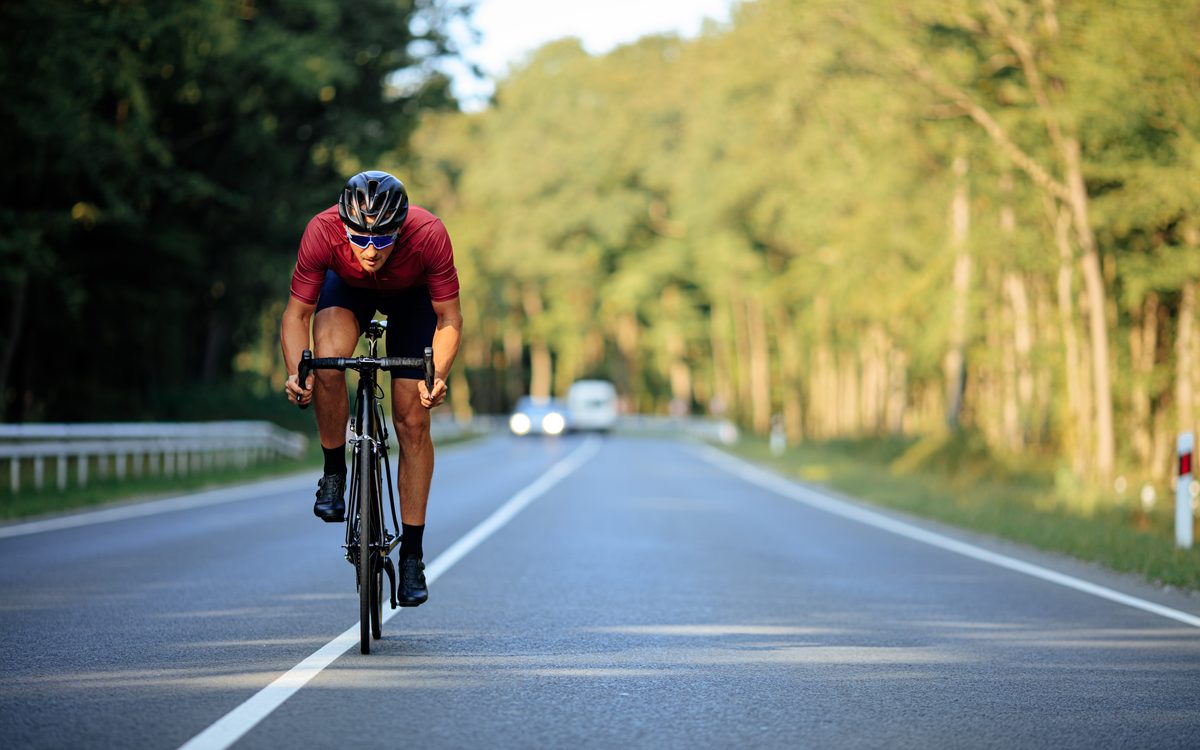
A tight corner on a wet criterium, the front of the bunch brakes, and a rider in the middle has nowhere to go. Most road cyclists have seen it or lived it. Road cycling injury prevention is the set of habits around a rider (a bike that fits, a good helmet, lights, steady training load, strength work, enough food, careful riding in a group and honest reporting of pain) that aim to lower the chance of getting hurt. They lower the odds; they cannot promise anything. What each injury looks like is on our road cycling injuries page, so we do not repeat it here. The discipline overview is on the road cycling hub.
Quick answer: The best-supported steps are a helmet that meets the US standard and fits, a bike that fits you, lights and visibility on shared roads, a training load that builds gradually, strength work, and eating enough to fuel the miles. Racing carries far more injury risk per hour than training, so riding skills matter. See a sports medicine doctor, physical therapist or athletic trainer if pain stays in one spot or changes how you ride, and call 911 after a head injury with danger signs.
Warm-up
We did not find a published injury-prevention warm-up program tested in road cyclists, so there is no named routine (like the FIFA 11+ in soccer) to point to. What USA Cycling’s first-time racer guide says is simple: warm up by spinning an easy gear before a race. General coaching practice adds a few minutes of easy pedalling building to a short harder effort before a race or hard session, and some riders add hip and leg mobility moves off the bike. Treat those as habits, not proven prevention.
Bike fit and position
A 2007 review of lower-limb cycling injuries (Wanich and colleagues, Journal of the American Academy of Orthopaedic Surgeons) found that many are preventable and that injury comes from a combination of inadequate preparation, inappropriate equipment, poor technique and overuse. Its prevention advice centers on bike fit and alignment, appropriate equipment, rider position, pedalling mechanics and appropriate training. The American Academy of Orthopaedic Surgeons advises a bicycle sized for your body, frame, handlebar and seat heights set to avoid overuse injuries, and a professional fit if you ride often. A 2026 systematic review (Barrajon and colleagues) looked at whether bike-fitting changes help low back pain in cyclists; we cite the topic only, not a result. Persistent numbness or pain is a reason to get the fit and your body checked by a professional, not to keep pushing.
Technique and riding in a bunch
Racing is where the crashes are. In a year-long study of 47 professional cyclists (Fallon and colleagues, 2025, Sports), the injury rate was 4.14 per 1,000 hours in racing against 1.23 per 1,000 hours in training, and the authors reported a significantly higher risk in racing for both women and men. The practical habits below are general coaching practice, not tested programs:
- Hold a predictable line, avoid sudden moves, and call or point out hazards.
- Keep your hands near the brakes in a bunch, and look ahead of the rider in front.
- Brake before a corner and keep the bike upright on wet or dirty surfaces.
- Learn bunch skills on group rides before racing; the American Academy of Orthopaedic Surgeons advises single file when riding in a group.
Progressive training load
Wanich and colleagues list overuse and training errors among causes of cycling injury. The 2013 European College of Sport Science and American College of Sports Medicine consensus on overtraining says excessive overload combined with inadequate recovery can lead to overreaching and overtraining syndrome, which is why rest days and easy weeks are built into plans. We found no single “safe” weekly increase backed by cycling research, so we do not give one; see the training page and ask a coach.
Strength and conditioning
A 2026 review of resistance training for cyclists (Scandinavian Journal of Medicine and Science in Sports) found one to two weekly sessions of moderate-to-high-load work improved key cycling performance measures, and that strength work may help counter the low bone mineral density common in competitive cyclists. That is a performance and bone-health finding; the review does not claim it prevents crashes. Professional riders surveyed in 2025 (Vikestad and colleagues) named preventing injuries among their reasons for lifting.
Roads, traffic, weather and heat
The National Highway Traffic Safety Administration counted 1,166 bicyclists killed in US traffic crashes in 2023, and its safety reminders include using lights, riding with traffic and wearing a helmet. A controlled experiment in Odense, Denmark (Madsen and colleagues, 2013, 3,845 cyclists) found a 19% lower accident rate with permanent running lights, though accidents were self-reported. The American Academy of Orthopaedic Surgeons advises a working headlight and taillight visible from 500 feet at night, bright clothing, riding in the direction of traffic, avoiding headphones and checking brakes, tires and gears. For heat, a 2024 review of endurance events (Armstrong and colleagues) found few reports of hyperthermia and exertional heatstroke in cycling field studies compared with running and triathlon, but cyclists still lose fluid on long rides; see our nutrition page.
Helmets and protective gear
Helmets are the best-documented protective item. A meta-analysis of studies of injured cyclists (Olivier and Creighton, 2017, International Journal of Epidemiology) linked helmet use with lower odds of head injury. The Consumer Product Safety Commission says US helmets sold since 1999 must meet its standard (16 CFR 1203), that helmets are for a single impact and should be replaced after a crash, and that no helmet has been proven to prevent concussions. USA Cycling requires a helmet at permitted events. Gloves and eyewear are advised by the American Academy of Orthopaedic Surgeons. See our gear page for standards and fit.
Eating enough
A 2026 review from the UCI Sports Nutrition Project (Burke and colleagues) says cyclists are a weight-conscious group that frequently reports restrictive eating, and that the combination of high training load and low energy intake may put riders at high risk of problems with health and performance. The IOC’s 2023 consensus statement on Relative Energy Deficiency in Sport describes the same risk. Under-fuelling is an injury and illness risk, not just a performance one; see the nutrition page.
What prevention cannot do
A crash in a fast bunch can hurt any rider with any gear. Prevention lowers the odds and rarely removes them. Several of the habits above come from observational studies or expert reviews, so treat them as sensible practice, not proof.
When to see a professional
See a sports medicine doctor, physical therapist or athletic trainer for pain that stays in one place, shows up at rest or at night, gets worse each ride, or follows a crash; for numbness that does not clear; and for repeated illness or constant fatigue. After a blow to the head, the CDC lists danger signs that need 911 or an emergency department: repeated vomiting, seizures, worsening headache, slurred speech, weakness or numbness, unusual behavior or a pupil larger than the other.
Road cycling injury prevention: FAQs
Does a bike fit prevent injuries?
Reviews say fit and alignment are a main prevention focus for cycling overuse injuries, and the American Academy of Orthopaedic Surgeons recommends a professional fit if you ride often. We found no study proving a fit prevents a specific injury, and one 2026 review of fitting for low back pain is cited only by topic.
Is racing more dangerous than training?
In a 2025 year-long study of 47 professional cyclists, injury rates were 4.14 per 1,000 hours in racing and 1.23 per 1,000 hours in training. Professionals race at higher speed in bigger bunches than most club riders.
Do lights really help in daytime?
A Danish controlled experiment with 3,845 cyclists found a 19% lower rate of injury accidents with permanent running lights, though accidents were self-reported. Lights are a visibility tool, not a guarantee.
Should I replace my helmet after a crash?
The Consumer Product Safety Commission says helmets are designed for a single impact and should be replaced after a crash.
Can strength training prevent road cycling injuries?
It can help performance and bone health according to a 2026 review, and professional riders cite injury prevention as one reason they lift. We did not find a trial showing it prevents crashes or specific injuries.
Sources
- Wanich et al. 2007, cycling injuries of the lower extremity
- Fallon et al. 2025, injury and illness in professional cycling, year-long prospective study
- Clarsen, Krosshaug and Bahr 2010, overuse injuries in professional road cyclists
- Madsen et al. 2013, permanent running lights for bicycles
- Olivier and Creighton 2017, bicycle injuries and helmet use
- CPSC: which helmet for which activity
- AAOS OrthoInfo: bicycle safety
- NHTSA: bicyclists and other cyclists, 2023 data
- Armstrong et al. 2024, hyperthermia and exertional heatstroke in endurance events
- Resistance training for cyclists (2026 review)
- Burke et al. 2026, UCI Sports Nutrition Project: energy availability in cycling
- IOC 2023 consensus statement on REDs
- Meeusen et al. 2013, ECSS and ACSM overtraining consensus
- Barrajon et al. 2026, bike fitting and low back pain
- CDC HEADS UP: signs and symptoms
- USA Cycling: first-time racer guide
General information for education only, not medical advice. It does not diagnose, treat or clear anyone to ride or race. Talk to a sports medicine doctor, physical therapist or athletic trainer about your own body. How we write and check our pages is in our editorial policy.