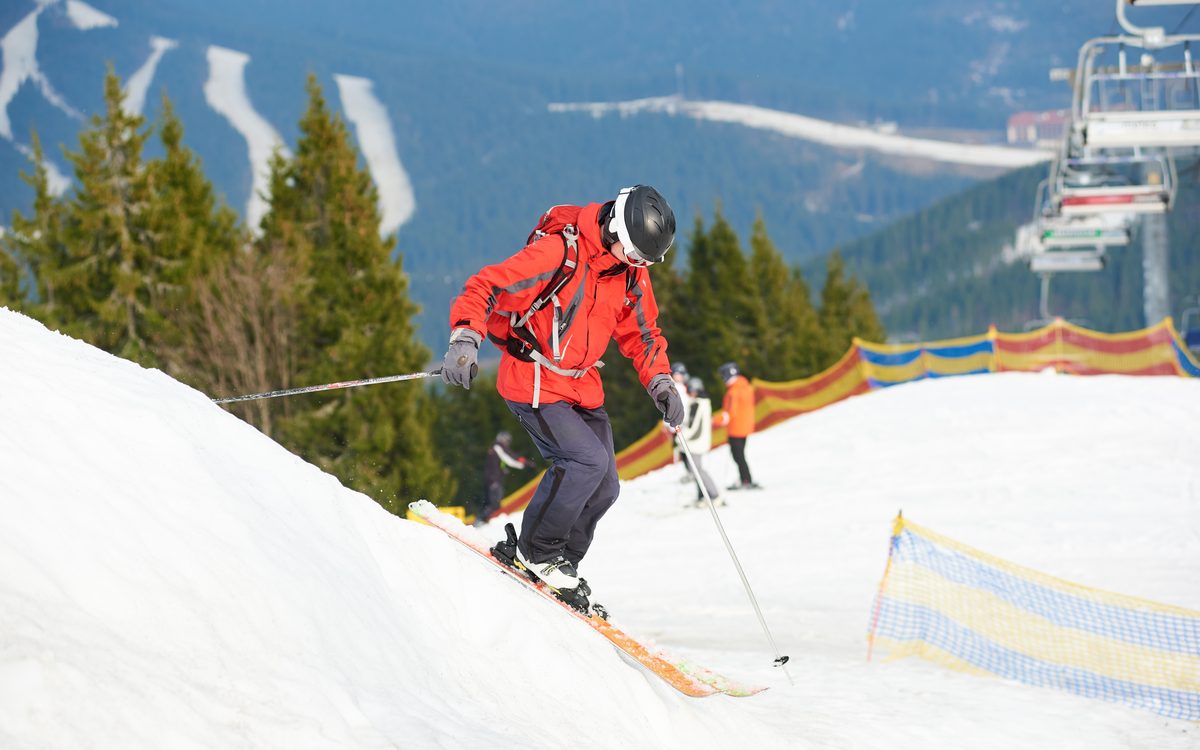
October, a dry gravel parking lot at a ski club, and a dozen teenagers in shorts are doing jump squats and single-leg landings between cones while a coach counts. The snow is still weeks away. Alpine ski training is the work done mostly away from the course, strength, power, balance, conditioning and technique, that prepares a racer for a few minutes of intense skiing. This page covers what the sport asks of the body and a sensible shape for a week and a year. It is general information, so a coach and a clinician should set an individual plan. Rules and levels are on our getting started page; the alpine skiing hub has the sport overview.
Quick answer: Alpine racing rewards leg and trunk power used with precise technique over short, hard efforts (2026 Olympic snow sports review). Typical programs combine strength and power work, balance and core training, some aerobic base and plenty of time on snow, building volume gradually. The evidence is thin: a 2025 FIS consensus statement says there is little evidence and no international standard, so treat any program as expert opinion. Check with a coach and a sports medicine professional before starting hard training, especially for young racers.
What the sport demands
A 2026 review of Olympic snow sports places alpine skiing among the disciplines where neuromuscular power and technical precision matter most, in contrast with endurance-dominant sports such as cross-country skiing. A strength and conditioning review for ski racing (Hydren and colleagues, Strength and Conditioning Journal, 2013) notes that race runs last from about 40 seconds to over two minutes, and recommends emphasising muscle size and maximal strength, power, balance, dynamic mobility and anaerobic energy support. We read that review through its published abstract summaries, so check the full paper.
A systematic review of 28 studies covering 1,107 racers (Ferland and Comtois, 2018) found men generally scored higher than women on physical tests and higher-level racers higher than lower-level ones. The authors also called for more research on women and for clearer test protocols. In other words, test numbers from a table are a rough guide at best, not a target.
Skiing is also a vigorous activity in general: a 2026 study in the Journal of the International Society of Sports Nutrition measured about 7.8 METs for recreational alpine skiing in young adults, which counts as vigorous intensity. That is recreational skiing, not racing.
A sensible weekly shape
No published source gives a universal weekly plan, and the FIS consensus on training and testing (2025) explicitly says evidence is limited. The outline below is common coaching practice, offered as a starting picture to discuss with a coach, not a prescription.
- Strength, 2 to 3 sessions. Squats and hinges, single-leg work, calf and hip strength, trunk and back strength, with a coach teaching the lifts. Youth racers use lighter loads and technique first.
- Power and landings, 1 to 2 short sessions. Jumps, bounds and landing drills placed when the athlete is fresh.
- Balance and agility. Single-leg balance, lateral movement, and reaction drills, often as part of the warm-up.
- Aerobic base, 1 to 2 sessions. Cycling, running or hiking at an easy to moderate effort. Racers need to recover between runs and between days of training.
- Skiing, as available. Gate training, free skiing and drills. In season, on-snow days take the place of some gym days.
- At least one full rest day. See our recovery page.
The year: periodisation basics
Periodisation just means planning the year in phases. For a ski racer, a common shape (again general coaching practice) is:
- Off-season and early preparation: general fitness, mobility, strength base, correcting weaknesses.
- Pre-season dryland: heavier strength and more power work, building toward the first snow days.
- On-snow preparation: volume of skiing rises quickly, gym work shifts to maintenance.
- Race season: short, sharp maintenance sessions, with racing and travel taking up most of the energy.
- Transition: a planned lighter spell after the season.
A 2021 prospective study of 91 elite youth racers (Journal of Sport and Health Science) found training volume and intensity did not significantly predict injury, but higher intensity and volume were associated with more illness. One season of one group does not make a rule, yet it is a reason to watch fatigue, sleep and sickness as training ramps up.
Technique and skills training
The physical work supports the skiing; it does not replace it. A narrative review of talent development in alpine racing (Journal of Sports Sciences, 2019) points to core strength and neuromuscular control as modifiable risk factors and notes that youth racers’ injury rates are lower than World Cup athletes’. Coaches build technique with drills (carving, pressure on the outside ski, line), free skiing, and video review. The mental side is covered on our mental training page.
Young racers
A 2020 study of 89 racers aged 10 to 14 (International Journal of Environmental Research and Public Health) found biological maturity and changes over the season in height, leg length and jump agility were linked to injury risk, with athletes closer to peak height velocity at lower risk. In plain terms, growth spurts change coordination, and children of the same age can be at very different stages. Youth strength training under qualified supervision is widely supported by the international consensus for young athletes. See our youth skiing page for the wider picture.
When to get help
A sudden jump in training, pain that stays in one place or tracks with the sport, or a young athlete losing weight or energy are good reasons to see a sports medicine doctor, physical therapist or athletic trainer. Injury detail is on our injuries page and how to lower risk is on our injury prevention page.
Frequently asked questions
How often should a ski racer lift weights?
No source sets a number. Many programs use two to three strength sessions a week in the off-season and preseason, and fewer in season. A coach with youth experience should set it, and young racers should start with technique.
Do you need to be good at endurance to race?
Alpine racing is mostly short, intense efforts, so power and technique come first. An aerobic base still helps you recover between runs and training days (general coaching practice).
Is dryland training enough without snow?
No. Dryland builds the body, but skiing skills are learned on snow, so coaches combine the two.
Are fitness test numbers a target?
No. The 2018 systematic review found men and higher-level racers scored higher on average, but test methods varied and women were under-represented. Use numbers to track your own progress.
Is more training always better?
No. The 2021 youth study linked higher volume and intensity to more illness, and growth spurts add risk for young racers. Rest and gradual build-up are part of training.
Sources
- Zoppirolli et al., Olympic snow sports review, 2026
- Hydren et al., Review of strength and conditioning for alpine ski racing, Strength Cond J 2013 (database record)
- Ferland and Comtois, Athletic profile of alpine ski racers: systematic review, J Strength Cond Res 2018
- FIS consensus statement on training and testing, BMJ Open Sport Exerc Med 2025
- Training load and injury and illness risk in elite youth ski racing, J Sport Health Sci 2021
- Challenges of talent development in alpine ski racing: narrative review, J Sports Sci 2019
- Fitness, maturity and injury risk in elite youth ski racers, Int J Environ Res Public Health 2020
- Energy cost of alpine skiing, snowboarding and cross-country skiing, J Int Soc Sports Nutr 2026
- Lloyd et al., international consensus on youth resistance training, Br J Sports Med 2014
General information for education only, not medical advice. It does not replace a visit with a doctor, physical therapist or athletic trainer. See how we write and check our pages in our editorial policy.