This article contains affiliate links: if you buy through them we may earn a commission, at no extra cost to you. Learn more.
A school gym on a Tuesday afternoon: thirty fourth-graders behind a strip of tape, quiet as a library, waiting for the whistle. A Saturday-morning club class where a 10-year-old hears her first arrow thump into the gold. An Olympic final at 70 meters, two archers trading single arrows with 20 seconds on the clock and the whole match riding on the last one. Archery is one of the few sports where a kid, a grandparent and an Olympian can stand on the same shooting line, and it’s growing fast in schools: the National Archery in the Schools Program (NASP) says its lessons reached more than 10,000 schools in the 2024–25 school year.
Archery, page by page
- Rules: how the game works at every level
- Leagues & associations: pro, college, high school and youth
- Youth & high school: ages, safety and recruiting, for players and parents
- Injuries & sports health: prevention, concussion, when to see a pro
- Training & conditioning: before: off-season to in-season
- Game day: during: fueling, hydration, heat
- Recovery: after: games, tournaments, sleep
- Nutrition & supplements: what to eat, tested supplements
- Best wearables: trackers and watches for the sport
- Gear: the complete equipment list
Buying guide · Our Archery buying guide compares the gear we'd pick, with prices and sizing:
This page is archery for athletes and the people who look after them, and a plain guide to archery for beginners: how target archery works (recurve, compound and barebow, plus field and 3D), what it looks like at every level from school programs to the Olympics and Paralympics, and how to stay healthy doing it. Archery looks calm, but it’s a repetitive, one-sided strength sport, and the shoulder of the drawing arm takes most of the load. Then training, recovery and the non-weapon gear that matters. One thing up front: bows and arrows should be fitted at a pro shop or a club by someone who can measure your draw length and pick the right draw weight. That’s why we don’t sell them here.
Archery at a glance
| Main bowstyles | Recurve (the Olympic bow), compound (pulleys and a release aid, mechanical sight) and barebow (a recurve with no sight or stabilizers). |
|---|---|
| Outdoor distances | Recurve 70 m at a 122 cm target; compound 50 m at an 80 cm target; barebow 50 m at a 122 cm target. Indoors, every division shoots 18 m. Youth classes shoot shorter. |
| Scoring | Ten rings from 10 points in the center to 1 on the outside; an arrow touching a line scores the higher ring. A 72-arrow qualification round, then head-to-head matches. |
| Governing bodies | World Archery worldwide (founded in 1931 as FITA); USA Archery in the US; the NFAA for field and indoor archery; NASP for school archery. |
| Olympic and Paralympic | Olympic since 1972’s return to the program; five recurve events at Paris 2024, with compound mixed team added for Los Angeles 2028. Paralympic since the first Games in Rome in 1960. |
| Main physical demands | Holding a bow steady and drawing it again and again: shoulder, upper back, core and balance; mental focus and breathing. |
| Most common problems | Overuse pain in the drawing shoulder, neck and back, elbow and forearm; string slap on the bow arm; finger cuts and soreness. |
How archery works
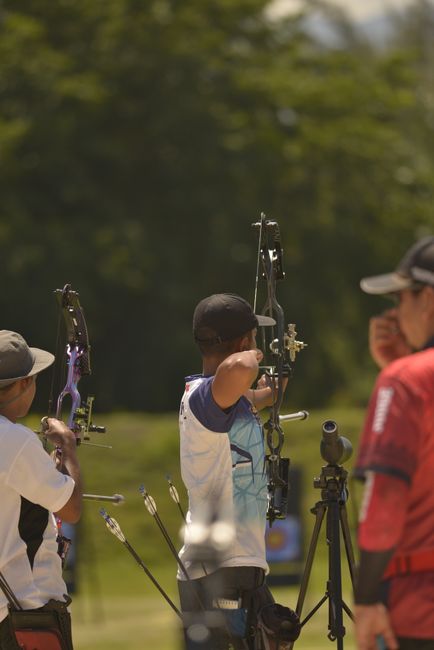
In target archery, archers shoot at a round face of five colors: gold (10 and 9), red (8 and 7), blue (6 and 5), black (4 and 3) and white (2 and 1). Arrows are shot in “ends” (groups of three or six), within a time limit, and then everyone walks forward together to score and pull arrows. Under World Archery rules, a competition starts with a 72-arrow qualification round that ranks everyone, then head-to-head matches.
Recurve and barebow matches use the set system: each set is three arrows, the higher set score earns 2 set points (a tie earns 1 each), and the first archer to 6 set points wins. At 5–5, one arrow each decides it, closest to the center. Compound matches are simply the highest total of 15 arrows. The full breakdown, with time limits and the whistle signals, is on our archery rules page.
Field and 3D archery take the sport outdoors on a walking course. In World Archery field events, archers shoot three arrows at each target, at 5 to 60 meters over natural terrain, some at marked and some at unmarked distances. In 3D archery, the targets are life-size foam animals at unmarked distances, with two arrows per target. In the US, the National Field Archery Association (NFAA) runs field, hunter and animal rounds plus the famous indoor Vegas Shoot.
Archery for beginners: how to start
- Take a class first. USA Archery’s Explore Archery program, built with the Archery Trade Association, runs try-it events, camps and multi-week classes for ages 8 and up, taught by certified Level 1 instructors.
- Use the club’s equipment. USA Archery notes that many clubs rent equipment, so you can try archery before you buy anything.
- Get fitted before you buy a bow. A pro shop or club coach measures your draw length, checks which eye is dominant and picks a draw weight you can hold with good form. Too heavy a bow is the fastest way to bad habits and a sore shoulder.
- Buy the protective gear early. An arm guard and a finger tab or glove cost little and make the first weeks much more pleasant (see archery gear).
Archery at every level
Kids and school archery
For many American kids, archery starts in PE class. NASP teaches international-style target archery in grades 4–12 with the same equipment in every school: the Genesis bow, which has no let-off and adjusts from 10 to 20 pounds, so one bow fits almost every student. NASP says 77% of its students had never touched a bow before. School teams shoot NASP tournaments at 10 and 15 meters, all the way to the national championships. Outside school, USA Archery’s Junior Olympic Archery Development (JOAD) clubs coach young archers from age 8, year-round. Our youth archery page covers both, with the safety rules and parents’ questions.
Teens and youth competition
USA Archery’s youth age classes step the distance up as archers grow. For recurve outdoors: 30 meters for U13, 40 for U15 (a class new for 2026), 60 for U18 and the full 70 for U21. Compound and barebow archers move from 30 meters to 50. Indoors, everyone from U13 up shoots 18 meters at a 40 cm face. Talented archers can move on to USA Archery’s regional elite development programs.
College
Archery isn’t one of the NCAA’s championship sports, so college archery runs through USA Archery’s Collegiate Archery Program, which covers varsity teams (some with scholarships), club sports and student organizations. Its events include Collegiate Target Nationals, college divisions at the US Indoor Nationals and a collegiate 3D championship with the Archery Shooters Association. At the 57th Indoor Nationals in March 2026, Texas A&M won the overall collegiate team title for the second year in a row. The NFAA added collegiate divisions in 2024.
Olympics and Paralympics
Olympic archery is recurve at 70 meters. Paris 2024 had five events (men’s and women’s individual and team, plus mixed team) with 128 archers from 53 countries. The 10-ring on that 122 cm target is just 12.2 cm across, about the size of an orange. In April 2025 the IOC added a compound mixed team event for Los Angeles 2028, the first new bowstyle since archery returned to the Games in 1972, which brings Olympic archery to six events. Para archery has been on the program since the first Paralympic Games in Rome in 1960, with open, W1 and visually impaired classes; visually impaired archers shoot 30 meters with tactile sights.
Adults and lifelong archers
Archery is one of the great lifelong sports. USA Archery has 50+, 60+ and 70+ age classes, and the NFAA’s divisions run from Cub (11 and under) to Master Senior (70 and older). Adults shoot weekly club leagues, indoor 300 rounds in winter, field courses in the woods and 3D shoots in summer. Many come to it through bowhunting, others through a family class. For the governing bodies and pathways, see archery leagues and associations.
Sports health for archers
Archery is generally considered a safe sport, but archers do get hurt, mostly from doing the same pulling motion thousands of times. This section is general information, not medical advice. If you’re hurt, see a professional.
The drawing shoulder takes the load
- Overuse is the main story: in a survey of 396 archers of all bow types, 57.3% had had some injury from archery, most often the drawing shoulder (28.2%) and neck or back (19.9%). Half of those archers had to stop shooting for a time.
- Elite archers too: among German and European championship archers, more than half of overuse injuries were in the shoulder, mostly the drawing side; the authors pointed to imperfect technique as a major risk factor and recommended good technique plus trunk and shoulder strength.
- Young archers who train hard: at a European Youth Championship (200 archers, average age about 17), 43.5% reported shoulder pain during training and 31.8% had had to stop training because of an injury.
- Fingers and forearms: a study of US emergency-room records from 2013–2022 estimated about 43,000 archery-related injuries; fingers were the most common site and cuts the most common diagnosis. The authors suggested finger tabs, gloves and forearm protection.
The same German study found that acute injuries were rare and were mostly caused by equipment failure, so check your equipment before and after every session: strings, cables, limbs and arrows. Never “dry-fire” a bow (draw and release with no arrow); NASP teaches that it can hurt the archer, people nearby and the bow. And let a qualified coach or pro shop set your draw weight; jumping up in weight too fast is a common route to a sore shoulder.
Range safety is part of the sport
Archery’s safety record depends on everyone following the same simple rules. You draw a bow only on the shooting line, only with the bow pointed at the target, and only when the range is clear in front and behind. You walk, never run, and you go forward to pull arrows only on the signal. Whistle or sound signals run the range: in school archery two whistles mean “get your bow,” one means “shoot,” three mean “go get arrows,” and five or more mean emergency, stop shooting now. Details are on our rules page.
Sun, heat and long tournament days
An outdoor 72-arrow round plus matches can mean a whole day standing in the sun. Bring water, shade and sunscreen: the American Academy of Dermatology recommends broad-spectrum, water-resistant SPF 30+ sunscreen, reapplied about every two hours and after sweating. Know the warning signs of heat illness; call 911 for confusion, collapse or a very high body temperature. More on tournament day.
When to see a doctor, physical therapist or athletic trainer
See a professional for shoulder pain that lasts or comes back every session, pain at night, weakness, numbness or tingling in the arm or fingers, a cut that won’t stop bleeding, or any injury from an arrow or a broken bow. A sports medicine physician manages most sports injuries without surgery; the AMSSM says about 90% of sports injuries are non-surgical. A physical therapist can work on shoulder blade control and strength, and an athletic trainer is a licensed or regulated health care professional who works with physicians. More on archery injuries.
Training and conditioning for archery
Archers train more than just shooting. Two small studies point the same way: in university archers, a 12-week program focused on the lower trapezius (the muscle that pulls the shoulder blade down and back) raised scores in a simulated competition from an average of 628 to 639 out of 720 and balanced the upper and lower trapezius; and four weeks of side-bridge exercises reduced bow movement while aiming in college students. Many coaches use resistance bands for “bow trainer” work: drawing a band in your shooting posture to build the same muscles without shooting an arrow (see our resistance band guide). Core work, balance and the mental game (breathing, a repeatable routine) matter too; see mental training tools for athletes and our archery training page.
Build volume slowly. More arrows per session, a heavier draw weight or a new bow all add load to the shoulder; change one thing at a time and give the body a few weeks to adapt.
Recovery after shooting
Recovery starts with sleep: the CDC, citing the American Academy of Sleep Medicine, recommends 9–12 hours for children 6–12, 8–10 hours for teens and 7 or more for adults. After a long day on the line, many archers stretch the chest and shoulders and use a foam roller or massage gun on the upper back and forearm. Tools like these are for comfort, not treatment; pain that keeps coming back needs a professional. Our recovery tools guide compares the options, and our archery recovery page goes deeper.
Gear for archery
- Bow and arrows: fitted at a pro shop or club, matched to your draw length and draw weight. Arrows must be the right length and stiffness for your bow; a wrong arrow is a safety issue, not just a scoring one.
- Arm guard: protects the inside of the bow arm from string slap.
- Finger tab or glove: for recurve and barebow archers who shoot with their fingers; compound archers usually use a mechanical release (fitted at the shop).
- Chest guard, quiver, bow stand and case: a chest guard keeps loose clothing out of the string’s path; a hip or field quiver holds arrows; a stand keeps the bow off the ground between ends.
Three easy starting picks: the SAS 8″ Armguard, a vented arm guard with three buckle straps; the Easton Flipside 3-Tube Hip Quiver, which reverses for right- or left-handed archers; and the THERABAND resistance band beginner kit for bow-trainer and shoulder work at home. Our archery gear page has the full list.
Easton Flipside 3-Tube Hip Quiver
- 3 arrow tubes
- Reversible: right or left
- About $21
THERABAND Resistance Band Beginner Kit
- 3 latex bands
- Yellow, red, green
- About $19
For after the range, browse Recovery & Regeneration and Training & Performance.
Archery FAQs
What’s the best way to start archery as a beginner?
Take a beginner class at a club or range, using their equipment. USA Archery’s Explore Archery program runs classes and camps from age 8, and many clubs rent bows. Once you’re hooked, get fitted for your own bow and arrows at a pro shop or through your club coach.
How far do Olympic archers shoot?
Seventy meters, at a 122 cm target with a 10-ring just 12.2 cm across. Compound archers shoot 50 meters at an 80 cm target, and indoors everyone shoots 18 meters.
What’s the difference between recurve, compound and barebow?
A recurve has limbs that curve away from the archer and is shot with the fingers, usually with a sight and stabilizers; it’s the Olympic bow. A compound uses cams (pulleys) and is usually shot with a mechanical release and a magnifying sight. Barebow is a recurve with no sight or stabilizers, aimed by instinct and technique.
Is archery a good sport for kids?
Many families find it is: it rewards focus and patience more than size or speed, and boys and girls shoot together. NASP teaches it in schools from grade 4, and JOAD clubs coach kids from age 8. It must always be supervised, with clear range rules.
Why does my shoulder hurt after archery?
The drawing shoulder is the most common place archers hurt, usually from overuse, technique or too heavy a draw weight. Rest it, ask a coach to check your form and draw weight, and see a sports medicine doctor or physical therapist if pain lasts or keeps coming back.
Do I need an arm guard?
Almost every beginner should wear one. The string can slap the inside of the bow arm, especially while you’re learning, and a guard costs about as much as a lunch. NASP allows arm guards and chest protectors in competition.
Archery rewards patience, good habits and a strong, healthy shoulder, and it’s a sport you can keep for life. Keep exploring: our resistance band guide for the shoulder, the recovery tools guide, electrolytes for hot tournament days, and every other sport on our sports hub.