This article contains affiliate links: if you buy through them we may earn a commission, at no extra cost to you. Read our affiliate disclosure.
Tesero, in the Val di Fiemme, February 2026: Norway’s Jens Luraas Oftebro jumps first, then chases down his rivals on the cross-country trail to win the large hill event, completing a sweep of all three Olympic Nordic combined golds and giving Norway its first Olympic title in the sport in 28 years. It was also a farewell of sorts: on July 7, 2026, the International Olympic Committee announced it was dropping Nordic combined from the 2030 Winter Games. Nordic combined pairs ski jumping with cross-country skiing in a single competition.
Nordic Combined guides: what do you need?
New to nordic combined? Start with the first card. Everything here is general education, not medical advice.
History & Origins of Nordic Combined
Nordic combined pairs ski jumping with a cross-country race, and it is one of the oldest events in the Winter Games: it has been on the Olympic programme since the first Games at Chamonix in 1924, the same year and place FIS was founded (Olympedia, FIS). We could not tie its pre-Olympic origins to an official page, so we do not give a start date for them.
The Olympic format changed over time. A team event was added in 1988 at Calgary, and by 2026 the programme had three events, all for men: two individual events (normal hill and large hill, each with a 10 km cross-country race) and the team event. It is the only Winter Olympic discipline with no women’s event through 2026 (Olympedia). Our hub page covers the IOC’s July 2026 decision on the 2030 Games.
- 1924: Nordic combined at the first Winter Olympics, Chamonix; FIS founded.
- 1988: Team event added at Calgary.
- 2026: Three men’s events at Milano Cortina; still no women’s Olympic event.
Official results and records
- Olympedia: Nordic combined at the Olympic Games
- Olympics.com: Milano Cortina 2026 Nordic combined results
Legends of the Sport
Olympic medal counts are from Olympedia as read on November 13, 2026. This is not a ranking.
- Ulrich Wehling (East Germany): three Olympic golds from three consecutive Games, when only one combined event was held.
- Felix Gottwald (Austria): seven Olympic medals, three of them gold.
- Samppa Lajunen (Finland): three golds and five Olympic medals.
- Eric Frenzel (Germany): seven Olympic medals, three of them gold.
- Jørgen Graabak (Norway): six Olympic medals, four of them gold.
- Jens Lurås Oftebro (Norway): five Olympic medals, four of them gold.
How we keep this current: we re-check facts after each major championship and update this page. Spot an error? See our editorial policy.
This page explains how the jump and the race fit together, who competes, where the sport stands at the Olympics (a story that changed in 2026), what it demands from athletes and what researchers have found about injuries.
Nordic combined at a glance
| What it is | A ski jump, then a cross-country race whose starting order and gaps are set by the jump. |
|---|---|
| How it is won | First across the finish line in the race wins. Jump points are converted into time gaps (the Gundersen method). |
| Olympic events 2026 | Three, all for men: individual normal hill, individual large hill and team large hill (confirmed by NBC Olympics). |
| Who competes | Youth clubs, junior national teams, World Cup athletes. Women compete in FIS events; the Olympics have been men-only. |
| Governing body | FIS worldwide; USA Nordic and U.S. Ski & Snowboard in the US. |
| Olympic future | Not on the 2030 program; the IOC president said it could return for 2034. |
How Nordic combined works
Day one has two parts that fit together like a relay with yourself. First, each athlete makes a ski jump; the better the jump (distance plus style points, as in ski jumping), the earlier they start the race. According to Wikipedia’s summary of the Gundersen method, jump points become time handicaps: the top jumper starts at zero, others start later by their time gap, and the first across the line wins, so the finish order is the final result. At Milano Cortina the individual events used a 10 km cross-country race.
The team event is different. In 2026 each team had two athletes in a 2 x 7.5 km relay with alternating 1.5 km laps, and heavy, powdery snow caused several crashes. Because the two halves need different equipment, athletes change gear between them: NBC Olympics notes jumping skis are about 2.5 m long and roughly twice as wide as normal skis, with bindings that hold the heel, while cross-country bindings attach only at the toe. Jumping ski length is capped at 145% of body height, based on a minimum BMI of 21, per NBC Olympics.
Who competes, and at what level
Nordic combined is a small sport. Steamboat Springs Winter Sports Club in Colorado runs a combined jumping and Nordic combined program for ages 8 to 10 (U10) and older groups, and says its jumping and Nordic combined programs are among the largest in North America. Other US clubs are tied to the jumping hills they use; contact a club through USA Nordic for age and ability rules. The NCAA skiing championship lists alpine and cross-country events only, so Nordic combined is not an NCAA championship sport (we did not find a college program list).
Women’s competitions are newer. Wikipedia (as a secondary source) says FIS approved women’s Nordic combined events in 2016, with women in the FIS Junior World Championships from 2019 and the senior World Championships from 2021. The Olympics have not caught up: women were not included at Milano Cortina 2026. Reports say FIS pushed for a women’s event and the IOC did not approve it, and AP reports the IOC said Nordic combined was the only Winter Olympic sport that excluded a gender.
Olympic and Paralympic status
- Milano Cortina 2026 (confirmed): three men’s events. Norway won all three golds and Austria took two silvers and a bronze; Finland took one silver and two bronzes. Medalists in the normal hill: Oftebro (Norway), Johannes Lamparter (Austria), Eero Hirvonen (Finland). In the team event Norway beat Finland and Austria.
- History: Nordic combined has been in the Winter Olympics since the first Games in 1924 (Wikipedia and Reuters-based reports).
- 2030 (French Alps), confirmed by AP: dropped on July 7, 2026. The IOC said it ranked last in 11 of 14 popularity indicators at the Milan Cortina Games, struggled to attract a modern audience and had weak international representation outside Europe. IOC President Kirsty Coventry said it could return at the 2034 Utah Winter Games. Check the official programme for the current Games.
- Paralympics: not on the Paralympic program; FIS lists para alpine, para cross-country and para snowboard.
The sport continues outside the Games; we found no source on FIS plans, so check FIS.
What Nordic combined asks of the body
A 2026 review of Olympic snow sports describes Nordic combined as a hybrid: ski jumping is a neuromuscular power and technique sport, while cross-country skiing relies on high aerobic capacity and movement efficiency. Combined athletes need both, which is hard to train at once. The same review says research on Nordic combined is limited and that sex-specific data are scarce. In plain language: short bursts of leg power and balance for the jump, then a hard 10 km endurance effort.
Health and safety for Nordic combined athletes
This is general information, not medical advice. If you are hurt, see a sports medicine doctor, physical therapist or athletic trainer. Jumping should be learned only under qualified coaching on suitable hills.
What the studies show
Data specific to Nordic combined are limited. At the 2023 FIS Nordic World Ski Championships in Planica, which covered cross-country, Nordic combined and ski jumping, researchers recorded 24 injuries, 4.0 per 100 athletes, with the lower limbs the most common location (58.3%) and half of those lower-limb injuries at the knee; the study did not break the numbers down by sport in what we could read. A small 2025 survey of 22 elite ski jumping and Nordic combined athletes found a high prevalence of hip pain, which was linked to knee and ankle symptoms, and its authors suggested hip strength and conditioning work. The jumping half carries the crash-landing risk seen in women’s World Cup ski jumping data (crash landings caused 70% of injury events there); see our ski jumping page.
Safety habits
- Respect weather. The 2026 team event saw several crashes in heavy powdery snow, and the women’s jumping study found nearly half of acute jump injuries came in snowy, windy or cloudy conditions.
- Concussion: the CDC’s HEADS UP program says to remove anyone with a suspected concussion from activity; a healthcare provider decides when it is safe to return. Call 911 for danger signs such as repeated vomiting, a seizure, or one pupil larger than the other.
- Cold: the AAP lists fingers, toes, ears and noses as the first places frostbite strikes and recommends layers and breaks.
- Fuel and weight: the BMI rule in jumping exists because of underweight problems. Anyone worried about food, weight or low energy should see a doctor or dietitian.
Training, recovery and nutrition pointers
Athletes train for both halves: jumping technique and power on one side, endurance skiing on the other (the Zoppirolli review above). The hip research above suggests paying attention to the hips. For general guidance see our ski training, ski recovery and nutrition and supplements pages, plus the cross-country skiing training page for the endurance side. The CDC recommends at least 7 hours of sleep for adults and 8 to 10 for teens. A heart rate monitor is a common tool for endurance sessions; our heart rate monitor guide compares options.
Gear that matters for Nordic combined
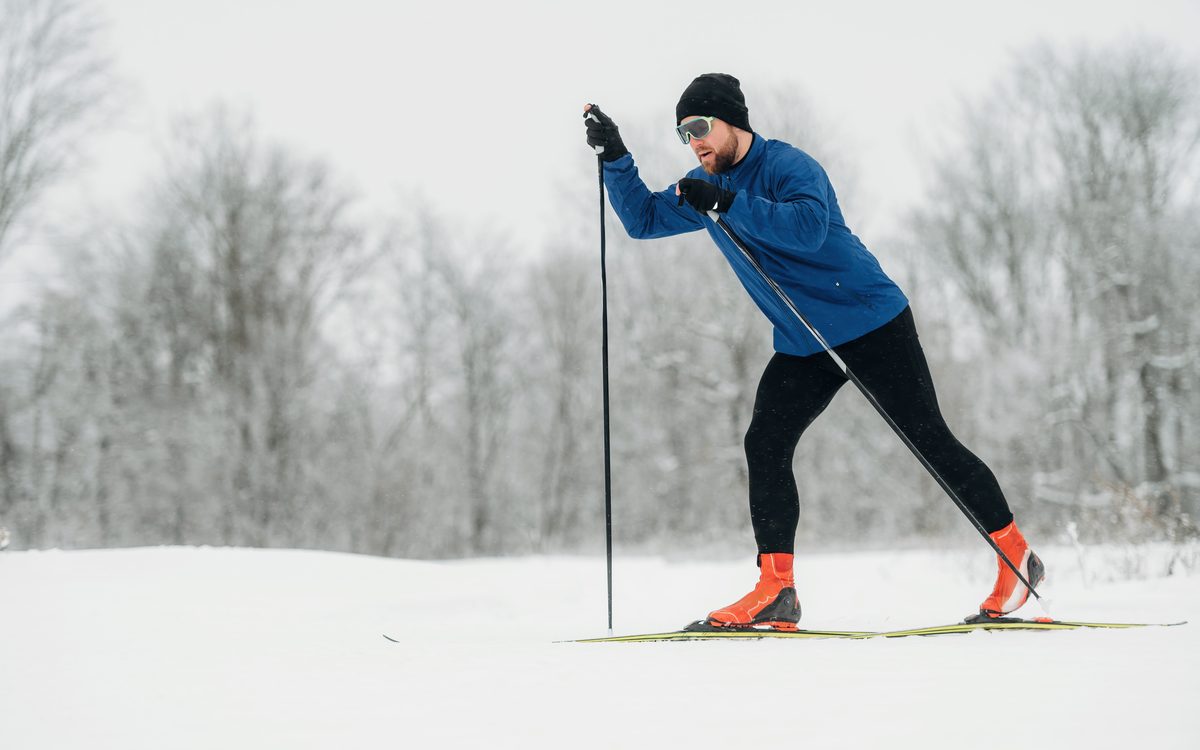
Athletes need two kits: ski jumping gear (long jumping skis within the length rule, a regulated suit, helmet and boots with a low front cut) and cross-country gear (lighter skis and boots, equal-length poles, a stretchy suit). Cross-country skis are about 100 mm shorter than the skier’s height and must weigh at least 750 g without bindings, per NBC Olympics. Jumping gear is specialist equipment from your club or a specialty shop; we have no verified product pages for it. The picks below cover training and warmth: a chest-strap heart rate sensor, a merino base layer and a foam roller.

Polar H10 Heart Rate Sensor
- Bluetooth and ANT+
- Chest strap, M-XXL
- For endurance sessions

Smartwool Classic Thermal Merino Base Layer Crew
- 100% merino wool
- Midweight, slim fit
- Interlock knit
$93.75 at Amazon, as of Nov 17, 2026 01:07 UTC
Check price on Amazon
TriggerPoint GRID 1.0 Foam Roller
- 13 in multi-density
- Hollow core
- Pairs with a mobility routine
Related sports and disciplines
Parent: skiing. Siblings: ski jumping, cross-country skiing (the race half), alpine skiing, freestyle skiing and ski mountaineering. Another sport that combines two skills: biathlon.
Nordic combined FAQs
How does the winner get decided?
The ski jump decides the starting gaps for the cross-country race, and the first person across the line wins. The best jumper starts first; everyone else starts later by their time gap.
Is Nordic combined still in the Olympics?
It was at Milano Cortina 2026, but the IOC removed it from the 2030 program on July 7, 2026. The IOC president said it could return in 2034; that is not a decision.
Can women compete in Nordic combined?
Yes, in FIS competitions (women’s events were approved in 2016 and women have been in the senior World Championships since 2021, per a secondary source). The Olympics have had men’s events only.
How do kids start?
Through a club that offers jumping and cross-country, such as Steamboat Springs Winter Sports Club’s U10 program for ages 8 to 10. Ask for coaching, supervision and equipment rules before the first jump.
Sources
- NBC Olympics: Nordic combined at Milano Cortina 2026
- AP via WTOP: 2030 Winter Olympics adds synchro skating and freeride; Nordic combined dropped
- NBC Olympics: Nordic combined 101, equipment
- Kastner et al., injuries at the Nordic World Ski Championships 2023 (2025)
- Vasavada et al., hip, knee and ankle outcomes in elite Nordic jumping athletes (2025)
- Zoppirolli et al., Olympic snow sports review (2026)
- CDC HEADS UP: Signs and symptoms
Keep exploring: the skiing hub, skiing injuries, our recovery tools guide, the HRV for athletes guide, and every sport on our sports hub.