This article contains affiliate links: if you buy through them we may earn a commission, at no extra cost to you. Read our affiliate disclosure.
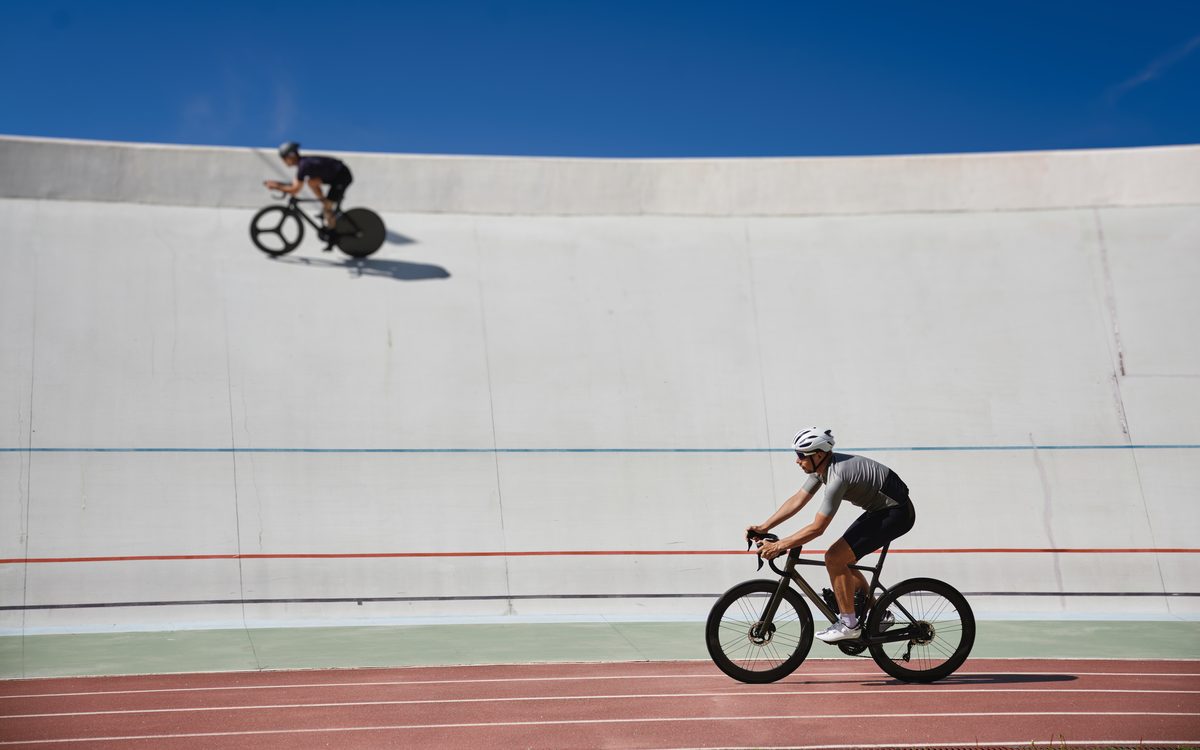
Two riders crawl around a steeply banked wooden oval, each trying not to be the one who has to lead. One stands almost still, balanced on a bike with no brakes, then the other jumps, and in three seconds the whole building is shaking. Track cycling is the quickest way to see what a human body can do on two wheels. Track cycling (also called velodrome racing or “the track”) is racing on a banked oval called a velodrome, on fixed-gear bikes with no brakes.
Track Cycling guides: what do you need?
New to track cycling? Start with the first card. Everything here is general education, not medical advice.
History & Origins of Track Cycling
Racing bicycles around an oval track is among the oldest forms of competitive cycling, with track racing documented from at least 1870. The first track world championships were held in Chicago in 1893, for amateurs (Wikipedia, as a pointer), and men’s track events were part of the first modern Olympics in Athens in 1896, with track cycling missing from the Games only in 1912 (Wikipedia, as a pointer).
The track itself changed over the decades. Velodromes were commonly 333.33 m around until about 1989; since 1990 the standard has been 250 m, and the Olympic track moved indoors at Sydney 2000. Women’s events have grown too: since 2012 men and women have the same number of Olympic track events, and since 2025 men’s and women’s world championship events are the same length. Specific origin years for the keirin (a sport with a long Japanese tradition) and the madison (named for the six-day races once run at Madison Square Garden) are told differently in different histories, so we leave exact dates out. The sport’s modern governing body is the UCI, and the world championships are now held every year.
- 1893: First track world championships, in Chicago (amateurs).
- 1896: Track cycling is part of the first modern Olympics in Athens.
- 1990: The 250 m track becomes the standard length.
- 2000: The Olympic track events move indoors, at Sydney.
- 2012: Men and women get the same number of Olympic track events.
- 2022: Filippo Ganna sets the current men’s hour record (October 8, Grenchen).
- 2024: Paris Olympics; the Dutch men’s team sets the team sprint world record.
- 2026: World championships in Shanghai, with a new 4 km individual pursuit world record.
Legends of the Sport
- Harrie Lavreysen (NED): sprinter with 23 world titles and five Olympic golds, including sprint, keirin and team sprint at Paris 2024.
- Jeffrey Hoogland (NED): Paris 2024 team sprint gold medallist and holder of the men’s 1 km world record; won the 1 km at the 2026 worlds.
- Ellesse Andrews (NZL): won both the sprint and keirin at Paris 2024.
- Jennifer Valente (USA): Olympic omnium champion at Paris 2024.
- Filippo Ganna (ITA): holder of the men’s hour record at 56.792 km.
- Jonathan Milan (ITA): won the individual pursuit at the 2024 and 2026 worlds and set the 4 km world record in 2026.
- Anna Morris (GBR): individual pursuit champion in 2024 and 2025 and omnium and madison champion in 2026.
- Lorena Wiebes (NED): won the world scratch race in 2024, 2025 and 2026 and the 2025 omnium.
- Iúri Leitão (POR): 2026 world omnium champion.
Official results and records
We only list champions and records here after checking them on the official source. For the latest results, go to:
How we keep this current: we re-check facts after each major championship and update this page. Spot an error? See our editorial policy.
This page covers how track racing works, how to get started, what it asks of the body, and the specific safety questions that come with a banked track. For the whole sport, see our cycling hub.
Track cycling at a glance
| What it is | Racing on a banked oval (velodrome) on fixed-gear track bikes with no freewheel and no brakes. |
|---|---|
| How it is won | First across the line in match sprints, keirin and points-based races; fastest time in pursuits and time trials; most points after several races in the omnium. |
| Participants and levels | Juniors, amateur categories 5 to 1 in the US, collegiate riders, national and professional teams, Olympic and Paralympic athletes. |
| Where it is played | Indoor and outdoor velodromes; the international standard is 250 metres around, built of wood for the top events. |
| Governing bodies | UCI worldwide; USA Cycling in the United States. |
| Season | Indoor tracks run year-round; the UCI Track World Cup runs six meetings from October to January, with the world championships held annually. |
How track racing works
Track bikes are stripped down: one fixed gear, so the pedals always turn when the bike moves, no brakes, narrow high-pressure tires and a rigid frame. You slow down by easing off the pedals. Races divide into sprint events and endurance events.
- Sprint: a head-to-head match sprint, run over a few laps (about 3 to 8) that are more tactical than fast until the final burst.
- Keirin: a group of six riders follows a motor-paced bike (a “derny”) that pulls away before the final sprint. The event comes from Japan, where pro keirin racing is a betting sport.
- Team sprint and team pursuit: teams race the clock or each other, with riders taking turns at the front.
- Omnium: four mass-start races in one day, with points added up. At Tokyo 2020 one of them was a 10 km scratch race for men and 7.5 km for women.
- Madison: two-rider teams take turns racing, with a hand sling to swap places. Widely seen as the most complex event to follow.
Most new racers learn at a local velodrome, where an accreditation or intro class is usually required before riding the banking; ask your velodrome what it offers. Aerobars are allowed only in pursuit and time-trial events. The “hour record,” riding as far as you can in 60 minutes, remains one of the sport’s best-known challenges.
Who rides the track, and at what level
Beginners and club riders. USA Cycling runs track with the same five categories as road and cyclocross, from Category 5 (novice) up to Category 1, with points earned in races. Juniors are grouped in two-year age bands. Track is popular in Europe as off-season training for road racers. See youth cycling and race day.
Elite level. The UCI Track World Cup and annual world championships lead the international calendar, and Olympic track events include sprint, keirin and omnium on a 250-metre velodrome. For the governing structure, see cycling leagues and associations.
Olympics and Paralympics. Track cycling is an Olympic discipline, with women’s events added in 1988 and indoor velodromes in use since Sydney 2000. Paris 2024 had six events for men and six for women. As of 2026, NBC Olympics lists 12 track medal events for Los Angeles 2028 at the Carson Velodrome: men’s and women’s sprint, keirin, team sprint, team pursuit, omnium and madison, scheduled for late July 2028. The UCI lists road and track as its two Paralympic cycling disciplines; see para-cycling. Check the official programme for the current Games.
Physical demands
Sprinters need huge short-burst power. One 2026 study measured 333 elite male track cyclists on a 30-second all-out ergometer sprint and then on flying 100 and 200 metre sprints on an indoor velodrome, and used the power numbers to predict their sprint times. Endurance riders need an aerobic engine plus the ability to surge repeatedly in a points race or madison. A narrative review of power profiling (Leo and colleagues, 2022) is a good plain starting point on how best efforts shrink as they get longer. Because the bike has a fixed gear, riders also need smooth pedaling, balance and handling skill in a pack at high speed. Strength work for the legs and trunk is a regular part of track programs.
Health and safety on the track
This section is general information, not medical advice. If you are hurt, see a sports medicine doctor, physical therapist or athletic trainer.
A 2025 systematic review across competitive cycling (Fallon and colleagues, 44 studies) found that about 44% of track cycling injuries were upper-limb injuries; skin lacerations and abrasions were the most common injury type across disciplines, with fractures second. Track riders go down on a hard, banked surface at speed, so gloves, long sleeves or a skinsuit and a properly fitted helmet are sensible, and USA Cycling requires helmets at its permitted events. The same review is honest that its evidence for several disciplines is thin.
Track-specific habits that coaches and velodromes typically teach: learn the bike on the flat before using the banking, keep pedaling as the track tilts, hold your line, and follow the rider and rule instructions of your velodrome. Fixed-gear bikes have no brakes, so inexperienced riders should not ride them in traffic; that is general guidance, not a sourced figure. If a rider hits their head, follow the CDC HEADS UP steps: recognize the signs (headache, dizziness, confusion), remove them from riding, and have a healthcare provider decide when to return. Call 911 for danger signs like repeated vomiting or a seizure. Do not move a rider with neck pain after a crash. For more, read cycling injuries.
Training, recovery and nutrition pointers
Track riders mix short, maximal efforts with long aerobic work, and many use heart-rate monitors or power meters to track the load. Plan fuel around heats, finals and the gaps between, since a session may have several efforts spread over hours. Sleep matters: the CDC recommends at least 7 hours for adults and 8 to 10 for teens. See our training, recovery and nutrition and supplements pages, and our heart-rate monitor guide.
Gear for the track
Your velodrome or club will tell you what bike and gear it requires; many rent track bikes to beginners. Start with a CPSC-compliant helmet (all bike helmets sold in the US since 1999 must meet the standard, and a helmet is made for one impact). The Giro Syntax MIPS is a low-profile road-style helmet; the maker describes MIPS as a rotational-impact liner. A chest-strap monitor like the Polar H10 shows effort during intervals, and Chamois Butt’r is a chamois cream many riders use for long sessions. See cycling gear.

Giro Syntax MIPS Road Helmet
- MIPS rotational-impact liner (maker)
- Low-profile road fit
- Check size and color before ordering

Polar H10 Heart Rate Sensor
- Chest strap
- Bluetooth and ANT+
- Works with many watches and apps

Chamois Butt'r Original
- Chamois cream
- Non-greasy, rinses off (listing)
- 8 oz tube
Related sports and disciplines
Parent: cycling. Siblings: road cycling, cyclocross and gravel cycling. Neighbors: BMX, speed skating (another oval sport) and para-cycling.
Track cycling FAQs
Is track cycling an Olympic sport?
Yes. NBC Olympics lists 12 track medal events for Los Angeles 2028. Check the official programme for the current Games.
Do track bikes really have no brakes?
Yes. Track bikes are fixed gear, so you slow by resisting the pedals. They are built for velodromes, not for the street.
How do I try track cycling?
Find a velodrome near you through USA Cycling or a local club and ask about intro classes and bike rental. Most will want you to complete a beginner course before you ride the banking.
What is the difference between keirin and sprint?
A match sprint is a head-to-head race. A keirin puts a group of six behind a motor-paced bike that pulls off before the final sprint.
Sources
- NBC Olympics: cycling at Los Angeles 2028
- UCI: about the UCI and its disciplines
- Wikipedia: Track cycling (general format facts)
- USA Cycling: first-time racer guide
- Fallon et al. 2025, injury and illness across competitive cycling disciplines
- Kim and Park 2026, track sprint performance in elite male cyclists
- Leo et al. 2022, power profiling in cycling
- CPSC: which helmet for which activity
- CDC HEADS UP: signs and symptoms
More on cycling: the rules, cycling wearables, our recovery tools guide, and every sport on our sports hub.