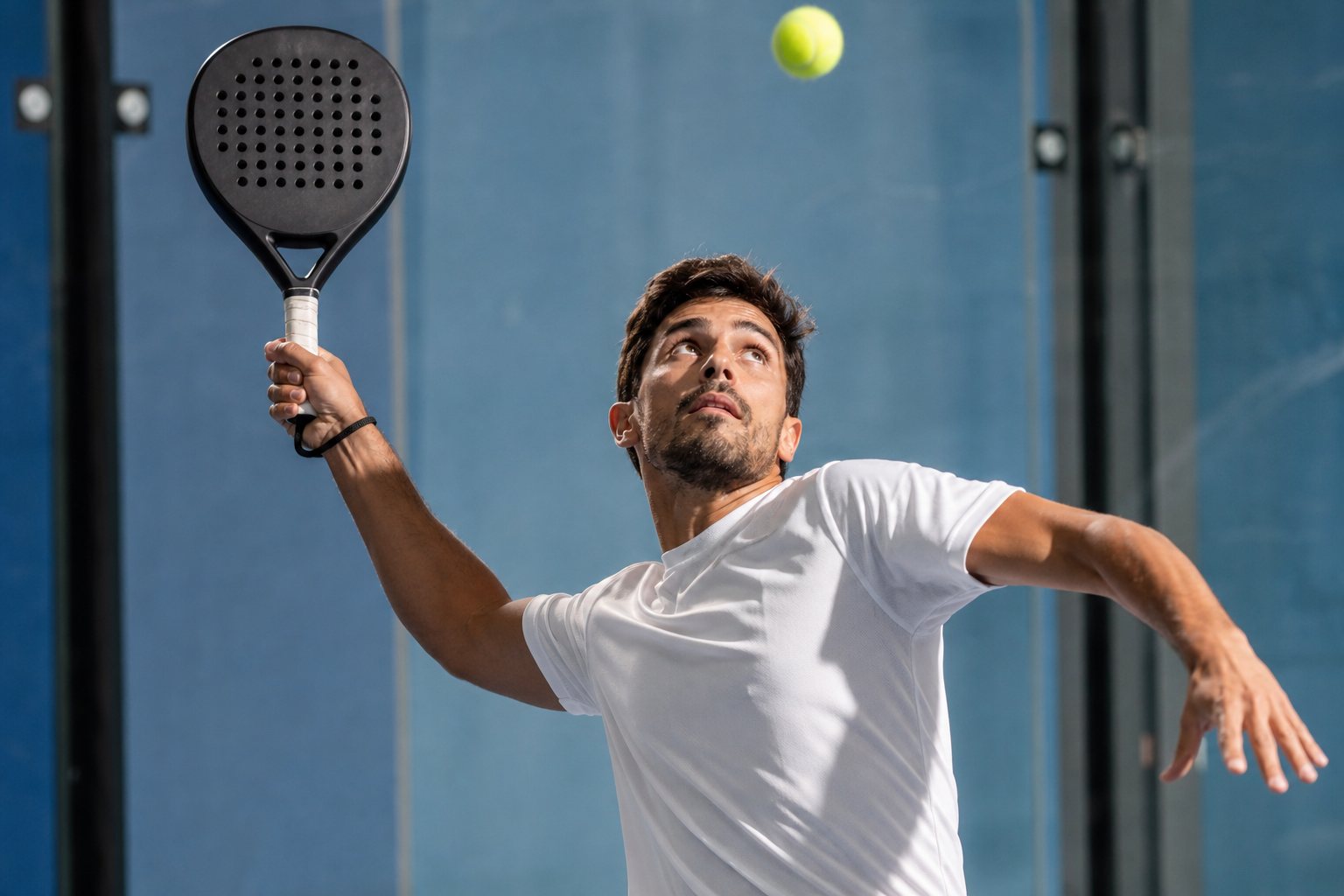
Your friend hands you a racket with no strings and says, “Don’t worry, the wall is your friend.” Two minutes later you let a ball bounce, it skims off the back glass, and you swing and miss while three other people laugh kindly. Padel (also written “pádel,” and called “padel tennis” in some places) is a doubles racket sport played on a 10 by 20 metre enclosed court, and its first lesson is always the same: learn the walls and the rest follows. This page covers the basic skills, the rules in plain words, and how a beginner in the United States can find a court, a lesson and a club. For the full picture of the sport, start at the padel hub.
Quick answer: Padel is played in pairs with a solid stringless racket, an underhand serve and walls that stay in play. Score it like tennis (15, 30, 40, game; best of three sets); the ball may bounce only once on your side before you return it, and you may play it off your own walls. The easiest way to start is a beginner clinic or lesson at a local club, where the racket and balls are usually easy to arrange; ask the club. The official rulebook is the FIP Rules of Padel.
What you need to play
Four players (two pairs), a padel court, a padel racket and padel balls. The FIP rulebook describes the racket as solid and perforated, no longer than 45.5 cm in total and no thicker than 38 mm, with a wrist cord of up to 35 cm that is obligatory. The ball is rubber, 6.35 to 6.77 cm across, and a little softer than a tennis ball. The court is 10 m wide and 20 m long inside, split by a net that is 88 cm high at the centre, with walls at the ends and fence or glass along the sides. Ask your club what you can borrow before you buy anything; our padel gear page explains what matters when you do.
Basic skills a beginner learns first
- The serve. Underhand and simple. You bounce the ball inside your service box, hit it at or below waist height with at least one foot on the ground, and send it diagonally into the opposite service box. A first-serve fault gets a second serve.
- The return and the bounce rule. You may hit the ball out of the air or after one bounce on your side, and you may let it come off your own back or side wall first. A second bounce loses the point. Your shot must land on the opponents’ floor before it touches their walls or fence.
- Volleys at the net. A ball hit out of the air, before it bounces. In the Italian sub-elite study (PMID 35886239) volleys and smashes were more likely than ground or wall shots to finish a point, so net play is worth learning early.
- Lobs, smashes and the bandeja. A lob sends the ball high over the net players. A smash attacks a high ball. The bandeja is a controlled overhead shot used to keep the net position; the 2025 under-18 review lists it among the techniques used to finish points at advanced levels.
- Wall play. Reading the rebound off the back glass and side glass and moving behind the ball. This is the part that takes the most practice and the part a coach or clinic helps with fastest.
The rules in plain words
This follows the FIP Rules of Padel (review of application 1 January 2026); your club or event may adapt some of it.
Scoring
A game goes 15, 30, 40, game. The first pair to win six games, by two, wins the set; at 6-6 a tie-break to seven points (win by two) decides it. A match is best of three sets. When both pairs reach three points (deuce), the FIP rulebook offers three options and the event chooses: classic advantage; the “Star Point,” a deciding point after the third deuce; or the “golden point,” a deciding point at the first deuce. In the deciding point the receiving pair chooses which side to receive on and may not swap positions. The rulebook also describes shorter formats, such as a super tie-break to ten points in place of a third set.
How a point is lost
Under Rule 13 a pair loses the point if the ball bounces twice on their side, if a player (or racket, or anything carried) touches the net, the posts or the opponents’ side, if a player hits the ball twice or both partners hit it, or if their shot touches the opponents’ wall or fence before the opponents’ floor. A shot that hits the metal fence on your own side also loses the point, and so does dropping your racket or breaking the wrist cord.
Serving and changing ends
The server keeps one foot behind the service line and may not touch it. A serve is a fault if it lands outside the receiver’s box, touches the server or partner, or bounces in the box and then hits the fence. Two faults in a row lose the point. Pairs change ends after the first game and every odd game after that.
Pace of play
Competition rules give 20 seconds between points, 90 seconds at changes of ends and up to 120 seconds between sets. Only an accredited coach may give advice, and only during rest times. A friendly club night is more relaxed.
Levels and how to find where to start
Most beginners start in a clinic and then join social nights at a club. If you want to compete, USA Padel is the US national governing body; it sanctions tournaments and publishes its rules, rankings and circuit structure online. The International Padel Federation (FIP) sets the rules of the game worldwide. As of 2026 the FIP counts about 38 million players in 178 countries and territories, and USA Padel reports just over 1,000 courts in 31 states as of April 2026.
- Find a club: USA Padel’s “Where to Play” page lists member clubs by location, and its home page points new players to learn-to-play programs. USA Padel’s home page cites learn-to-play clinics at more than 75 clubs during National Padel Month in October 2026.
- Find a coach: USA Padel does not run coaching courses; it endorses independent organizations, listing the Racquet Sports Professionals Association (RSPA) and RB Padel Academy on its Certifications page. Ask a coach which course they trained under.
- College students: USA Padel’s Collegiate Padel programme offers free club membership to registered college padel clubs and describes support for starting a campus club. We could not confirm padel as an NCAA sport.
- Juniors: a 2025 scoping review of under-18 padel research found coaches teach 8 to 10 year olds on smaller courts (down to 10 by 6 m) with lower-pressure balls.
Olympics and official rulebooks
Padel is not an Olympic sport as of 2026; check the official programme for the current Games. It is confirmed as a medal sport at the European Games in Istanbul in 2027. Bookmark the FIP Rules of Padel and the USA Padel Rules and Regulations page.
Padel rules and getting-started FAQs
Do I need to be fit or good at tennis to start?
No. The underhand serve and the walls keep the ball in play, so beginners get long rallies quickly. Tennis experience helps but is not required. Start gently; our padel injury prevention page explains how to build up.
What is the difference between advantage, Star Point and golden point?
They are three ways to settle a game that reaches deuce. Advantage needs two points in a row. The Star Point plays a deciding point after the third deuce. The golden point plays one deciding point at the first deuce. The event decides which one applies.
Is the wrist cord really compulsory?
In FIP competition, yes: the rulebook calls it obligatory, as protection against accidents. Ask your club about social play.
How is padel different from tennis and pickleball?
Padel uses tennis-style scoring but a stringless racket, an underhand serve and playable walls. Pickleball uses a paddle on a smaller open court, and tennis has no walls. Compare with tennis, pickleball and squash, which also uses walls.
Sources
- International Padel Federation, Rules of Padel, review of application 1 January 2026 (PDF)
- FIP, history of padel (padelfip.com)
- FIP news, 23 June 2026, padel numbers (padelfip.com)
- USA Padel, home page and National Padel Month 2026 (padelusa.org; article)
- USA Padel, Where to Play (page), Certifications (page), Collegiate Padel (page), Rules and Regulations (page)
- USA Padel, over one million US players and just over 1,000 courts, April 2026 (article)
- FIP news, European Games Istanbul 2027 (padelfip.com)
- Padel match analysis during official Italian sub-elite competitions, PMID 35886239 (PubMed)
- Topics of study in under-18 padel categories: a scoping review, Sports (Basel) 2025, PMID 40137799 (PubMed)
General information for education only, not medical advice. It does not replace a visit with a doctor, physical therapist or athletic trainer. See how we write and check our pages in our editorial policy.