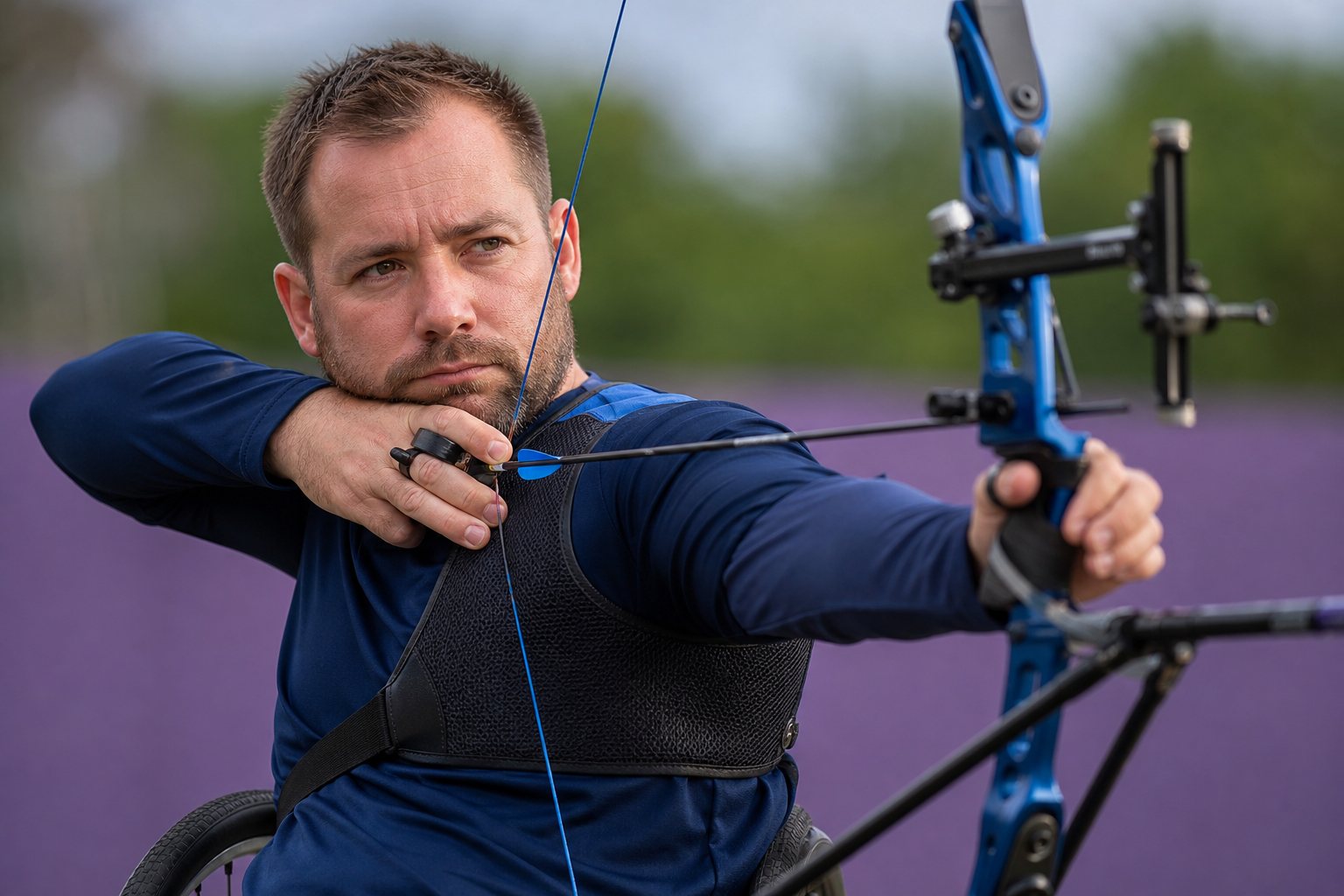
The wind picks up, the arrow before has missed, and the clock is running. Para archery is a sport of tiny repeated movements done under pressure. Mental training here means practising focus, routines and ways of handling a bad arrow so that your best shot is available when it counts.
Quick answer: Archers often name confidence and a positive mindset as important, and slow breathing, a fixed shot routine and a plan for a missed arrow are common tools. Research supports parts of this, but no technique guarantees a score. Mental performance is different from mental health: see a doctor or licensed mental health professional if anxiety, low mood or exhaustion affects daily life. In the US, call or text 988.
Back to the para archery hub. For physical preparation see training; for rest, recovery.
Why the mind matters in archery
Archery has no opponent to react to in a ranking round, so the work is internal. A 2026 study of 15 compound archers found that after a 30-minute mental fatigue task their accuracy was worse, while heart rate did not change. In a study of 8 elite archers across 184 matches, heart rate ranged from about 97 to about 111 beats a minute, and a heart-rate variability measure stayed stable and was similar in high- and low-scoring ends. So a calm body does not guarantee a high score, but fatigue of attention seems to matter.
Confidence and mindset
A 2024 study of 65 Korean archers with experience of X-ring (bullseye) shots found confidence and a positive mindset were leading themes in their accounts. That is how archers describe themselves, not proof that confidence causes scores. Many archers build confidence the practical way: shooting a routine in practice until it feels automatic.
Focus and self-talk
A meta-analysis of 32 studies by Hatzigeorgiadis and colleagues found self-talk helped more on fine, novel tasks, which describes archery well. Short cue words such as “smooth” or “release” can pull attention to one thing. Experiment in practice rather than in a final.
Breathing and arousal
A 2018 study by Zaccaro and colleagues on slow breathing (under 10 breaths a minute) and found it linked to higher heart rate variability and feeling calmer and more alert. Many archers use it at the line. If breathing is affected by your impairment, adapt the pace to what is comfortable; do not force it.
Attention across a long round
A ranking round is 72 arrows, so concentration has to last. The mental fatigue study above suggests attention is a resource that can run down, which is one reason many archers use short routines, breaks between ends and simple cues instead of constant analysis. Ask your coach how to pace attention across a round and a full tournament day.
Goal setting
Goals about process (hold the same anchor, finish each shot) are easier to control than goals about score. A simple ladder is a process goal, a score goal and a dream goal. This ladder is common coaching practice, not a researched formula.
Visualization and imagery
Imagery is widely used by athletes to rehearse a shot and manage stress, and a 2026 scoping review maps how it is used for stress management. Blind and low-vision archers can rehearse feel and sound instead of sight. Treat it as a skill to practise, with no guaranteed benefit.
Pre-shot and pre-competition routines
A routine is the same short sequence before each arrow, for example stance, breath, picture, draw and release. In competition, time limits matter: the IPC states 30 seconds per arrow for para events, and other rounds are shorter, so practise your routine at the pace you will use. Rehearse the day too: arrival, warm-up, food and equipment check.
When the arrow goes wrong
A 2024 study found performance dropped after two consecutive missed bullseyes, a pattern some call “cold hand”. The practical lesson is to have a reset: breathe out, name the miss in one neutral word, then go back to the routine for the next arrow. Do not try to fix technique mid-round unless a coach has agreed a plan.
Competition preparation
Pack a checklist, plan the schedule and set a routine for travel and sleep. Protect your attention before the round: a 2026 study found mental fatigue worsened accuracy, so we suggest limiting screens and decisions before you shoot. This is our reading of one small study, not a rule. Beta-blockers are prohibited in archery in competition, and the page on nutrition and athlete health explains why not to use them for nerves.
Mental health is separate
Performance skills do not replace care. The IOC consensus statement on mental health in elite athletes treats mental health symptoms as health concerns that need assessment and care. Anxiety, depression, disordered eating or burnout should be taken to a doctor or licensed mental health professional. In the US, the 988 Suicide & Crisis Lifeline offers call or text support, and the Association for Applied Sport Psychology lists sport psychology resources.
Para archery mental training FAQs
How do I stay calm before a big shot?
Slow breathing and a fixed routine are common methods, and the research on slow breathing is encouraging, but nothing is guaranteed.
What do I do after a bad arrow?
Have a reset plan: breathe, label the miss neutrally and return to routine. Avoid changing technique mid-round.
Does visualization work?
Many athletes use it and a scoping review maps its use for stress, but the evidence does not promise better scores.
Is nerves a mental health problem?
Pre-competition nerves are common. If anxiety is constant or disrupts sleep, school, work or daily life, see a professional.
Can young archers use these ideas?
The basics are simple, but we did not find archery-specific youth research; involve parents and coaches.
Sources
- Soylu et al. 2026, mental fatigue in compound archers
- Lee & Hwang 2024, Korean archers
- Yuan & Chang 2026, elite archers heart rate
- Li & Zhao 2024, consecutive misses
- Zaccaro et al. 2018, slow breathing
- Hatzigeorgiadis et al. 2011, self-talk meta-analysis
- Zhao, Wang, Anuar 2026, imagery scoping review
- Reardon et al. 2019, IOC consensus on mental health
- IPC: Para archery
- 988 Suicide & Crisis Lifeline
- AASP resources
General information for education only, not medical advice. It does not replace a doctor, physical therapist, athletic trainer, classifier or qualified coach. See our editorial policy for how we research and write.