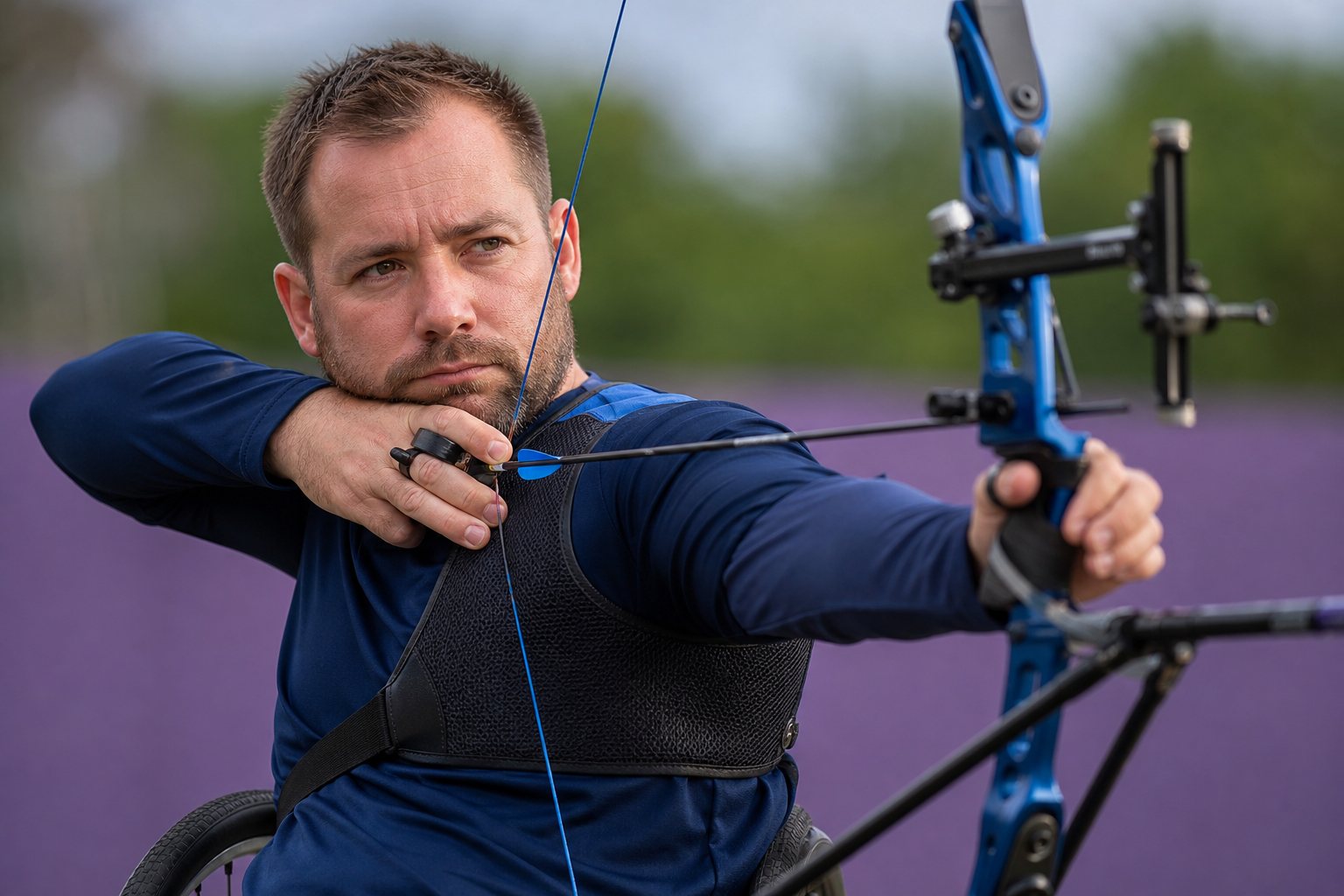
The first end of the morning feels easy. By the ninth, the shoulder that has drawn the bow all day is tired, and the arrows start landing a little low. Para archery training is about building the steadiness and endurance to keep your form through a full session of repeated draws, in a way that fits your impairment and your equipment.
Quick answer: Archery looks still but asks a lot of the shoulders, upper back and trunk, and a ranking round is 72 arrows. A sensible week mixes shooting practice with light strength, stability and mobility work chosen with your coach and a clinician. Research on archers links posture, stability and strength to accuracy, but there is no proven universal plan. See a sports medicine doctor, physical therapist or athletic trainer before starting if you have a medical condition.
Back to the para archery hub. For how the sport is scored and classified see skills, rules and getting started; for pain and injury see injuries and injury prevention.
What the sport asks of your body
A ranking round is 72 arrows (IPC), and the 70 m recurve round and the 50 m compound round are both 72 arrows in World Archery’s rulebook. Every arrow needs a repeatable stance or seated position, a controlled draw, a steady hold and a clean release. In a 2024 study of elite adolescent archers, 43.5% reported shoulder pain during training, which shows where the repeated work lands.
Studies of archers point to the same areas. A 2018 study compared the shoulder muscles of 15 elite archers with 30 non-archers and found differences between the shoulders and in several muscle groups, and the authors suggested these findings could inform training programs. A 2025 study of 37 archers shooting at 70 m and 50 m found that postural stability and strength measures were associated with scoring accuracy. These studies were not limited to para athletes, so use them as general background rather than a prescription.
Start with your set-up
Training starts with a position you can hold. Seated archers, standing archers, wheelchair users and archers who use a support all need a base that is stable and comfortable for a long session. Your classification card lists the devices you may use in competition, so talk with your coach and, for competition, your classifier before changing equipment. A light draw weight you can control is better than a heavy one you cannot, and a coach can set that for you.
A sensible weekly shape
There is no single published schedule for para archers, so treat this as a framework to discuss with your coach, not as a prescription:
- Shooting sessions (2 to 4 per week): quality arrows with rests, working on one thing at a time such as stance, anchor or release.
- Strength and stability (1 to 2 per week): shoulder, upper back, trunk and, where relevant, hand and grip work.
- Mobility and posture (a few short blocks): easy movement for the neck, shoulders and chest.
- Rest days: at least one fully off day, and more after tournaments.
These session counts are general coaching practice, not numbers from a study. The AAP states that young athletes need 1 to 2 days off a week and several months a year away from one sport, in one-month blocks, and the same idea is sensible for adults.
Strength and conditioning
The AAOS rotator cuff and shoulder conditioning program is a well-known starting point for the muscles around the shoulder (deltoids, trapezius, rhomboids, rotator cuff). It says to start only if exercise is pain-free, to build up over 4 to 6 weeks, and then to continue 2 to 3 days a week. A clinician can adapt exercises for a wheelchair or a seated position.
Trunk stability matters for seated and standing archers. In a 2023 study, 20 male college students did four weeks of side-bridge exercise and shook less while sighting. It was a small study on non-para participants, so it shows an idea to try with your coach, not a promise. Light resistance bands are common for warm-ups and shoulder endurance away from the range.
Hands, forearms and grip
Drawing fingers and forearms work hard too. A US injury database study counted most archery injuries at the fingers and hands, so build grip and finger work gradually and keep a tab or glove in your training bag. Archers who use a release aid or an adapted grip should practice with the same equipment they will use in competition.
Periodisation basics
Periodisation means planning the year in blocks. A simple version is a build period with more volume and strength work, a sharpening period closer to a competition with fewer but higher-quality arrows, a taper in the last week, and a break after the season. Elite archers adjust volume around events, but the best plan depends on your impairment, schedule and coach. Plan your build around events that matter to you, such as nationals or classification appointments.
Mental fatigue also counts
A 2026 study of 15 compound archers found that after a 30-minute mental fatigue task their accuracy worsened. Long days of travel, screens or decisions before a round may matter. Our mental training page covers routines.
Para archery training FAQs
How many arrows should I shoot in practice?
There is no research-backed number for para archers. A ranking round is 72 arrows, so many archers build toward that volume gradually with their coach, stopping if form fades or pain appears.
Do I need strength training for archery?
Studies link strength and stability with accuracy, and the AAOS shoulder program is a common reference, but the right exercises depend on your impairment. Ask a physical therapist.
Can wheelchair users train the same way?
Many principles are shared, but exercises, positions and seat set-up should be adapted by a clinician and coach who know your situation.
How long before I improve?
That varies widely and no source gives a timeline. Track your scores and form notes over several weeks rather than judging one session.
Should I train when my shoulder hurts?
Pain that does not settle, tingling or weakness is a reason to stop and see a professional. The AAOS program says exercises should not cause pain.
Sources
- IPC: Para archery
- World Archery Rule Book 2 (2026-01-27)
- Injuries and persistent pain in elite adolescent archers
- Shoulder muscles in elite archers, Clinics in Shoulder and Elbow (PMC)
- Postural stability, strength and archery accuracy (2025)
- Side-bridge exercise and bow tremor (2023)
- AAOS: Rotator cuff and shoulder conditioning program
- Archery-related musculoskeletal injuries (NEISS)
- AAP: sports specialization (Brenner 2016)
- Mental fatigue and accuracy in compound archers (2026)
General information for education only, not medical advice. It does not replace a doctor, physical therapist, athletic trainer, classifier or qualified coach. See our editorial policy for how we research and write.