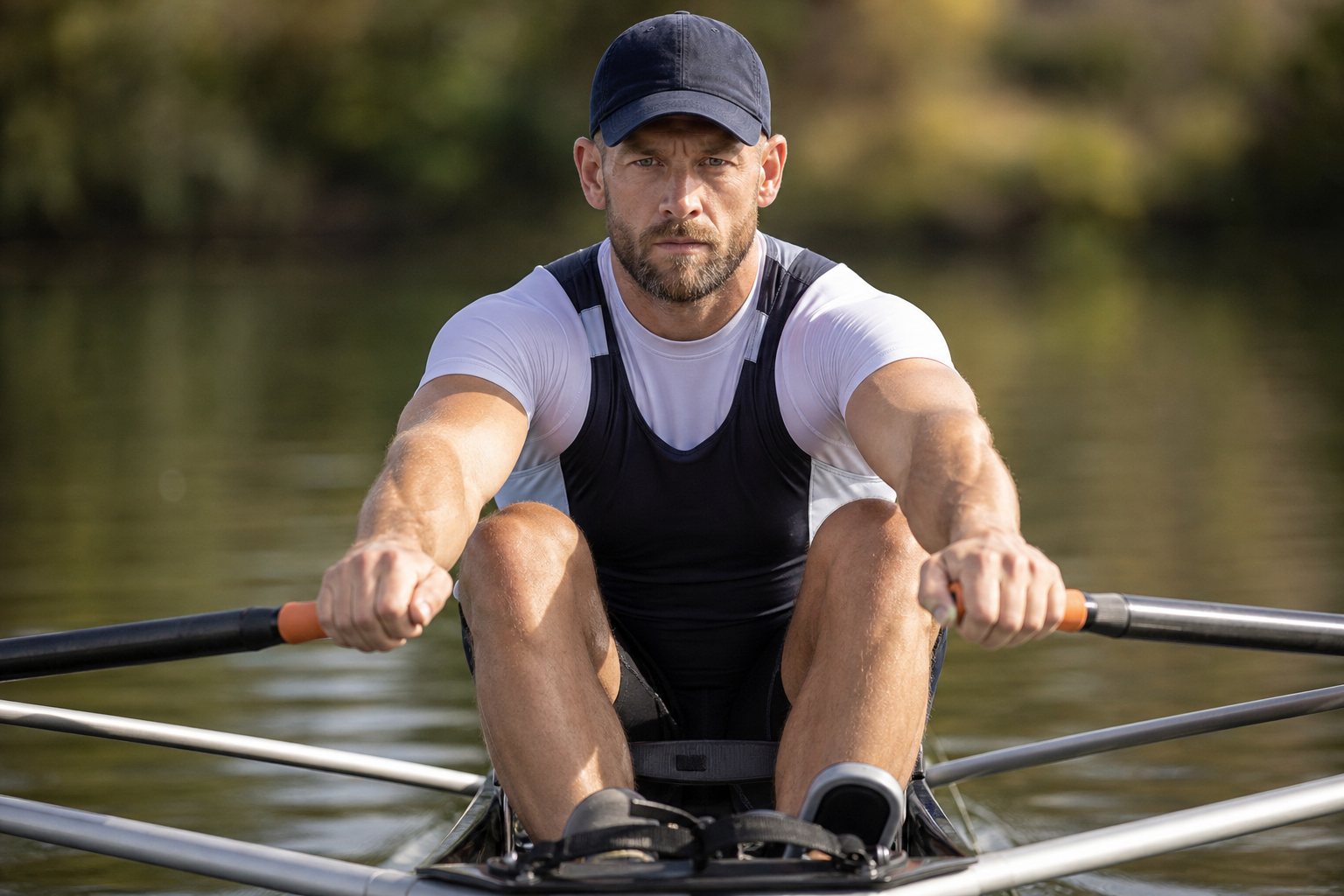
A rowing machine in a corner of a gym, the monitor counting down a 2,000 m piece, a coach calling out splits every 500 m. That scene is the backbone of Para rowing training, because the erg is where most athletes measure themselves between regattas. Para rowing training is the planned mix of rowing, strength and conditioning, and rest that prepares an athlete for a 2,000 m race in a boat set up for their class.
Quick answer: A 2,000 m Para race is a hard, several-minute effort that uses both the aerobic and anaerobic systems, so training is mostly steady rowing plus some intervals, strength work for the muscles your class uses to drive the boat, and rest days. Published research specific to Para rowing is thin, so use published activity guidelines as a floor, build slowly, and plan the details with a coach and a clinician who know your impairment.
For starting out see rules and getting started; for safety see injury prevention. This page is general information, not medical advice.
What a 2,000 m race asks of the body
Paralympic.org lists World Best Times of 9:12.99 for the PR1 men’s single (Roman Polianskyi, 2019 Worlds), 10:13.63 for the PR1 women’s single (Birgit Skarstein, 2018 Worlds) and 8:06.21 for double sculls (Corne de Koning and Annika van der Meer, 2017 World Cup); those were the figures in its 2021 article and may have been bettered since. So a race lasts roughly eight to ten minutes or more depending on boat and class. A 2025 study of 20 national-level male rowers, able-bodied, found that a 2,000 m ergometer test (mean time 6:49.6) is a whole-body effort needing aerobic and anaerobic energy together; the energy demand is similar in principle for Para crews, but we found no Para-specific numbers.
Where the power comes from, by class
The drive comes from different muscles in each class, which should shape the strength work. In PR1 the arms, shoulders and back drive the stroke with the trunk supported by straps, in PR2 the trunk swings as well, and in PR3 the legs join in, according to Paralympic.org. A 2025 study in Frontiers in Sports and Active Living tested 500 m race-pace pieces on fixed-seat ergometers with the trunk restricted or free. PR1 rowers were no slower with the trunk restricted, while PR2 and Not Eligible rowers were faster and produced more force per stroke when the trunk was free. The practical lesson is that technique and training in these classes is a specialty: ask for a coach who has worked with your class.
Sensible weekly shape
There is no published weekly template for Para rowers, so what follows is general coaching practice built on guideline floors, not a prescription.
- Floors from guidelines. The US Physical Activity Guidelines say adults with disabilities who are able should aim for the adult targets of 150 to 300 minutes a week of moderate aerobic activity (or half that vigorous) plus muscle strengthening, and otherwise be as active as their abilities allow. For adults with spinal cord injury, a 2018 guideline recommends at least 20 minutes of moderate to vigorous aerobic exercise twice a week plus 3 sets of strength exercises for each major working muscle group twice a week for fitness, and 30 minutes three times a week for cardiometabolic health.
- Most of the week easy. Common coaching practice is that most rowing is steady and conversational, with a minority of hard intervals. One coaching guide describes roughly 80 percent easy and 20 percent hard; treat that as one convention, not a standard.
- One or two harder days. Concept2’s race-prep material suggests intervals such as six 500 m pieces with a minute of easy paddling, three 1,000 m pieces with two minutes easy, or a 500, 1,000, 1,500, 1,000, 500 pyramid.
- Strength two or three days. Work the muscle groups your class uses, plus the postural muscles that keep you stable in the seat.
- Rest days. At least one full day off, more when you are sore or ill.
Strength and conditioning basics
Strength sessions are usually built around pulling (rows, pulldowns), pressing, and trunk work you can do safely from your seat or the floor. Because rowing repeats the same pull thousands of times, many programs add shoulder-balancing work such as rear-shoulder and rotator cuff exercises, which is general practice rather than a Para-specific finding. Athletes with spinal cord injury should check blood pressure, temperature and skin precautions with their medical team before adding load. A 2026 study in PeerJ followed 12 able-bodied coastal rowers through a 14-week plan of hypertrophy, transition, maximal strength and taper phases and saw gains in strength and power; with no control group and no Para athletes, it is an example of structure, not proof it works for Para rowers.
Periodisation in plain words
Periodisation means arranging the year in phases. General practice: a base phase of mostly steady rowing and general strength, a build phase that adds race-pace work and more specific strength, a short sharpening phase, then a taper that lowers volume before the main regatta. The details depend on your calendar and your coach.
Using the erg well
Concept2 recommends a baseline 2,000 m test, then using the average pace to set interval targets and repeating the test a week or so later. It warns that it is very easy to go out too hard, and suggests splitting the race into four 500 m pieces and pacing each. For classification, World Rowing’s indoor adaptive categories (IAR1 to IAR7) set the seat and strap rules for indoor events; see gear for set-up questions. Technology can help athletes with vision impairment: a 2015 study of six German national-team rowers found that sound feedback of boat acceleration was tested on the water, though it was a small case study and was debated in letters to the journal.
What the research does and does not say
A 2023 scoping review in Healthcare found only 17 studies on Para rowing across 18 databases, with gaps in nutrition, doping and psychology. Most training advice for Para rowers is borrowed from standard rowing or other Paralympic sports, so treat it as a starting point and ask your coach and clinician to adapt it. For recovery between sessions see recovery, and for fuel see nutrition.
Para rowing training FAQs
How often should a Para rower train?
There is no published rule for Para rowers. A common coaching approach is several rowing sessions plus two or three strength sessions a week with at least one rest day, built up gradually. Guideline floors for adults with disabilities are 150 to 300 minutes of moderate activity a week if able.
Do Para rowers train on the erg or on the water?
Both. Many athletes use the indoor rower for measured training and the boat for technique and racing. World Rowing has indoor adaptive categories for erg competitions.
Is training different for PR1, PR2 and PR3?
Yes in emphasis. The drive uses arms and shoulders in PR1, adds the trunk in PR2 and adds the legs in PR3, so strength work and technique differ. A 2025 study found trunk restriction affected PR1 rowers differently from PR2 rowers.
How do I avoid starting a 2,000 m race too fast?
Concept2 says it is easy to go out too hard. It suggests dividing the race into four 500 m sections and practising each pace, using your recent 2,000 m average as a guide.
Can I lift weights with a spinal cord injury?
The 2018 SCI exercise guideline recommends strength exercise twice a week for fitness, but loads, blood pressure and skin safety depend on your injury. Plan it with your medical team.
Sources
- Paralympic.org: 10 things to know about Para rowing
- Frontiers in Sports and Active Living 2025: trunk swing in fixed-seat rowing (PMID 40822737)
- Healthcare 2023: scoping review of Para-rowing (PMID 36981506)
- Frontiers in Physiology 2025: 2,000 m rowing time trial responses (PMID 41445672)
- PeerJ 2026: tempo-based strength periodization in coastal rowers (PMID 42333222)
- Spinal Cord 2018: scientific exercise guidelines for adults with SCI (PMID 29070812)
- HHS Physical Activity Guidelines for Americans, 2nd edition
- Concept2: training for a 2K erg test
- Journal of Sports Sciences 2015: acoustic feedback in Para-Rowing (PMID 25105858)
- World Rowing: Indoor Adaptive Rowing categories (Nov 2025)
General information for education only, not medical advice, and not a substitute for care from a sports medicine doctor, physical therapist, athletic trainer or your classification and coaching team. See how we write and check our pages in our editorial policy.