This article contains affiliate links: if you buy through them we may earn a commission, at no extra cost to you. Read our affiliate disclosure.
The classification appointment is booked, and USA Triathlon’s advice is clear: bring all your racing equipment with you. For a Para triathlete that can mean a handcycle, a racing wheelchair, a prosthesis, or a tandem, each fitted to one person. Para triathlon gear splits into two groups: the class-specific machines, which are regulated, individually fitted and best chosen with expert help, and the everyday kit, which is similar to any triathlete’s but needs a closer check of fit with your equipment. This page explains what matters, what to inspect, and how to tell standards from maker claims.
Quick answer: Class-specific equipment is set by World Triathlon rules and fitted by specialists, so talk to your coach, classifier and a specialist before buying. For everyday kit, a helmet that fits and carries a safety standard label comes first, then a tri suit, anti-chafe care and laces or a watch that work with your equipment. Maker claims are not independent tests, so check fit with your own equipment, and see a doctor, physical therapist or prosthetist for skin or pressure problems.
General information, not medical advice. Rules are on the rules page; heat and wetsuit issues are on the injury prevention page. Back to the Para triathlon hub.
Class-specific equipment
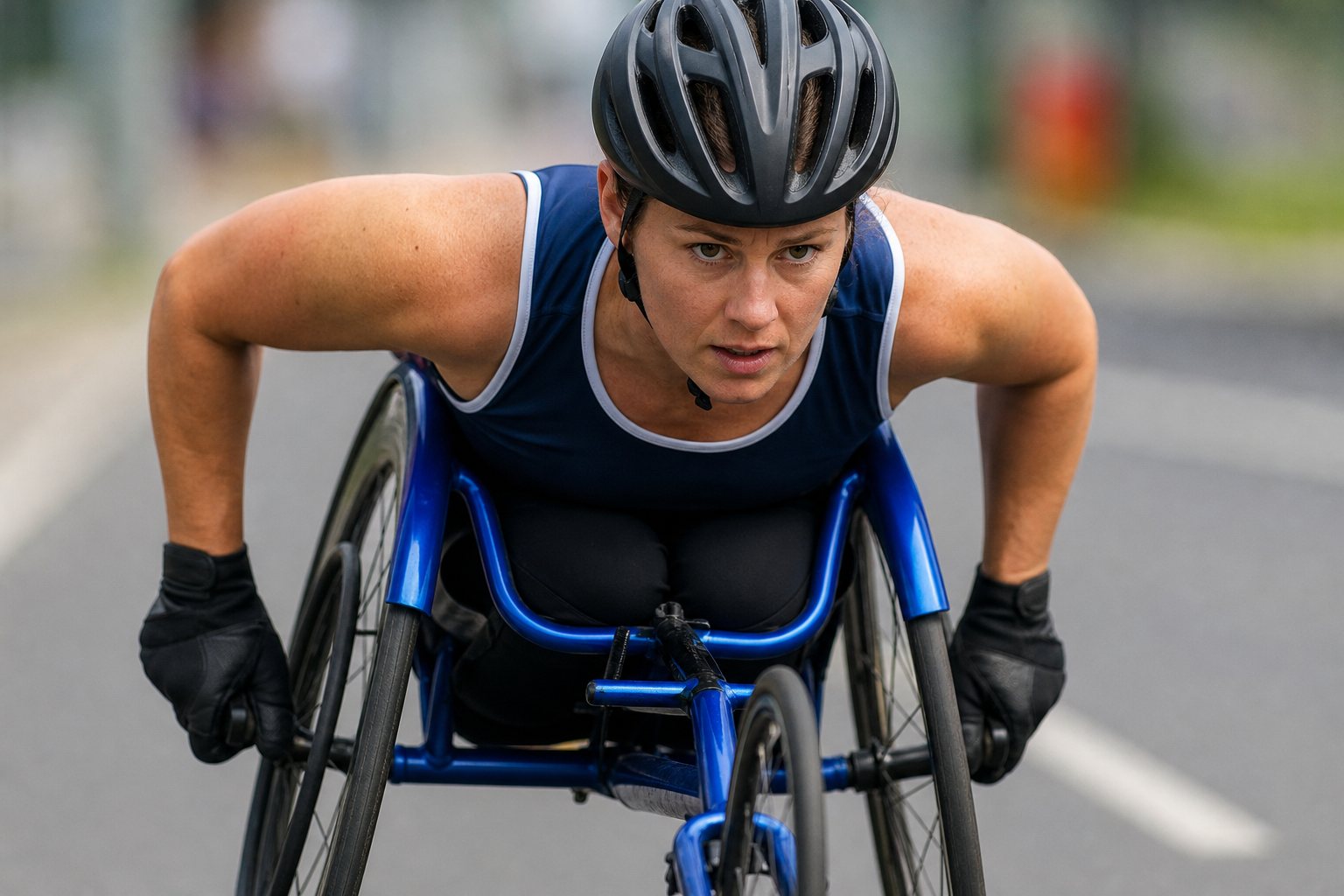
- Recumbent handcycle (PTWC): World Triathlon says PTWC athletes ride a recumbent handcycle on the bike leg. Nevin and colleagues’ review notes that seat position, crank height, crank fore-aft position, crank length and handgrip position each need individual configuration, so a proper fitting matters more than the brand.
- Racing wheelchair (PTWC run): a different machine from a daily wheelchair. World Triathlon describes pre-transition rules letting handlers help with daily chairs, so ask your race director how it works at your event.
- Prosthesis and adaptations (PTS): World Triathlon says PTS2 to PTS5 may use approved prostheses or supportive devices on the bike and run, and that bikes may be adapted. Examples from the Paralympic.org feature include prosthetic legs and modified bikes. Check your sport class and the Competition Rules before changing a device.
- Tandem and tether (PTVI): PTVI athletes ride a tandem with the guide in front and are connected by a tether during the swim and run (Paralympic.org). Tandems are usually long and heavy to move, so plan transport and storage.
- Funding: the Challenged Athletes Foundation, a nonprofit, says it funds adaptive sports equipment, prosthetics and coaching through grants. Check current availability, because funding changes.
Everyday kit that matters
Helmet
A helmet is the most important protective item. Pick one that fits snugly, sits level and has a current safety standard label (in the United States, CPSC for bicycle helmets). Standards are set by regulators and are not the same as a maker’s extra features, such as rotational-impact liners, which are described by the maker rather than by a standard. Handcyclists sit low, so check that the helmet does not push against a headrest. Replace a helmet after a hard impact.
Tri suit, wetsuit and skin care
A one-piece tri suit saves a change in transition, but check the seams and chamois against your seat, socket or cushion. A study of 28 Para triathletes racing in the heat found 57 percent wore wetsuits and those athletes had higher core temperature during the swim (Stephenson and colleagues), so wetsuit choice involves heat as well as buoyancy. A 2026 scoping review found little evidence on pressure injury prevention in disability sport, so for skin, work with your clinician. A simple anti-chafe balm is common practice for friction points.
Laces, belts, watches and lights
- Elastic no-tie laces speed up the run shoes in transition; check they work with your prosthesis or footwear.
- A rear light or radar light helps other riders see a low handcycle or a tandem; check how it mounts to your frame.
- Multisport watches suit many athletes. Whether a given model offers a wheelchair or handcycle activity profile is a question for the maker; we did not verify any for this page, and a watch cannot replace a medical heart-rate or temperature plan.
Fit, inspection and standards versus claims
- Fit: re-check handcycle, chair and prosthesis fit when your strength, body weight or training load changes, and before any key race. A poor fit can change where force goes through the shoulder.
- Inspect: before each ride, check tires, brakes, steering and quick-release parts, and look at chair wheels, bearings and the gloves you push with. This is general bike and chair care.
- Rules: World Triathlon and USA Triathlon rules set which equipment is allowed in each class, and USA Triathlon says to bring all your racing equipment to your classification appointment. Read the rulebook for your race.
- Standards versus claims: a helmet standard is a regulator’s test; a “lightweight” or “aerodynamic” label is the maker’s claim. Treat claims as claims until an independent test says otherwise.
Everyday items some athletes find useful
The cards below are everyday items, not class-specific equipment. They are examples, not recommendations from any federation or clinician, and none has been tested by us for use with a handcycle, chair or prosthesis, so check fit and mounting with the maker.

Giro Register MIPS Helmet
- MIPS rotational liner (maker)
- Universal adult fit (54-61 cm)
- Meets CPSC standard
$39.99 at Amazon, as of Nov 17, 2026 02:07 UTC
Check price on Amazon
Body Glide Original Anti-Chafe Balm
- Balm stick
- 1.5 oz
- Check skin comfort first
$11.69 at Amazon, as of Nov 17, 2026 02:07 UTC
Check price on Amazon
Lock Laces Elastic No-Tie Laces
- 48 in, stretch to 72 in
- One size, kids and adults
- Check fit with your footwear

Garmin Varia RTL515 Radar Tail Light
- Rear radar and tail light
- Check mounting on your bike
- Maker claims long visibility
$149.98 at Amazon, as of Nov 17, 2026 02:07 UTC
Check price on AmazonMore on related gear: Para cycling, Para swimming, Para athletics and the standard-sport triathlon guide.
Para triathlon gear FAQs
What equipment do I need for my first Para triathlon?
It depends on your class. Many first races allow an adapted setup; ask the race director and USA Triathlon. A helmet that fits, a swim kit and a suit are the basics.
Should I buy a handcycle or racing wheelchair before classification?
Talk to your coach and classifier first. USA Triathlon says to bring all your racing equipment to the appointment, and class rules affect what is allowed.
Do I have to wear a wetsuit?
Not always. Rules and water temperature decide, and wetsuits can raise core temperature in warm races, according to a study of Para triathletes.
How do I know if a helmet is safe?
Look for the current safety standard label (CPSC in the United States), fit it snugly and replace it after a hard impact. Extra features are maker claims.
Where can I get funding for equipment?
The Challenged Athletes Foundation lists grants for adaptive equipment. Check current availability and eligibility.
Sources
- World Triathlon: Para categories
- World Triathlon: Paratriathlon, what you need to know
- Paralympic.org: Introduction to Para triathlon, Paris 2024
- USA Triathlon: Para classification
- Nevin et al., The science of handcycling (IJSPP 2022)
- GSSI, Thermoregulatory challenges in para sport (SSE 259)
- Pressure injury in disability sport: scoping review (2026)
- Challenged Athletes Foundation
- Amazon product pages: Giro Register MIPS, Body Glide, Lock Laces, Garmin Varia RTL515
General information for education only, not medical advice. It does not replace a visit with a doctor, physical therapist or athletic trainer. See how we write and check our pages in our editorial policy.