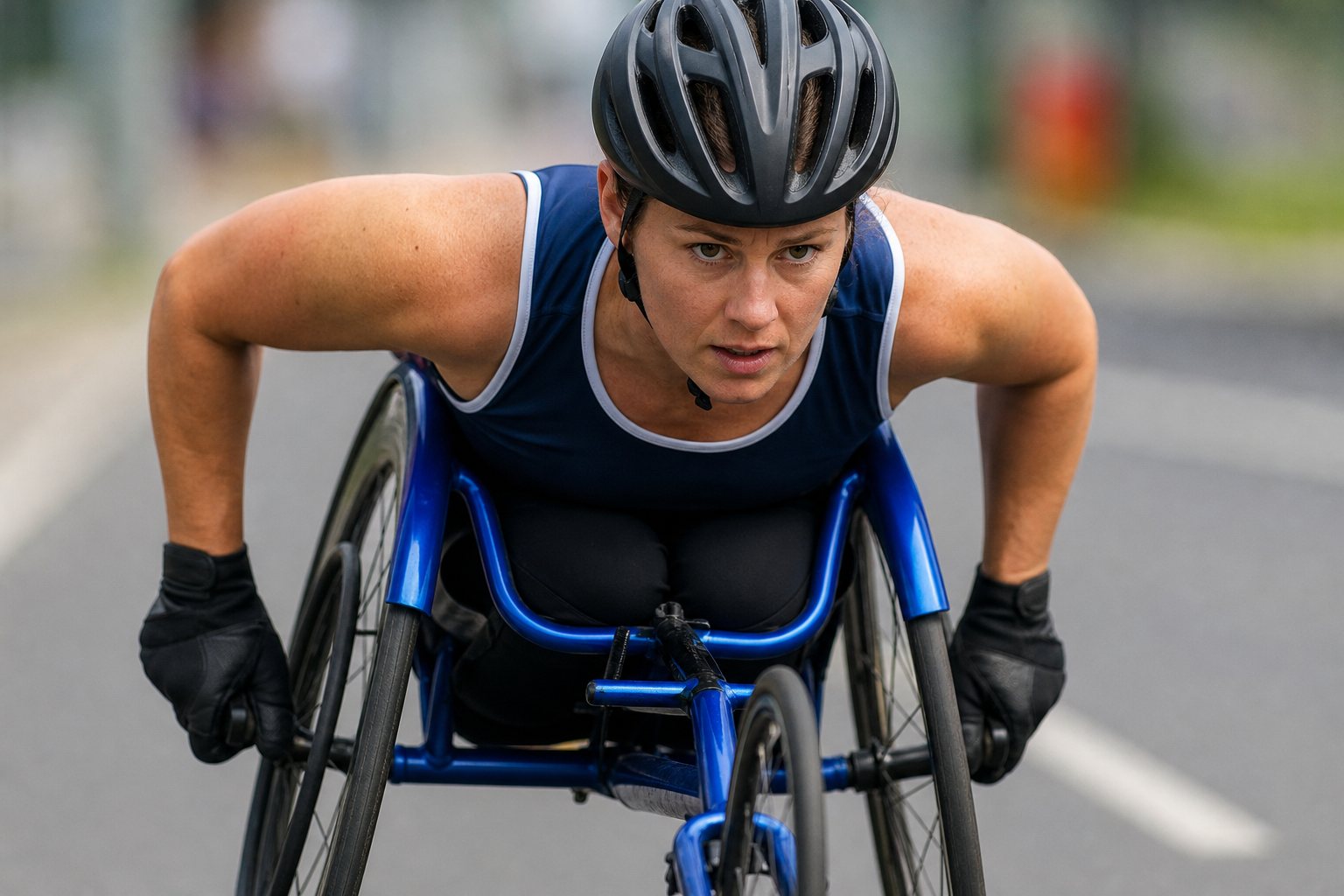
Dawn at Venice Beach is where the next Paralympic triathlon will start, according to USA Triathlon, but most Para triathletes meet the sport somewhere much smaller: a pool session, a handcycle borrowed from a club, a local race with an adaptive division. Para triathlon (also written paratriathlon) is triathlon for athletes with a physical or vision impairment: a 750 m swim, a 20 km bike and a 5 km run, raced back to back, with equipment and help rules set by the athlete’s sport class. This page explains how a race is won, what the classes mean in plain words, the basic skills, and how a beginner can get started.
Quick answer: A Para triathlon is a continuous 750 m swim, 20 km bike and 5 km run, won by the fastest total time including transitions. Wheelchair users (PTWC) ride a recumbent handcycle and run in a racing wheelchair, standing athletes (PTS2 to PTS5) use approved adaptations or prostheses, and athletes with a vision impairment (PTVI) ride a tandem and run with a guide. You do not need to be classified to try an adaptive division at a USA Triathlon certified race, but World Triathlon events require classification. Ask the race director and USA Triathlon before you enter.
General information, not medical advice. For the standard sport see our triathlon guide; for this sport as a whole, the Para triathlon hub. Training, injuries and gear each have their own page, linked at the end.
How a Para triathlon is won
World Triathlon describes Para triathlon as a continuous race: a 750 m swim, a 20 km bike and a 5 km run (or a 5 km racing wheelchair leg). The winner is the athlete with the fastest total time, and the two transitions count as part of that time, which is why Paralympic.org calls them a key part of the race. Men and women race separately. Where two classes share one medal event, a start-interval system lets the athletes in the more impaired class start first so that the finish order reflects the race. We do not quote the interval times here because World Triathlon changes them between events; they are published in each event’s athlete briefing.
The nine classes in plain words
A sport class groups athletes whose impairments affect the sport in a similar way. World Triathlon lists nine: PTWC1 and PTWC2, PTS2 to PTS5, and PTVI1 to PTVI3. For a first race you mostly need to know the group you belong to.
| Class | Who | What changes |
|---|---|---|
| PTWC1, PTWC2 | Wheelchair users | Recumbent handcycle on the bike, racing wheelchair on the run. Both classes share one medal event. |
| PTS2 to PTS5 | Standing athletes with physical impairments | PTS2 is the most impaired group and PTS5 the least (World Triathlon). Conventional bikes with approved adaptations; approved prostheses or supportive devices allowed on the bike and run. |
| PTVI1 to PTVI3 | Vision impairment, from partially sighted to totally blind | Tandem bike with a guide in front. One guide of the same nationality and gender is mandatory throughout the race. |
Guides, handlers and the swim exit
Paralympic.org says guides for PTVI athletes are connected by a tether during the swim and run and ride the tandem in front; its Sport Week feature adds that the guide may not lead the athlete by more than 0.5 m in the swim. In the transition area, handlers may help athletes in and out of a handcycle or racing chair and prepare equipment. World Triathlon also describes swim-exit assistants, with the athlete’s swim-cap colour showing how much help is needed (red for full lifting, yellow for support), and a pre-transition area where athletes can collect assistive devices (PTS2 to PTS4) or their daily wheelchair (PTWC). Exactly what a handler may and may not do is set in the World Triathlon Competition Rules, so read that section with your coach before you race.
The basic skills a beginner works on
Skills are the same three sports plus the “fourth discipline,” so a beginner can start with whichever leg is most familiar. The list below is general coaching practice rather than a published curriculum, with the class-specific points noted.
- Swimming: comfortable, relaxed breathing and the ability to swim 750 m without stopping, ideally including some open water with a buddy. Wetsuits are optional in many races; whether one is allowed depends on water temperature and the event’s rules.
- Handcycle or tandem: bike handling, braking, cornering and riding in a group of other athletes. Handcycles sit low, so learn how to be seen and how to ride single file with traffic. PTVI athletes also learn to communicate with the pilot (calls for turns, gear changes, stops).
- Racing wheelchair or run: a racing wheelchair is a different machine from a daily chair, so learn push technique and steering on flat, safe ground first. Standing athletes learn run form with their prosthesis or support device.
- Transitions: rehearse the whole sequence with your handlers or guide: exit the water, wetsuit off, chair or bike on, helmet on, go. Practice makes it calmer.
Levels, clubs and how to find a program
USA Triathlon’s Para triathlon page lists development pathways (youth racing, high school and collegiate clubs, age-group racing, draft-legal racing), a club finder, adaptive events and camps, a Get Started Racing page, an adaptive triathlon getting-started guide, an introductory Para triathlete questionnaire and the Paratriathlon Nationals Qualifier Series. A getting-started guide published with the Challenged Athletes Foundation, a nonprofit that lists grants for adaptive equipment, coaching and other costs, also covers equipment, classification and how to enter a first event; check with CAF and USA Triathlon for current offerings, because programs and funding change.
USA Triathlon’s classification page explains that unclassified athletes can still race adaptive divisions at its certified races, while classification is required for World Triathlon competitions. For physical impairments you register for an event that offers classification, your doctor completes the Physical Impairment Medical Diagnostic Form, and you bring it with all your racing equipment to your appointment. Vision impairment classification is handled with an ophthalmologist’s form. Questions can go to [email protected].
Paralympic status
Para triathlon debuted at the Rio 2016 Paralympic Games. At Paris 2024 it was held on 1 and 2 September in the Seine, with 11 medal events (six men’s, five women’s) and up to 120 athletes, according to Paralympic.org. USA Triathlon reports that LA28 will host Para triathlon at Venice Beach with 12 medal events across six classes (PTWC, PTVI, PTS2, PTS3, PTS4 and PTS5) for men and women, and about 120 athletes. Qualification details change between Games, so check the official programme for the current Games.
Official rulebooks
- World Triathlon: Para categories and its Competition Rules library for international events.
- USA Triathlon Multisport Competition Rules for races in the United States, which have their own Para sections.
Next: training and performance, injury prevention, gear, and the related sports Para swimming and Para cycling.
Para triathlon rules and getting started: FAQs
Do I have to be classified to race a Para triathlon?
Not to start. USA Triathlon says unclassified athletes can race adaptive divisions at its certified races. Classification is required for World Triathlon competitions, and each race director sets the details for adaptive entries.
What is the difference between PTWC, PTS and PTVI?
PTWC is for wheelchair users (handcycle and racing chair), PTS for standing athletes with physical impairments, and PTVI for athletes with a vision impairment (tandem and guide). The number is the class within the group.
Can I have help in transition?
Yes, depending on class. Handlers may assist PTWC athletes and others as the rules allow, and PTVI athletes race with a guide throughout. The exact limits are in the World Triathlon or USA Triathlon rulebook, so confirm them before race day.
How long is a Para triathlon?
750 m of swimming, 20 km of cycling and 5 km of running or wheelchair racing: a sprint-style format used at the Paralympic Games.
Where do I find a club or program?
Start with USA Triathlon’s club finder and its Para triathlon page, then ask the Challenged Athletes Foundation about regional programs and equipment grants. In other countries, ask your national triathlon federation.
Sources
- World Triathlon: Para categories
- World Triathlon: Paratriathlon, what you need to know
- Paralympic.org: Introduction to Para triathlon, Paris 2024
- Paralympic.org: 10 things to know about Para triathlon
- USA Triathlon: Para classification
- USA Triathlon: Paratriathlon community page
- USA Triathlon: Venice Beach to host Para triathlon at LA28
- USA Triathlon Multisport Competition Rules
- Challenged Athletes Foundation: grants and Paratriathlon Getting Started Guide
General information for education only, not medical advice. It does not replace a visit with a doctor, physical therapist or athletic trainer. See how we write and check our pages in our editorial policy.