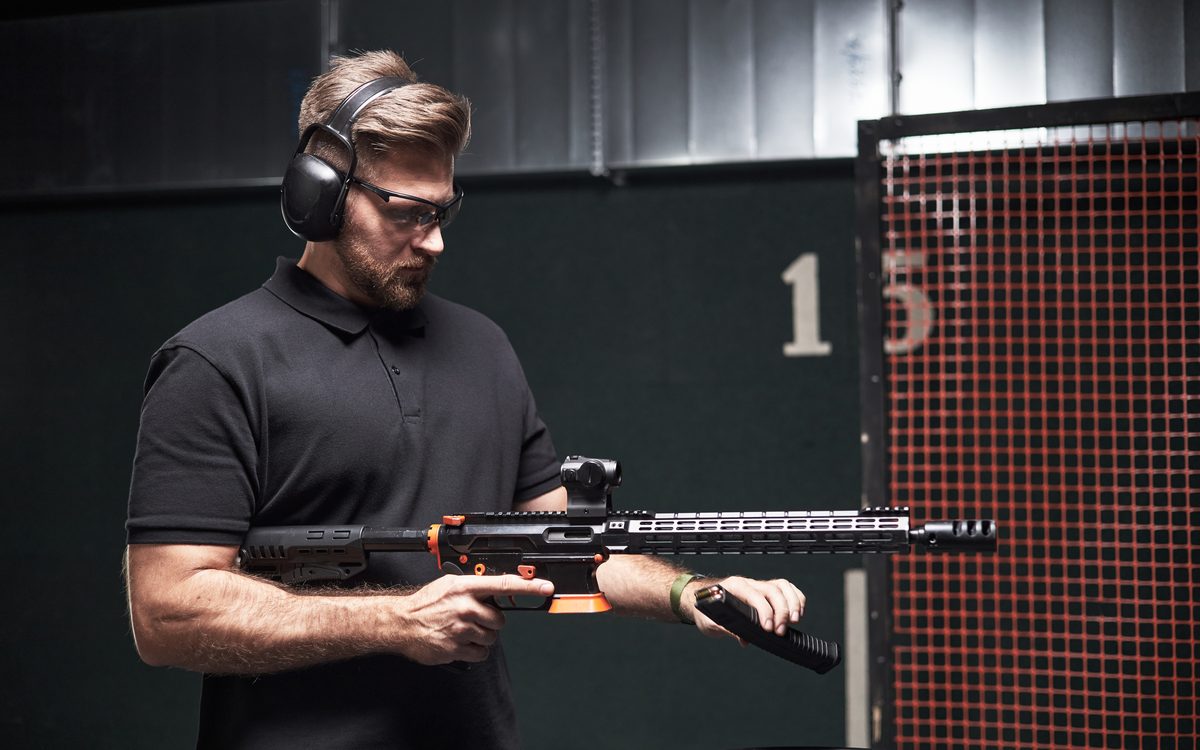
The first thing a new shooter learns is not how to hit the ten. It is how to stand on a firing point: gun pointed downrange, action open until the range officer says so, a bright orange flag sticking out of the barrel whenever the gun is not being fired. Shooting rules and getting started is about that world: the events, how a score is counted, the commands a range runs on, and the route from “I’d like to try this” to a first coached session. For the sport as a whole, see the shooting hub.
Quick answer: Olympic-style shooting is scored on accuracy: shots are counted by ring value on a target (or by hits on clay targets) and the highest total wins. Beginners start with a certified club or range, a coach and club-owned equipment, often with air rifle or air pistol. Learn the range commands and safe-handling rules before anything else, and use the official federation rulebook for any competition question.
The events in plain words
The International Shooting Sport Federation (ISSF) groups Olympic-style events by gun and distance. In the 2022 edition of the ISSF rules (read for this page), the rifle and pistol events include 10 m air rifle, 50 m rifle three positions, 10 m air pistol and 25 m rapid fire pistol, and the shotgun events are trap and skeet. The shooting hub lists the LA28 programme as the ISSF has announced it.
- 10 m air rifle and air pistol: compressed-air guns shot indoors at 10 metres. In the 2022 rules a qualification round is 60 shots, and the final is 24 shots for the top qualifiers.
- 50 m rifle three positions: shot in three body positions, kneeling, prone and standing, with 3 x 20 shots in the 2022 qualification format. The ISSF changed final formats from 1 January 2026, so check the current rulebook before quoting a final.
- 25 m rapid fire pistol: a pistol event with series shot against a clock. The 2022 rules list 8, 6 and 4 second series, in two stages of 30 shots.
- Trap and skeet: shotgun events where the athlete breaks clay targets thrown into the air. The 2022 rules list 125 targets in qualification for both.
- Mixed team events: a man and a woman shoot together on one team. The 2022 rules list 30 shots each for mixed air rifle and air pistol and 75 targets each for mixed trap and skeet.
Para shooting has its own classes and is covered on the Para shooting page.
How a score is counted
On a rifle or pistol target, the rings from the centre outward are worth ten down to one. The ISSF rules also describe decimal scoring: one full ring is divided into ten equal parts, so a shot can score 10.0 up to 10.9 instead of a flat 10. The 2022 rules require decimal scoring in finals and, in ISSF championships, in the qualification rounds for 10 m air rifle and 50 m prone, while some other qualification rounds use full rings only. The rules also require electronic targets to score to at least half of one decimal ring and to show each shot on a monitor at the firing point.
In shotgun events a clay target is either broken or missed, so a score is a count of targets broken. Ties are settled by shoot-off or count-back procedures that differ by event, so read the event rule.
Range commands and safety flags
Range commands are the part of the rules every beginner meets first. The ISSF rules say guns may only be loaded on the firing point after the command “LOAD” or “START”, and that at all other times guns and magazines must be kept unloaded. When “STOP” is given, shooting must stop immediately. When “UNLOAD” is given, athletes make their guns safe, and air guns are made safe by asking the range officer first.
The 2022 rules also set out safety flags: bright orange flags (or “safety lines” for air guns) must be inserted in rifles, pistols and semi-automatic shotguns whenever they are not being fired, to show the chamber is empty, and shotgun actions must be open. While on the firing point, guns must always point in safe directions, and the action must not be closed until the gun is pointing downrange. Outside the firing point, guns stay in their cases unless a range officer allows otherwise. Your own range will have its own rules too, so always follow the range officer.
The ISSF rules also require ear protection for everyone close to the 25 m, 50 m and 300 m firing lines and all shotgun ranges, and say athletes should wear shatterproof shooting glasses or similar eye protection. For plain-language safety content, see shooting injury prevention.
Basic skills a beginner works on
This part is general coaching practice, not a quote from a rulebook, and a certified coach will teach it in their own order. Most coaches break a shot into a few simple pieces:
- Stance or position: a stable, repeatable body position that does not need muscle to hold it up.
- Sight picture and aim: keeping the front and rear sights lined up on the target while the gun settles.
- Breathing: a calm breath cycle so the body is not moving at the moment of the shot.
- Trigger control: a smooth, deliberate release that does not disturb the aim.
- Follow-through: staying still for a moment after the shot so that the whole routine is the same every time.
Clay target shooters add gun mounting, tracking and timing. All of this is taught on the range by a coach.
How to get started
USA Shooting, the US national governing body for Olympic shooting sports, says on its About page that it supports certified clubs and training centres, and lists a “Clubs and Shooting Centers” page and a “Find a Club” link on its website. The same page links to the Scholastic Action Shooting Program and the Scholastic Clay Target Shooting Program as partners. Its pages we could read do not give junior age limits, so ask a local club directly about youth programs, age rules and any parent or guardian requirements.
A common beginner route, based on how clubs describe their programs, is general coaching practice rather than an official rule:
- Contact a certified club or range and say you are new.
- Ask for a coach and club-owned equipment for the first sessions, which many clubs provide.
- Start with air rifle or air pistol, which are quiet and can run indoors.
- Learn the range commands and your range’s safety rules before you shoot.
Outside the US, start with your national federation. Para athletes can start from the Para shooting page.
Levels and where to read the official rules
Competition runs from club and regional matches through national championships and the ISSF World Cups and World Championships, with the Olympic Games at the top. The ISSF publishes its rules and says the 2026 edition was updated with effect from 1 July 2026, according to the Asia Shooting Confederation. We read the 2022 edition for this page, so use the ISSF rules page for the current wording before any competition. For training ideas see shooting training, and for equipment see shooting gear.
Shooting rules FAQs
Do I need my own equipment to start?
Many clubs provide club-owned equipment for beginners, according to how USA Shooting describes its certified clubs and centres, but this varies. Ask the club first, and do not buy equipment before a coach advises you.
What does a score of 10.9 mean?
It is a decimal score. The ISSF rules divide one full ring into ten equal parts, so shots can score from 10.0 to 10.9 in events that use decimal scoring.
What is the difference between air rifle and 50 m rifle?
Air rifle is shot at 10 metres with compressed air, usually indoors. The 50 m rifle events are shot at 50 metres, and three positions means kneeling, prone and standing in qualification.
Can kids shoot Olympic-style events?
Many clubs and school programs run youth shooting, but age limits vary. USA Shooting’s pages we read do not list junior age rules, so ask your local club.
Sources
- ISSF Rule Book, 2022 edition (copy hosted by Swiss Shooting; also read the General Technical Rules copy)
- ISSF, Rules and regulations page
- Asia Shooting Confederation, notice of the updated 2026 ISSF rules (effective 1 July 2026)
- ISSF, 2026 final format changes
- USA Shooting, About
General information for education only, not medical advice. It does not replace a visit with a doctor, physical therapist or athletic trainer, or instruction from a certified coach or range officer. See how we write and check our pages in our editorial policy.