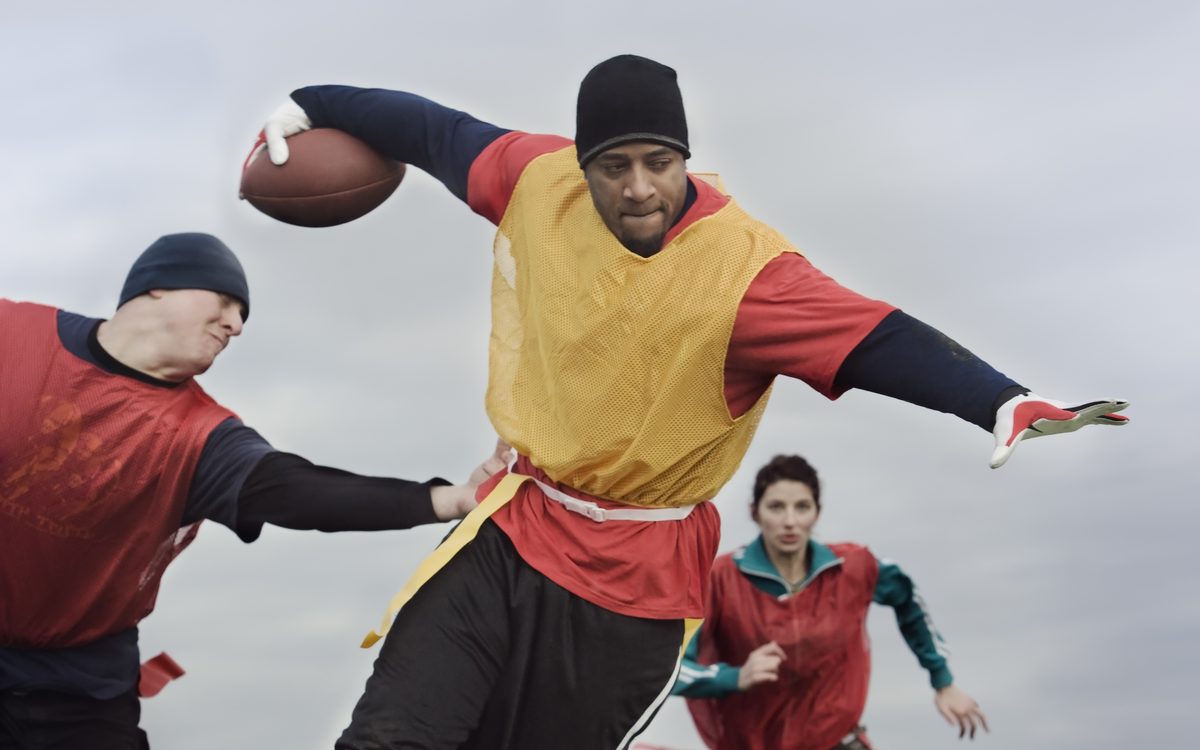
Fourth-and-goal from the 10, tied game, and the receiver has to sprint, cut, catch and reset in the same few seconds. Then the next series starts. Flag football training is the work you do between games to make those repeated short bursts feel easier and safer: speed and change of direction, leg and hip strength, hands and throwing, and enough easy conditioning to keep going through a tournament day. This page lays out what the game asks of the body, a sensible weekly shape, and how to build up. It is general information, not a coaching plan.
Quick answer: Flag football asks for repeated short sprints, quick stops and cuts, catching and throwing, with brief rests. A balanced week mixes speed and agility, two strength sessions, skill work and easy days. We found no study measuring flag players’ game workloads, so the weekly plan here is a common-sense example, not a prescription. Build up gradually, and see a sports medicine doctor, physical therapist or athletic trainer for pain that lingers.
For the rules, see rules and getting started. Injury detail is on the injuries page and warm-up habits are on injury prevention. Hub: flag football.
What the game asks of your body
We did not find a published study of how far or how fast flag football players move in a game, so this section sticks to what the rules imply. With five players a side and no blocking, everyone runs. NFL FLAG’s rules let up to two defenders rush the quarterback from a 7-yard line, so quarterbacks need quick decisions and receivers need to get open fast. Expect:
- Repeated short sprints on routes and in coverage, with short rests between plays.
- Cutting and stopping. Changes of direction load the ankles, knees and hips.
- Backpedalling and shuffling for defenders.
- Catching and throwing while moving, plus reaching, bending and jumping.
- Repeat effort over a day. Youth and adult tournaments can mean several games, which we cover in nutrition and recovery.
A sensible weekly shape
The layout below is an example of how to organise a week, not a plan from a study or a federation. Adjust it to your age, your league’s season and how you feel. Players who are new to training, young or returning after a break should start with less.
- Day 1, speed and agility. Warm up, then short sprints with full rest, plus cutting and backpedal drills. Stop while your form is still sharp.
- Day 2, strength. Legs, hips, core and upper body, with simple lifts and body-weight work.
- Day 3, skills and an easy day. Catching, throwing, route running, flag-pulling practice, plus easy movement.
- Day 4, strength or game. A second strength session, or a game or scrimmage.
- Day 5 and beyond. Game, light activity and at least one full rest day.
Strength, power and conditioning
Strength. The 2014 international consensus statement on youth resistance training (Lloyd and colleagues, British Journal of Sports Medicine) supports well-supervised strength work for children and teens, with a focus on technique and gradual increases. For flag, that usually means squats and lunges, hip hinges such as deadlift patterns, calf raises, pushing and pulling movements, and core work. Hamstring strength matters for sprinters: the American Academy of Orthopaedic Surgeons (AAOS) describes sprinting as a common way to strain the hamstring, with fatigue, tightness and muscle imbalance among the risk factors.
Power and speed. Jumps, skips and short sprints train the quick bursts that routes need. Keep these fresh: do them early in a session and with plenty of rest. Fatigue is when form slips.
Conditioning. The game is not a long run, but a tournament is. Easy aerobic work, such as jogging, cycling or swimming, helps you recover between sprints and between games. Interval work with sprints followed by walking can mimic the pattern of play. We have no flag-specific numbers for this, so use how you feel and your coach’s guidance.
Skills practice
- Throwing. Quarterbacks work on quick releases and accuracy under pressure, and on throwing while moving.
- Catching. Receivers catch away from the body, in traffic of defenders and while turning.
- Flag pulling and footwork. Defenders practise approach angles and pulling the flag with control.
- Route running. Sharp breaks and acceleration out of cuts.
Periodisation basics
Periodisation just means organising the year into phases. A simple version has an off-season for strength and general fitness, a preseason that adds speed and sport-specific work, an in-season that keeps strength while games take priority, and a break. The AAOS football injury page recommends off-season fitness work, and the American Academy of Pediatrics (Brenner, 2016) advises young athletes to take one to two days off a week from their main sport and time off in blocks over the year. Flag players who also play other sports can use those sports as cross-training.
Building up safely
- Increase gradually. We did not find a flag-specific rule of thumb. Add a little at a time, and do not jump from no sprinting to hard sprinting in a week.
- Watch total hours. A 2015 study of young athletes (Jayanthi and colleagues) found those training more hours a week than their age in years had about twice the odds of a serious overuse injury. It was not specific to flag football.
- Count recovery as training. Sleep and rest are part of the plan. See recovery and mobility.
- Returning after a break? Adult players coming back to a game after years away should start with lighter sessions and check in with a doctor if they have health concerns.
For equipment to practise at home, see gear and equipment. For the tackle game’s training ideas, see the football hub.
Flag football training FAQs
How do I get faster for flag football?
Short sprints with full rest, good running form, and leg and hip strength all help. Keep speed work early in a session when you are fresh. We found no flag-specific study, so treat this as general guidance and ask a coach.
How often should I train for flag football?
It depends on your age, season and experience. The example week above mixes about four training days with at least one full rest day. The American Academy of Pediatrics advises young athletes to take one to two days off a week.
Do kids need strength training for flag football?
A 2014 international consensus statement says supervised, technique-focused resistance training is appropriate for young people. Check with a doctor and find a qualified coach.
What should I practise most as a beginner?
Throwing and catching, flag pulling, and basic route running or coverage. They are the core of the game and you can practise most with one other person.
Should I do cardio or sprints?
Both have a place. Easy aerobic work helps recovery between games, and short sprints match the demands of play.
Sources
- NFL FLAG, flag football rules
- Lloyd et al., youth resistance training consensus, Br J Sports Med 2014
- AAP, Brenner, sports specialization and intensive training, 2016
- Jayanthi et al., sports specialization and overuse injury, 2015
- AAOS OrthoInfo, hamstring muscle injuries
- AAOS OrthoInfo, football injury prevention
General information for education only, not medical advice. See a sports medicine doctor, physical therapist or athletic trainer about your own situation. How we write and check our pages is in our editorial policy.