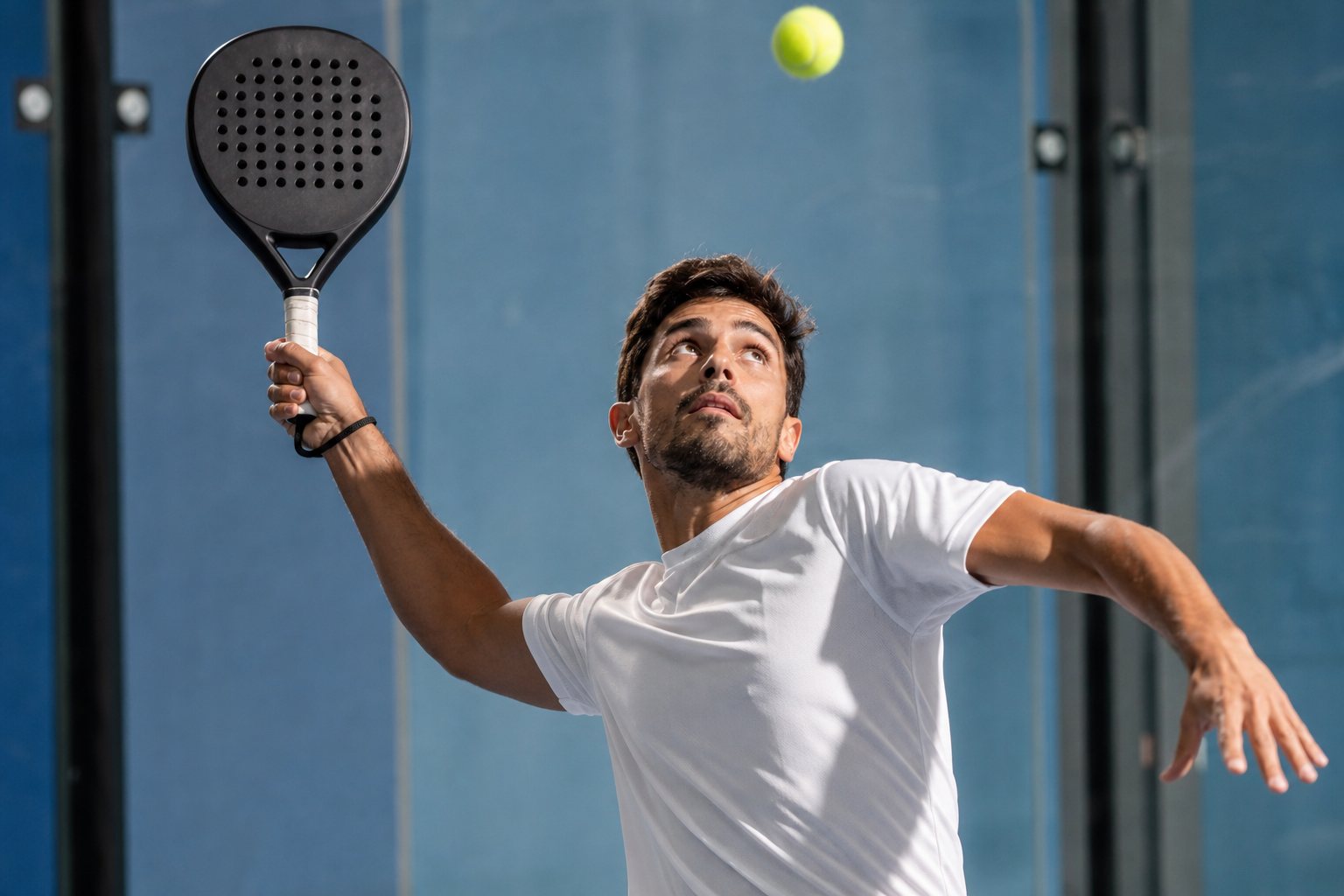
Golden point, 40-40 in a tight match: your partner is looking at you, the ball is in your hand, and the receivers have just chosen the side you least wanted. Your heart is racing and you feel the urge to hit something harder than you usually do. Mental training in padel is the set of skills (focus, confidence, routines, partnership and handling pressure) that help you play to your level in moments like this one. It is separate from mental health, which is covered further down, and it does not guarantee results.
Quick answer: Padel research on psychology is still limited, so most of the tools below come from general sport-psychology sources and are suggestions, not guarantees. The best-supported ideas for pressure are a short pre-point routine, a clear simple focus, and practising under pressure. Partner communication matters in doubles. If you are struggling with anxiety, low mood, disordered eating or burnout, that is a health matter: please see a qualified professional, and in the US call or text 988 if you are in crisis.
What padel research says about the mind
A 2025 systematic review of padel and pickleball and wellbeing (PMID 40799328; 14 of 71 studies, 1,403 participants) found padel studies mostly look at performance aspects such as self-confidence, anxiety and mental fatigue, while pickleball studies look more at wellbeing. The authors point to gaps, which means padel-specific advice rests on a small base. A study of 475 padel players in Saudi Arabia (PMID 42506823) found that enjoyment-driven motivation was linked with lower depression, stress and anxiety, while motivation focused on achievement was linked with higher scores. It is a survey, so it cannot show cause, but it fits a common coaching idea: keep the fun in the game.
Confidence, focus and motivation
- Confidence. A scoping review of under-18 padel research (PMID 40137799) reports higher self-confidence and lower anxiety in the studies it covered, and greater somatic anxiety in boys than girls. That is a group finding, so check in with each player.
- Focus. With rallies lasting 7 to 12 seconds at the levels in that review and 20 seconds between points in competition, you have a few seconds to reset. Many coaches teach a one-word focus (for example “feet” or “early”) for each point.
- Motivation. A 2025 survey of 201 recreational players (PMID 41295760) found that motivation came mostly from personal interest, enjoyment and perceived benefits, with little difference by age or gender.
Goal setting and imagery
Set goals you control: a good first serve percentage in practice, getting to the net after a lob, or staying patient for ten shots. Outcome goals (winning the match) are out of your hands. Imagery, such as picturing a bandeja or a smooth wall exit, is widely used in sport psychology; we found no padel trial of it, so treat it as an option to test rather than a proven method.
Pre-point and pre-match routines
The Exercise and Sports Science Australia (ESSA) position statement on performance under pressure (PMID 42271117) lists four evidence-based approaches: pre-performance routines, implicit attentional strategies, psychological skills training and mindfulness. A 2026 meta-analysis of 21 studies (PMID 41951087) found counteractive interventions such as quiet eye training, pre-performance routines and self-talk generally reduced the performance drop under pressure, with larger effects in closed-skill sports (where the environment is stable) than in open-skill tasks like padel rallies. That caution is worth remembering: routines may help most for serves and set shots. A simple pre-point routine could be: look at the score, take a breath, pick your target and play. Try it in practice first.
Handling pressure and setbacks
- Deciding points. The FIP rules describe Star Point and golden point formats where the receivers choose a side and may not swap. If your event uses one, practise these points in training, perhaps starting games at 40-40. ESSA says pressure training can prepare athletes for competition.
- Breathing and arousal. In 12 high-level amateur players (PMID 41562729), heart rate variability changed through matches and winners showed higher values during the first set. This is a very small study and cannot tell you what to do, but it hints that staying calm early may matter.
- After an error. In the Italian sub-elite study (PMID 35886239), 65% of points came from opponents’ unforced errors, so a missed shot is rarely the end of a point you cannot win. A short “next ball” cue can help you reset.
- Losing streaks. Talk with your partner and coach between sets. Only accredited coaches may advise during matches in FIP competitions, and only during rest times.
Tactics, decisions and teamwork
Padel is played in pairs, so communication is part of the sport. Many pairs agree in advance who takes balls down the middle, who covers lobs and how to signal a switch. We found no padel study of partner communication; the doubles evidence we know of comes from tennis and other sports. Agree simple rules, and keep feedback calm and short. Our rules and skills page explains the wall and net play where those decisions happen.
Competition preparation
Arrive early enough for the courtesy rally and a warm-up; the FIP rules give a walkover if you are not ready on court ten minutes after the start time. Pack water, snacks and a spare racket cord. See our gear page for what to check and our nutrition page for fuelling.
Young players
The under-18 scoping review (PMID 40137799) found higher self-confidence and lower anxiety in young players in the studies reviewed, and that training with professional players can raise motivation. In 104 players aged 15 to 20 (PMID 41150491), injured players reported higher stress, and girls reported slightly higher stress than boys (median 3 versus 2). Keep youth padel fun, avoid pressure on results, and watch for signs of too much stress.
Mental health is different from mental performance
Nerves before a match are normal and trainable. Persistent anxiety, low mood, panic, trouble sleeping, disordered eating, burnout or thoughts of self-harm are health matters, not skills problems. The 2026 IOC consensus statement on mental health in elite athletes (PMID 42580854) says mental health symptoms and disorders are common in elite athletes, can impact performance and may be managed with treatments including psychotherapy and medication, and that many athletes can continue competing with support. Talk to a doctor, a licensed mental health professional or a qualified sport psychologist. In the US, you can call or text 988 (the Suicide and Crisis Lifeline) any time, free and confidential. If you are in immediate danger, call 911.
Padel mental training FAQs
How do I stop choking on big points?
No method guarantees it. The ESSA statement lists routines, attention strategies, psychological skills training and mindfulness as evidence-based options. Practise pressure points in training and keep a simple routine.
What should I say to my partner?
Keep it short, positive and specific. Agree on who covers which balls before the match. No padel study tells us the best phrases.
Does visualisation help in padel?
It is widely used in sport psychology, but we found no padel trial. Try it for serves and set plays, and keep what works for you.
Why do I play worse when I try harder?
Pressure can help or hurt. The ESSA statement says pressure has both facilitative and debilitative effects, so a routine and pressure practice can help you stay in the helpful range.
When should I get professional help?
If nerves, mood, sleep, eating or burnout affect daily life or enjoyment, see a doctor or licensed mental health professional. In the US, call or text 988 in a crisis.
Sources
- Padel, pickleball and wellbeing: a systematic review, Front Psychol 2025, PMID 40799328 (PubMed)
- Sport motivation and mental health outcomes among padel players in Saudi Arabia, Sports 2026, PMID 42506823 (PubMed)
- Motivational determinants of recreational padel participation, Sports 2025, PMID 41295760 (PubMed)
- Under-18 padel scoping review, Sports 2025, PMID 40137799 (PubMed)
- Heart rate variability dynamics in padel players, J Funct Morphol Kinesiol 2025, PMID 41562729 (PubMed)
- Padel match analysis, Italian sub-elite competitions, PMID 35886239 (PubMed)
- Training load, injuries and well-being in youth padel players, PMID 41150491 (PubMed)
- ESSA position statement, Performance Under Pressure in Sport, 2026, PMID 42271117 (PubMed)
- Zeng et al. 2026, counteracting choking under pressure in sport, meta-analysis, PMID 41951087 (PubMed)
- Reardon CL et al., IOC consensus statement, Mental health in elite athletes (2026), PMID 42580854 (PubMed)
- 988 Suicide and Crisis Lifeline (988lifeline.org)
- FIP Rules of Padel 2026 (PDF)
General information for education only, not medical advice. It does not replace a visit with a doctor, physical therapist or athletic trainer. See how we write and check our pages in our editorial policy.