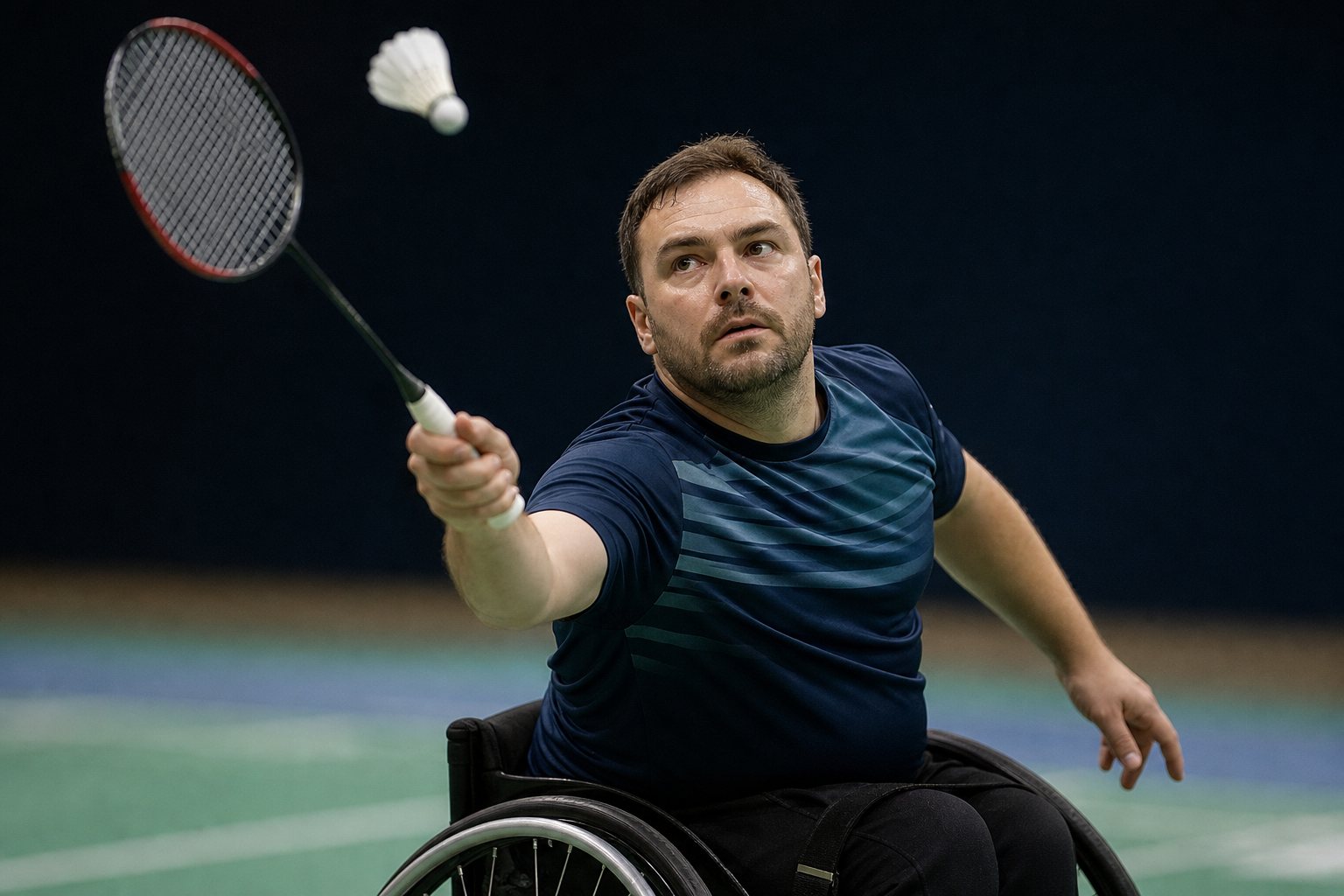
It is the third game of a long club night. The wheelchair player has hit a few dozen overhead shots without a proper warm-up, the shoulder has started to ache on the clear, and the first instinct is to play through it. Para badminton injury prevention is the set of habits around a player, a proper warm-up, sound technique, a training load that grows slowly, strength work, equipment that fits and honest reporting of pain, that aim to lower the chance of getting hurt. They lower the odds. They cannot promise anything.
Quick answer: The best-supported idea is to look after the shoulder, wrist and trunk, because the shoulder complex carried the greatest injury burden in a one-year study of 102 Para athletes and the Para smash works the wrist, elbow, lats and abdominals hard. Reviews of Para sport find very little evidence on which prevention measures work, so these are sensible habits, not guarantees. See a sports medicine doctor, physical therapist or athletic trainer if pain stays in one place, shows up at rest, or changes how you swing, and call emergency services after a head injury with danger signs.
General information, not medical advice. This page is about lowering risk. What injuries look like is on our Para badminton injuries page, so we do not repeat it here. For the sport as a whole start at the Para badminton hub.
Be honest about the evidence
A 2024 systematic review of sports-related health problems in Para sport (64 studies) found that only three reported on whether prevention measures work. We found no injury-prevention trial in Para badminton. Everything below is therefore drawn from injury studies, from research on standard badminton and from basic sports medicine, and it is labelled that way.
Warm up before the first smash
USA Badminton says it plans to publish a basic warm-up for each classification, but we did not find one published. For standard badminton, a 2026 narrative review of 19 studies looked at the Advanced Throwers Ten exercise program as a warm-up for overhead shoulder health, and concluded it may help reduce shoulder risk and support the return from rehabilitation to competition. That is a review of a program designed for throwers, not a trial in Para players, so treat it as an idea to discuss with a physical therapist. A general pattern, common practice rather than a finding, is to raise the heart rate, move the shoulders, trunk and wrists through their range, then play easy shots before smashes.
Technique
A 2026 study of nine elite Para badminton players measured muscle activity in a smash. Wrist and elbow muscles worked hardest in the forward swing, the latissimus dorsi and abdominals joined in, and the authors suggested that wrist stability and good control through the trunk and shoulder should be a focus of injury prevention. For coaches that means two things: build the swing from the trunk out, not the arm alone, and fix a sore-arm pattern early. A coach who knows your class can adjust grip, chair position or stance to what your body does well.
Increase the load slowly
We did not find a sourced rule of thumb for how fast Para badminton training can grow. What a clinician typically asks is how much you did last week compared with this week. A practical habit, common practice and not a finding, is to raise the number of hard overhead shots or court hours a little at a time and to build rest days in. USA Badminton says competitors need at least five training days a week, which makes planning and variety matter: mix hard days with easy ones and mix overhead work with legs, trunk or chair skills.
Strength and conditioning
The Brazilian one-year study followed 102 Para athletes in swimming, athletics, powerlifting and taekwondo and found that the shoulder complex, then the ankle and knee, carried the greatest injury burden. Badminton was not among its sports, but overhead sport and wheelchair use both load the shoulder. Strength work for the rotator cuff, shoulder blades, trunk and forearms is a common coaching response. Our training page lists the targets, and a physical therapist should set the exercises for your impairment.
Chair, strap and prosthesis checks
USA Badminton’s equipment rules allow wheelchair players to be strapped at the waist, across the thighs or both, with feet fixed to the footrest and a rear supporting wheel allowed. Before play, check as common practice:
- Straps and footrest fixings are tight and undamaged.
- Wheels, tyres and brakes are in good order, and the rear support wheel is set as your coach advises.
- Standing players check that a prosthesis, socket and shoe fit well and that a crutch tip grips the floor.
Skin in contact with straps, seat or a socket can break down; ask your clinician how to check it.
Falls, head knocks and the CDC steps
Chair tips and floor falls happen. The CDC HEADS UP guidance says to stop after a head knock, watch for headache, dizziness, confusion or balance trouble, and have a healthcare provider decide when you can return. Call 911 for danger signs such as repeated vomiting, a seizure or one pupil larger than the other.
Eye protection
A shuttle or racket can reach the eye in any racket sport, and the American Academy of Ophthalmology publishes a clinical statement on protective eyewear for young athletes. Racket-sport eyewear is typically tested to ASTM F803; when a product says it meets that standard, that is a maker claim. See our gear page.
Heat, hydration and medical conditions
A 2024 study of 15 elite athletes with a spinal cord injury found that sweat rate was lower in athletes with tetraplegia, and six of the 15 were already dehydrated before exercise by urine measurement. Take breaks, drink, and ask your doctor what applies to you. For athletes with a spinal cord injury at or above T6, autonomic dysreflexia can raise blood pressure suddenly and be life-threatening (2022 review). If you know you are prone to it, know your plan and tell your coach. Do not induce it: boosting is banned by the IPC.
Youth players
The 2026 scoping review of youth badminton injuries (10 studies) says badminton is the most popular sport among adolescents worldwide and that research on this age group is limited. We found no Para-specific youth prevention study, so junior players should follow the same basics with a coach who knows their class and a parent or clinician who can help.
What prevention cannot do
No warm-up, strap or exercise removes the risk of injury. A 2024 review found injury rates in Para sport ranged from 0 to 91 per 1,000 athlete days depending on the sport and impairment, which shows how much the picture varies. Prevention aims to reduce risk, spot problems early and keep you playing.
When to see a professional
See a sports medicine doctor, physical therapist or athletic trainer if pain lasts more than a day or two, swells, feels unstable, wakes you at night or changes your stroke, or if you have a skin sore, numbness or a sudden headache with a blood-pressure spike. This page does not diagnose anything.
Para badminton injury prevention FAQs
What is the most common injury in Para badminton?
We found no surveillance for Para badminton alone. In the one-year Brazilian study of four other Para sports, the shoulder complex had the greatest burden. See the injuries page.
Does a warm-up prevent injuries?
We found no Para badminton trial. A warm-up prepares the body for play, and research reviews on shoulder programs in badminton are promising but not conclusive.
Should I wear eye protection?
The AAO has a clinical statement on protective eyewear for young athletes, and racket sports can put the eye at risk. Ask your eye doctor and coach what fits you.
Can wheelchair players hurt their shoulders from pushing and hitting?
Both overhead sport and wheelchair use load the shoulder, which is why strength and rest matter. See a clinician if pain persists.
Is it safe to play with a prosthesis?
Prostheses are allowed in SL3, SL4 and the wheelchair classes under USA Badminton’s equipment rules. Fit and checks should be agreed with your prosthetist.
Sources
- Systematic review of sports-related health problems in Para sports, 2024 (PubMed)
- Madaleno et al., one-year study of 102 Para athletes, 2025 (PubMed)
- Electromyographic analysis of the para-badminton smash, 2026 (PubMed)
- Advanced Throwers Ten program for shoulder injury prevention in badminton, narrative review 2026 (PubMed)
- Injury epidemiology in youth and adolescent badminton, scoping review 2026 (Frontiers)
- USA Badminton: Para athletes overview
- USA Badminton: equipment
- CDC HEADS UP: signs and symptoms
- American Academy of Ophthalmology: protective eyewear for young athletes
- How elite athletes with a spinal cord injury sweat during exercise, 2024 (PubMed)
- Autonomic dysreflexia following spinal cord injury, 2022 (PubMed)
- Electroceuticals for Paralympic athletes, 2026 (PubMed)
General information for education only, not medical advice. It does not replace a visit with a doctor, physical therapist or athletic trainer. See how we write and check our pages in our editorial policy. More: the sports hub and badminton.