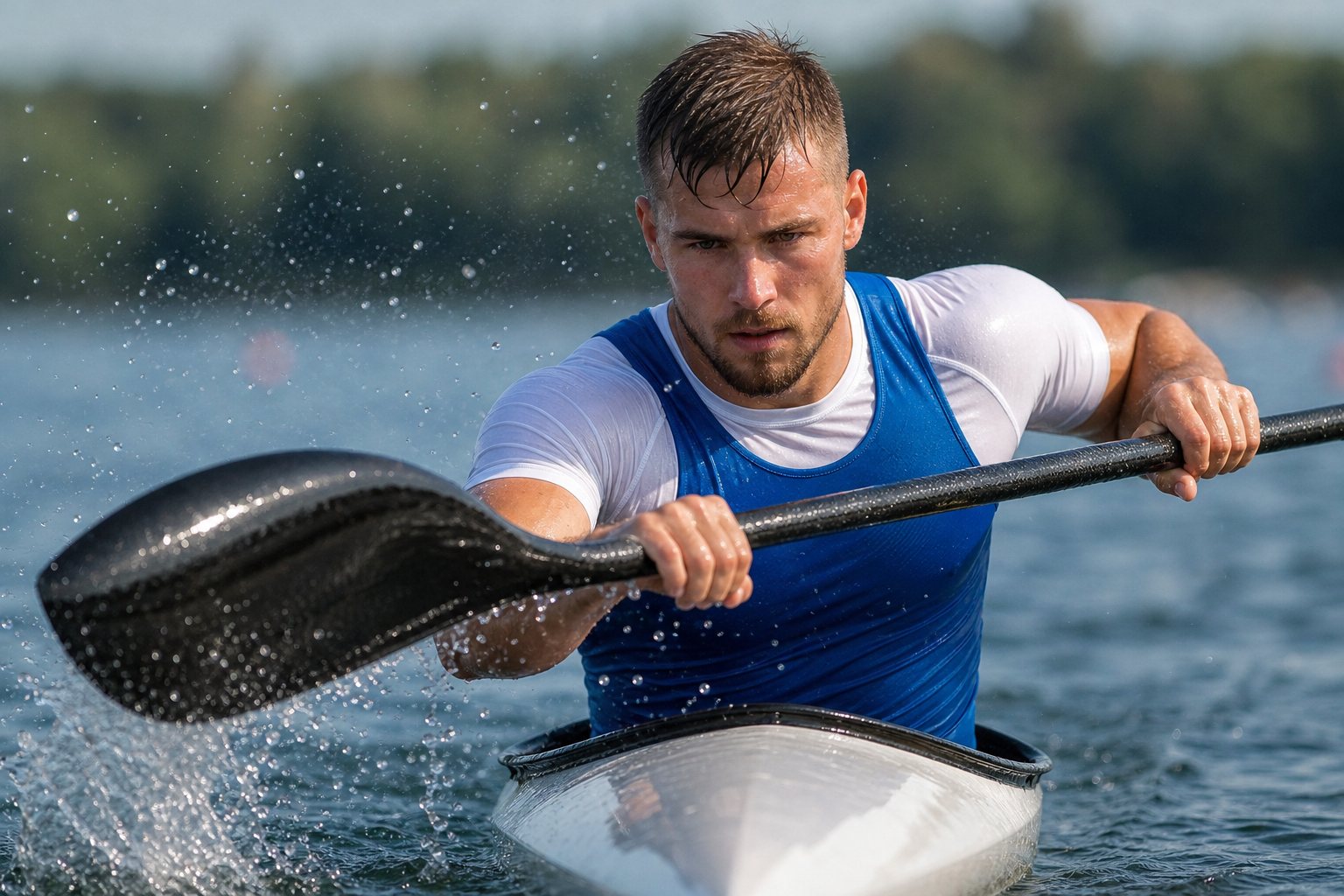
The race lasts well under a minute for most paddlers, but the work behind it is months of early starts: stroke after stroke on the water, shoulder and trunk work in the gym, and the honest question after a hard week of whether the body is ready for more. Para canoe training is the planned mix of paddling, strength, conditioning and rest that prepares an athlete for a 200-meter sprint. It has to be built around the athlete’s class, impairment and health, which is why a coach who knows both paddling and the athlete matters more than any template.
Quick answer: Para canoe is a 200-meter sprint driven by the shoulders, arms and trunk, so training usually combines on-water technique and sprint work, upper-body and trunk strength, aerobic conditioning and planned rest (Fletcher and colleagues 2021 review; IPC). Research on Para canoe training itself is thin, so most advice comes from related sports and from IOC load-management guidance. Plan with a coach and a clinician who know your impairment, and see a sports medicine doctor, physical therapist or athletic trainer if pain persists or you have any health concern before increasing load.
General information, not medical advice. This page covers building fitness. Rules are on our rules page, health on injury prevention and injuries, and day-after care on recovery.
What a 200-meter race demands
A 200-meter race is short and all-out: a fast start, a high stroke rate and a finish where little is left. The stroke is driven by shoulders, arms and trunk, and a 2021 narrative review of Paralympic biomechanics (Fletcher and colleagues, Sports) says sitting sports like canoeing and kayaking should focus on specific sitting positions, such as grip or seat configuration, and on ways to reduce drag. The IPC and USOPC class descriptions point the same way: the more trunk and leg function a paddler has (KL3), the more of the body can join the stroke, while KL1 paddlers rely mainly on the arms and shoulders.
How results look supports the idea that classes are still developing. A 2024 study of 628 200-meter kayak results from nine competitions between 2015 and 2023 (Ribeiro Neto and colleagues, Perceptual and Motor Skills) found times fell over the years in most classes, KL1 was slower than KL2 and KL3, and race times were more variable in the classes with more impairment. The authors read this as an early development stage for KL1 in particular. It is a reminder that a KL1 paddler is not behind; the pool of coaches and athletes is just newer.
The building blocks
- On-water technique and sprint work. Sitting position, seat and grip fit and stroke efficiency are skills that improve with repetition and with a coach watching. Short, hard sprints practice the race pattern; easier paddling builds the base. This is common coaching practice rather than a Para-canoe trial result.
- Trunk strength and stability. A 2026 study of 32 seated para-athletes (Lund Ohlsson and colleagues, Frontiers in Sports and Active Living) found that higher manual-muscle-test scores for the trunk and hips went with greater isometric trunk strength in every direction tested. A 2019 randomised trial of a six-month trunk program in 103 young kayak-canoe athletes (Kiss and colleagues) reported better abdominal and back muscle strength, flexibility and posture in the program group. That trial was not in Para athletes, so use it as a clue, not a prescription.
- Shoulder strength and balance. Paddling asks a lot of the shoulders. A 2023 study of 21 canoeists (Krzykała and colleagues, PLoS One) found left-right asymmetries in the arms in all parameters measured. A coach or therapist can look for imbalances, but only after assessing your own body.
- Aerobic base and general fitness. WHO guidelines cover adults living with disability, and the 2018 evidence-based exercise guidelines for adults with spinal cord injury (Martin Ginis and colleagues, Spinal Cord) set specific weekly doses for aerobic and strength work; ask your clinician for the current numbers that apply to you.
A sensible weekly shape
No published weekly template exists for Para canoe, so here is the shape most plans share rather than a prescription. A week usually mixes a few kinds of sessions: technique-focused paddling, harder sprint or interval sessions, strength and trunk work, easier aerobic work and real rest. Hard days are separated by easier days, and the loads that change are watched carefully. The IOC consensus statement on load in sport and risk of injury (Soligard and colleagues 2016, British Journal of Sports Medicine) names rapid changes in training and competition load as a risk factor and gives guidelines for prescribing and monitoring load. Its companion on illness (Schwellnus and colleagues 2016) links poorly managed load with acute illness and overtraining. In practice, that means raising volume and intensity gradually, not both at once, and tracking how you feel.
Periodisation basics, honestly stated
Coaches often divide the year into phases: a base period, a build toward racing, a short sharpening phase and a taper before a target event, with a planned easier period afterward. This is standard coaching practice, but we found no Para canoe study testing a specific model. A 2026 systematic review of Para sport training and health (Choudhary and colleagues, Sports) covered 22 studies, mostly wheelchair court sports, and concluded that individualised assessment and workload monitoring are provisional practice considerations because the evidence is small and varied. Treat every plan as a draft to adjust.
Watching the signals
A 50-week study of 61 Para athletes in four sports in Brazil (Madaleno and colleagues 2026, BMJ Open Sport and Exercise Medicine) asked athletes about stress, sleep, soreness and fatigue every day. High stress in a week went with 1.73 times the odds of a gradual-onset injury the next week, and high fatigue with nearly twice the odds of a substantial gradual-onset injury. None of the four sports was canoe, and associations are not proof of cause. Still, a short daily note on sleep, stress and fatigue is a cheap way to spot a pattern to share with a coach.
Health factors that shape training
Impairment can change how the body handles training. Paralympic heat reviews (Griggs and colleagues 2020, Temperature) describe that sport, impairment and class can all affect heat strain, and that cooling and acclimatisation may help vulnerable athletes. Athletes with spinal cord injury should also talk to their doctor about autonomic function and skin care before raising load. Our nutrition page covers heat and fuel, and the mental training page covers race preparation.
Para canoe training FAQs
How many days a week should a Para canoe athlete train?
There is no sourced number for Para canoe. The right amount depends on class, health, experience and the rest of your life. Start with what a coach and clinician advise, and add load gradually, following the IOC load guidance.
Do KL1 paddlers train differently from KL3 paddlers?
They usually share the same building blocks, but the way power is produced differs, because KL1 relies on arms and shoulders and KL3 can use more trunk and hip drive. A coach experienced with your class should set drills and strength work.
Is there a Para canoe study I can follow?
Not a training study. The research we found covers race-time trends (Ribeiro Neto 2024), injuries in non-Para paddlers and general Para sport health. We have marked these limits in our sources.
Do I need a gym to train for Para canoe?
Strength work for the shoulders and trunk is common, and can be done in a gym, at home or in a club space with adapted equipment. Ask a physical therapist or trainer to adapt exercises to your impairment.
How soon should I add speed work?
Many coaches introduce short sprints once technique and base fitness are comfortable. We did not find a Para canoe source for the timing, so decide with your coach.
Sources
- IPC: Para canoe
- USOPC: Paracanoe
- Ribeiro Neto F et al. 2024, Paralympic versus Olympic canoe sprint, 200 m kayak, Perceptual and Motor Skills (PubMed)
- Fletcher JR et al. 2021, biomechanics and Paralympic athletes, Sports (PubMed)
- Lund Ohlsson M et al. 2026, isometric trunk strength in seated para-athletes, Frontiers in Sports and Active Living (DOI)
- Kiss RM et al. 2019, trunk prevention program in kayak-canoe athletes, randomized trial (PubMed)
- Krzykała M et al. 2023, canoeists, asymmetry and postural stability, PLoS One (PubMed)
- Goosey-Tolfrey V et al. 2018, development of scientific exercise guidelines for adults with spinal cord injury, Br J Sports Med (PubMed)
- Soligard T et al. 2016, IOC consensus statement on load in sport and risk of injury (PubMed)
- Schwellnus M et al. 2016, IOC consensus statement on load in sport and risk of illness (PubMed)
- Choudhary PK et al. 2026, Para sport systematic review, Sports (DOI)
- Madaleno F et al. 2026, stress, sleep, fatigue and soreness in Para athletes, BMJ Open Sport Exerc Med (DOI)
- Griggs KE et al. 2020, heat-related issues for Paralympic athletes, Temperature (PubMed)
General information for education only, not medical advice. It does not replace a sports medicine doctor, physical therapist, athletic trainer or a classifier who knows your impairment. See our editorial policy for how we research and write.