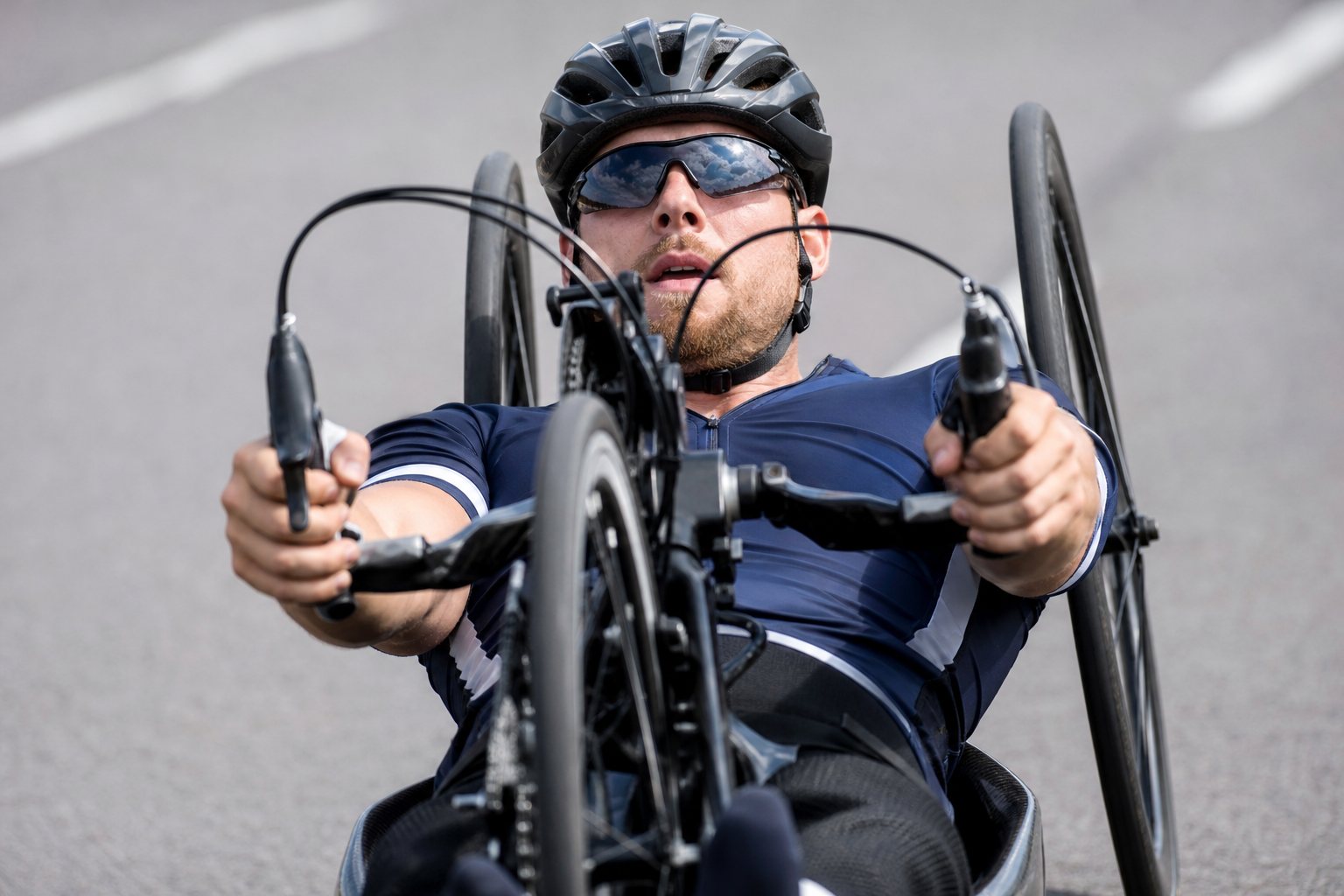
The start gate on the velodrome is a counted-down silence. At the Paris 2024 Paralympics, defending champion Kadeena Cox crashed within the first 50 metres of the women’s C4-5 500 m time trial, and Caroline Groot went on to win gold in 35.566 seconds. Mental training in Para cycling means practising the skills that help you ride your best when it matters: focus, confidence, routines, goal setting and coping with pressure and setbacks. It is a performance skill. It is separate from mental health, which we cover below.
Quick answer: Mental skills are trained like physical ones: little and often. Useful tools include process goals, a pre-race routine, imagery, helpful self-talk and a plan for setbacks. Research on Paralympic athletes is limited and mostly small studies, and no technique guarantees performance. Anxiety, depression, disordered eating or burnout are health matters for a qualified professional, not something to fix with a mental-skills routine.
General information, not medical advice. Skills here are general sport-psychology practice unless a source is named. For logistics and rules see skills and rules; sport overview: Para cycling.
What the research says
A review by Martin (2012, Clinical Journal of Sport Medicine) of mental preparation for Paralympic athletes concluded that developing mental skills can help Paralympians improve performance and that sport psychologists can help them manage Paralympic-specific stressors. Studies since then, for example psychological skills programmes with Paralympic table tennis players who have spinal cord injuries, report improved self-talk, emotion control and goal setting, though in single-case work the gains did not always carry into competition. Research on athletes with a visual impairment has found that impairment does not stop athletes using imagery and that interventions can draw on all the senses. In general, the studies are small, so the honest summary is that these skills are reasonable to try and are not proven to guarantee results.
Confidence
Confidence usually comes from preparation you can point to: sessions completed, personal bests, a tested bike setup. A simple habit is to write down three things that went well after each ride. Confidence is not the absence of nerves, and it is fine to feel nervous and ride anyway.
Focus and attention
Racing needs attention on the right cues: pedal or crank rhythm, breathing, line, the rider ahead. A cue word such as “smooth” can bring attention back after a distraction. For tandem pairs, clear communication is part of focus: the pilot calls what is ahead, and the stoker trusts and responds.
Goal setting and motivation
Three kinds of goals are common in sport psychology: outcome goals (a placing), performance goals (a time or power number) and process goals (what you do, such as holding a steady cadence on climbs). Process goals are the ones you control most. Break a season goal into steps, review them monthly, and revise them after illness, injury or a classification change. Motivation often comes from enjoyment and meaning, such as friends, adventure and independence, not only medals.
Imagery and visualisation
Imagery means rehearsing a ride in your mind using as many senses as you can: what you see, hear, feel through the bars or pedals. A review of Paralympic psychological work suggests imagery is most useful alongside other skills such as self-talk and routines rather than alone. Visually impaired athletes can use sound, touch and movement feel. Ten minutes a few times a week is typical coaching practice.
Pre-race routines
A routine is a short, repeatable sequence that gets you ready: for example, the same warm-up, a few breaths, a cue word and a check of equipment. Build it in training and use it before races so that it is automatic when you are nervous. For the practical side of race preparation, such as classification timing, equipment checks and travel, see our rules and getting started page. Allow time for classification if it is part of the event, since your class can be reviewed.
Handling pressure and setbacks
Pressure is normal. Useful responses include slow breathing, focusing on the next pedal stroke instead of the result, and having a plan if something goes wrong (a mechanical problem, a crash, a missed start). After a setback, give yourself a short time to react, then ask what is in your control and what the next step is. Injury and illness can be setbacks too: see injuries and be patient with your return.
Tactics and teamwork
Road racing and track events involve pacing, positioning and drafting where the rules allow. On tandems, pilot and stoker are a team: agree signals, roles and what each will do when something goes wrong. Team sprint and relay events add handover practice. Coaches can design race plans for each class.
Mental health is separate
Anxiety, depression, disordered eating, sleep problems, substance misuse and burnout are health issues. The IOC’s 2019 consensus statement on mental health in elite athletes (Reardon and colleagues, British Journal of Sports Medicine) reports that symptoms and disorders are common, from about one in five for alcohol misuse to as many as one in three for anxiety or depression in elite athletes overall, and notes that data on Para athletes are particularly sparse. The 2025 Para-cycling study found that tracking well-being along with training is feasible and was recommended as part of health monitoring.
If you are struggling, talk to a doctor, a psychologist or counsellor, ideally one with sport experience. In the US you can call or text 988, the Suicide and Crisis Lifeline, any time; elsewhere, use your local emergency or crisis line. The Association for Applied Sport Psychology lists sport psychology resources. Mental skills training can sit alongside treatment but does not replace it.
Para cycling mental training FAQs
Do mental skills really improve performance?
Research on Paralympic athletes is small and mixed, and results differ by athlete. Skills are worth practising, but nothing is guaranteed.
How do I stop pre-race nerves?
You may not remove them. Slow breathing, a routine and a focus on the next task can help you ride with them.
Is imagery useful if I cannot see?
Yes. Research on athletes with a visual impairment shows imagery can draw on all the senses.
Should my coach be part of this?
Many coaches build mental skills into sessions, and a sport psychologist can add specialist support.
When should I see a professional?
If worry, low mood, eating concerns, poor sleep or exhaustion last or affect daily life, see a doctor or mental health professional.
Sources
- Martin 2012: Mental preparation for the Paralympic Games (Clinical Journal of Sport Medicine)
- Applications of psychological skills training for Paralympic table tennis athletes
- Mental imagery in athletes with visual impairment (PMC6028204)
- Reardon et al. 2019: IOC consensus statement on mental health in elite athletes (BJSM)
- Injury and Illness Surveillance in Para-Cycling, Sports 2025
- 988 Suicide and Crisis Lifeline
- Association for Applied Sport Psychology: resources
This page is general information for education only, not medical advice or mental health care. See our editorial policy. More: recovery, all sports.