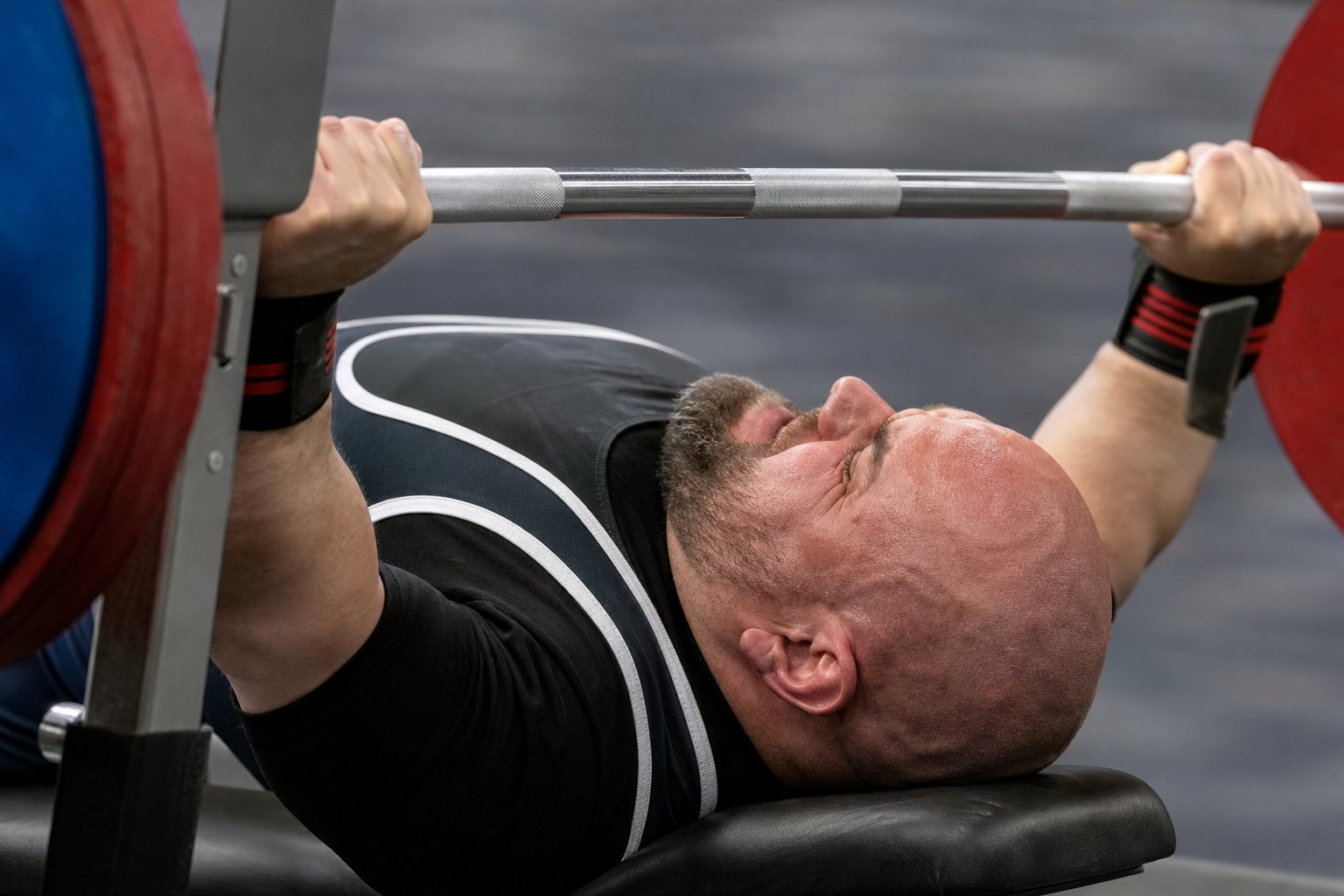
Saturday evening after a competition or a heavy session: the shoulders feel dense, the house is quiet, and the real question is how to be ready for Tuesday’s bench. Para powerlifting recovery is everything that helps an athlete absorb training: sleep, a sensible week, mobility work, food and fluids, and the judgment to tell normal soreness from an injury. This page covers what the sources say, and says plainly where the evidence is weak.
Quick answer: The best-supported recovery tools are the simple ones: regular sleep (adults need seven or more hours, per the AASM and SRS consensus), a week that does not stack heavy arm loads on top of each other, and watching fatigue and stress. In a study of the Brazilian national Para powerlifting team, sleep duration was the variable most consistently linked to performance change. Massage had the strongest evidence for soreness in a large review, but evidence for many gadgets is mixed. See a sports medicine doctor, physical therapist or athletic trainer for pain that does not settle.
General information, not medical advice. Start at the hub. Injuries are on the injuries page and training on the training page.
Sleep comes first
The American Academy of Sleep Medicine and the Sleep Research Society (Watson and colleagues, 2015) recommend that healthy adults sleep seven or more hours a night for good health. For lifters, a 2026 study (Giacomini and colleagues) followed 24 athletes from the Brazilian national Para powerlifting team across a competitive cycle. Sleep duration was the only variable that consistently differed between athletes whose performance matched or improved and those whose did not: those who matched or improved showed greater sleep stability. The authors urged caution because of the small sample, and it does not prove that sleep causes better lifts, but it supports protecting a regular sleep schedule. Disrupted sleep may also be more complicated for athletes with some impairments or pain; ask your medical team.
Manage load across the whole week
In a 50-week study of 61 Brazilian Para athletes, including powerlifters (Madaleno and colleagues, BMJ Open Sport & Exercise Medicine), high stress was linked to 1.73 times the odds of a gradual-onset injury the next week and high fatigue to 1.99 times the odds of a substantial one. A simple daily check (sleep, stress, fatigue, soreness, one to five) is general practice that makes these signals visible. If you use your arms for wheelchair pushing and transfers, count those as load: a heavy bench day followed by a demanding transfer day is not a rest day for the shoulders.
- Plan the hard days. Keep heavy bench sessions apart and put lighter work between them (general practice).
- Take a lighter week. Many programs include an easier week every few weeks; ask your coach how it fits your schedule (general practice).
- Rest after the meet. Allow time after competition before the next heavy block.
Mobility and flexibility
We found little research on mobility for Para powerlifters. Puce and colleagues’ 2022 scoping review counted five studies on recovery strategies out of 37, and the 2025 Silverthorne review calls for more research overall. Common practice is gentle shoulder, chest and upper-back mobility work and easy movement on rest days, adapted to your impairment and range of motion. If you have limited passive range, hypertonia or spasticity, ask a physical therapist what is safe for you before you stretch.
Recovery methods: what the evidence says
A large review (Dupuy and colleagues, 2018, Frontiers in Physiology) pooled 99 studies and found that active recovery, massage, compression garments, immersion, contrast water therapy and cryotherapy produced small to large reductions in delayed-onset muscle soreness, while other methods such as stretching showed no change; massage was the most powerful for soreness and fatigue. Two cautions: these were mainly studies of non-Para populations and measures of soreness and blood markers, not lifting performance. A foam roller or massage tool is a comfort choice, not a proven fix. Our gear page lists a roller with the same caution.
Heat and cold. Paralympic.org’s nutrition tips warn lifters with a spinal cord injury to be cautious with hot baths or saunas. If you have reduced sensation or heat regulation, check with your doctor before using heat, ice or cold immersion; we did not find a Para-specific guideline.
Soreness or injury?
General practice: muscle soreness is usually spread across a muscle group, appears a day or two after new or heavy work and eases as you move. Warning signs of something else include sharp pain in one spot, pain at rest or at night, numbness or tingling, swelling, or a drop in your strength that lingers. When in doubt, stop and ask a clinician.
Fuel and fluids
Recovery also depends on eating and drinking enough. Practical tips are on our nutrition and athlete health page.
Frequently asked questions
How much sleep do I need?
The AASM and SRS consensus says healthy adults should sleep seven or more hours per night. Individual needs vary, so ask your doctor if you are always tired.
Is massage worth it?
In the 2018 Dupuy review, massage was the strongest method for soreness and fatigue, but most of the studies were not in Para athletes and measured soreness, not lifting performance.
Should I stretch every day?
The same review found no change in soreness from stretching. Gentle mobility can feel good, but the right amount depends on your impairment; ask a physical therapist.
How long should I rest between bench sessions?
We found no sourced number for Para powerlifters. Many lifters allow a day or more between heavy sessions; your coach should set it with you.
Can I use ice or a sauna?
If you have a spinal cord injury or reduced sensation, check with your doctor first. Paralympic.org advises caution with hot baths and saunas for these athletes.
Sources
- Watson et al. 2015, AASM and SRS consensus: recommended sleep for a healthy adult (PMID 26039963)
- Giacomini et al. 2026, health and performance in the Brazilian national Para powerlifting team (PMID 42074398)
- Madaleno et al. 2026, daily stress, sleep, fatigue and soreness in Para athletes (PMC/Europe PMC record)
- Puce et al. 2022 scoping review of Paralympic powerlifting (PMID 36421643)
- Dupuy et al. 2018, post-exercise recovery techniques, systematic review with meta-analysis (PMID 29755363)
- Silverthorne et al. 2025 scoping review (PMID 40924269)
- Paralympic.org: Elizabeth Broad, five nutrition tips for powerlifters (2014)
General information for education only, not medical advice. It does not replace a sports medicine doctor, physical therapist, athletic trainer or your classifier. See how we research our pages in our editorial policy. Back to the Para powerlifting hub, the sports index and the standard sport’s powerlifting guide.