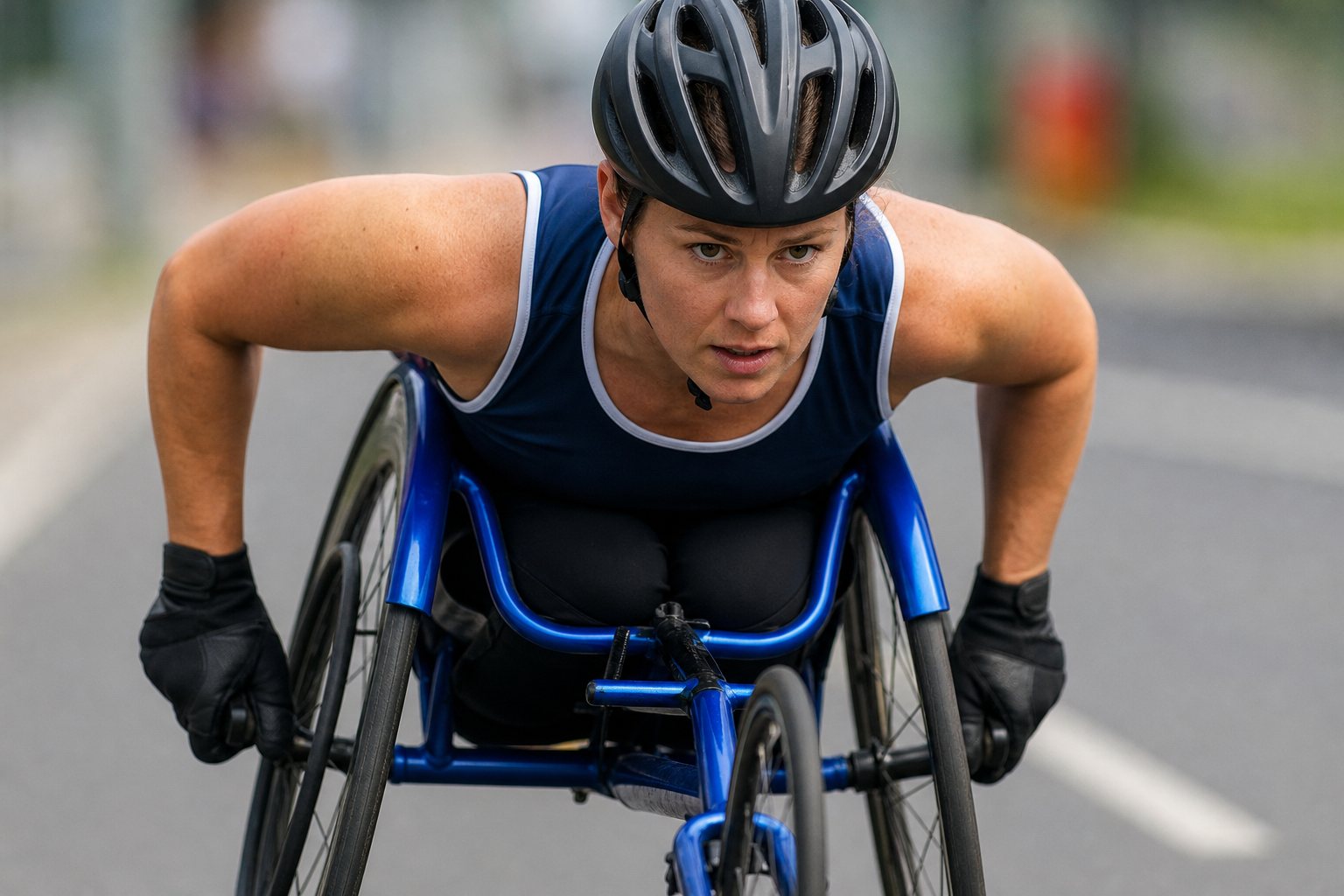
A wheelchair triathlete finishes a long handcycle interval, transfers to a racing chair, and pushes for ten minutes with arms that are already tired. That one session captures the training puzzle of Para triathlon: three endurance sports, one set of muscles in many classes, and very little published research to tell a coach exactly how to balance them. This page explains the physical demands, a sensible weekly shape, strength and skills work, and the basics of planning a season, and it says plainly where the evidence is thin.
Quick answer: Para triathlon asks for aerobic endurance in three sports plus smooth transitions. In wheelchair classes almost all the work comes from the upper body, so strength, shoulder health and equipment set-up matter as much as fitness. Reviews of handcycling suggest combining strength and endurance work in planned blocks, but they call this a suggestion based on limited evidence. Build gradually with a coach who knows your class, and see a sports medicine doctor, physical therapist or athletic trainer if pain persists.
General information, not medical advice. The race itself is explained on the rules page, and how to lower injury risk on the injury prevention page. Back to the Para triathlon hub.
What the sport demands
Paratriathlon is a sprint-distance endurance event, and what moves you changes with your class. A 2022 case report in Frontiers in Rehabilitation Sciences on a wheelchair triathlete notes that swimming, handcycling and wheelchair racing place substantial demands on the upper extremity, and that knowledge about testing and training is needed to improve performance and avoid overuse injuries. Standing athletes may race with a prosthesis, one arm or one leg, and PTVI athletes add the skill of racing as a pair with a pilot or guide. Because the sport is three disciplines, a coach who knows your impairment helps you share the load among them. The physiology of handcycling is the best studied part, and the next section summarizes it.
What handcycling research says
Two narrative reviews cover handcycling. Nevin and colleagues (International Journal of Sports Physiology and Performance, 2022) list equipment set-up, individual physiology and training history as the main determinants, and name power at a fixed blood lactate of 4 mmol per litre, relative oxygen consumption, peak aerobic power, relative upper-body strength and maximal anaerobic power as key physiological factors. They also say seat position, crank height, crank length and handgrip position each need individual configuration. Stephenson and colleagues (Scandinavian Journal of Medicine and Science in Sports, 2021) report that much of the aerobic data comes from trained male athletes in the H3 and H4 handcycling classes, so knowledge about other classes and about women is limited. Both reviews call for longer studies across all classes.
A sensible week
No published study gives a weekly schedule that fits all Para triathletes, so the shape below is general coaching practice, not research-based prescription. Adjust it with your coach, your doctor and your class.
- Swim, 2 to 3 sessions: mostly easy aerobic swimming with technique work; one session in open water when conditions and a buddy allow.
- Bike (handcycle, tandem or adapted bike), 2 to 3 sessions: one longer steady ride, one with intervals or threshold work, and short skills sessions for cornering and braking.
- Run or racing chair, 2 sessions: an easy session and a quality session, with one “brick” (bike then chair or run) every week or two in the build phase, so legs and arms learn the switch.
- Strength, 1 to 2 sessions: shoulder, upper-back and trunk work for wheelchair athletes, leg and trunk work for standing athletes, sized to your classification and doctor’s advice.
- Rest and easy days: at least one full rest day, and a lighter week every third or fourth week.
One elite example shows what high-level volume looks like, with caution because it is a single athlete. Quittmann and colleagues followed a wheelchair triathlete with a spinal cord injury over a Paralympic cycle: annual training load rose from 414 to 604 hours over two years, and the share of low-intensity training rose from 77 percent to 88 percent. The authors note that load in training camps was higher than in earlier studies and brought physical stress, and they conclude that careful prescription and monitoring are needed to avoid non-functional overreaching. This is not a target for beginners.
Strength, conditioning and skills
- Upper-body strength: Nevin’s review lists relative upper-body strength as a performance factor and suggests concurrent strength and endurance work in block periodization (endurance, threshold, interval and strength blocks). The authors present this as a suggestion from limited evidence.
- Trunk and balance: core work supports swimming, cycling position and pushing. Exact exercises depend on your impairment; ask a physical therapist.
- Transitions as a skill: Paralympic.org says transition time can significantly affect the result, so rehearse exits, chair or bike changes and prosthesis fitting with your handlers or guide. This is a coaching habit, not a measured protocol.
- Heat training: Stephenson and colleagues found that a mixed heat acclimation protocol lowered core temperature by about 0.27 degrees C and raised plasma volume in Para triathletes (summarized by the Gatorade Sports Science Institute). Plan any heat work with your medical team, especially after spinal cord injury (see the nutrition page).
Planning a season
The usual endurance pattern, general to all sports and not Para-specific, is a base phase of mostly easy volume, a build phase with threshold and race-pace work, and a short taper before the key race. Put a lighter week every few weeks, add intensity only after you can handle the volume, and schedule recovery as seriously as training (see the recovery page). Heart-rate zones and power targets from able-bodied athletes may not apply, because spinal cord injury can change heart-rate response; the case report above used handcycle lactate tests to set zones, and a coach with Para experience can help you choose a method.
Related: Para swimming, Para cycling, Para athletics, and the standard-sport triathlon guide.
Para triathlon training FAQs
How many hours a week should a beginning Para triathlete train?
No source gives a universal number. Start with the volume you can recover from, add gradually, and ask a coach who understands your class. The elite example above reached hundreds of hours a year, which is not a beginner target.
Do wheelchair triathletes need strength training?
Handcycling reviews list relative upper-body strength as a performance factor and suggest combining strength and endurance work, but the authors call this a suggestion from limited evidence. Choose exercises with a physical therapist.
Can I use normal heart-rate zones?
Not always. Spinal cord injury can change heart-rate response, so ask your coach or doctor. The case report above set zones from handcycle lactate testing.
How do I practice transitions?
Rehearse the whole sequence with your handlers or guide, including exiting the water, changing equipment and fitting a prosthesis if you use one. Paralympic.org says transitions can significantly affect total time.
Is heat training safe?
It can help, according to a study of Para triathletes, but heat illness is a real risk, especially after spinal cord injury. Plan it with your medical team.
Sources
- Nevin et al., The science of handcycling: a narrative review (Int J Sports Physiol Perform 2022, doi 10.1123/ijspp.2021-0458)
- Stephenson et al., Physiology of handcycling: a current sports perspective (Scand J Med Sci Sports 2021, doi 10.1111/sms.13835)
- Quittmann et al., training monitoring of a triathlete with spinal cord injury (Front Rehabil Sci 2022)
- Gatorade Sports Science Institute, Thermoregulatory challenges in para sport (SSE 259)
- Paralympic.org: Introduction to Para triathlon, Paris 2024
General information for education only, not medical advice. It does not replace a visit with a doctor, physical therapist or athletic trainer. See how we write and check our pages in our editorial policy.