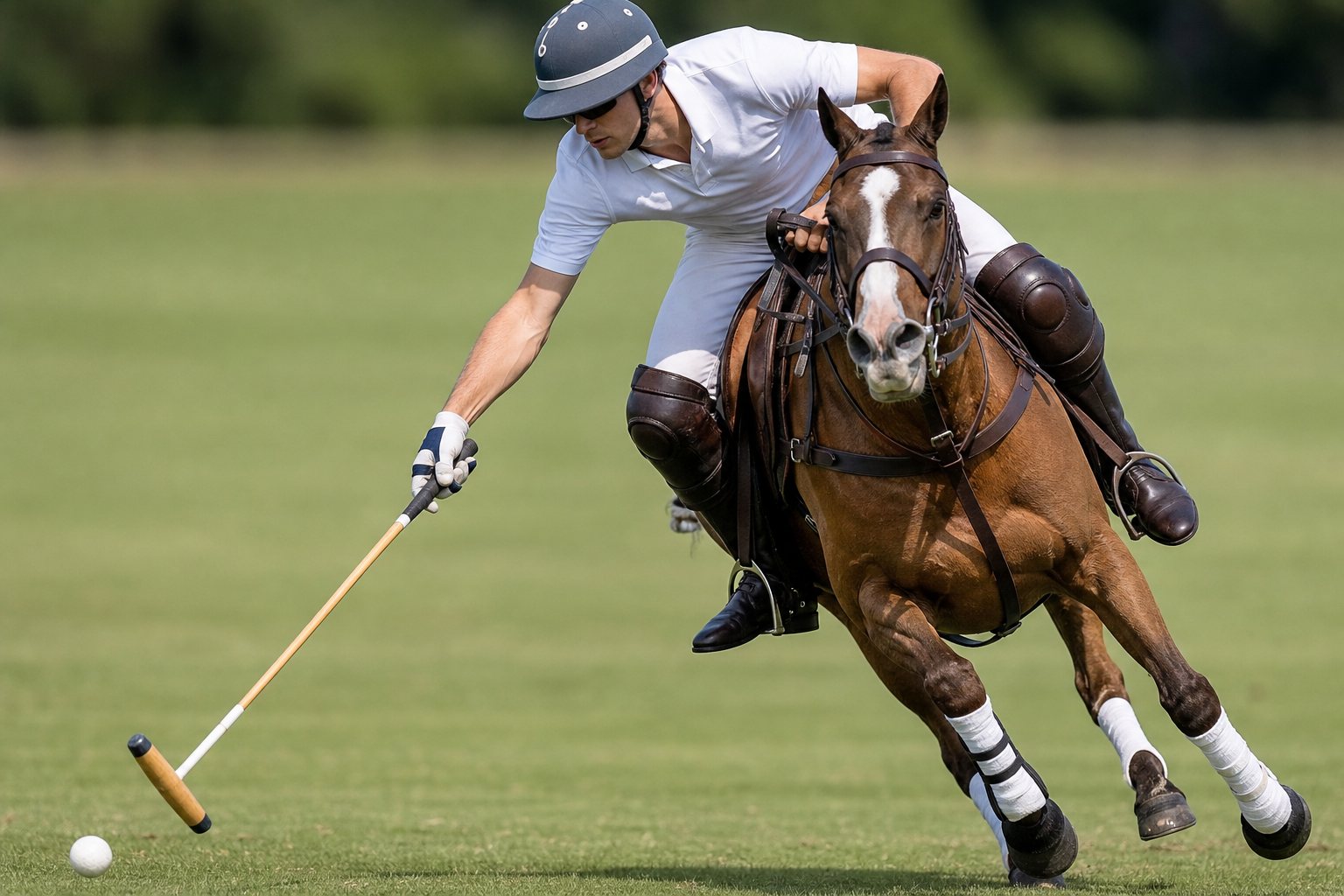
A rider tightens the chin strap, checks that the goggles sit under the helmet brim, and rides out to warm up before the first throw-in. Polo injury prevention is the set of habits around that moment: protective gear that meets the right standard and fits, a warm-up, fitness, a sensible build-up of intensity, safe ground, and the right to stop when something is wrong. No habit removes the risk in a sport with galloping horses, a hard ball and swinging mallets; the aim is to lower it.
Quick answer: The best-supported steps for polo are a helmet that meets your association’s standard (the USPA requires NOCSAE ND050), eye protection (the 2026 English injury study advises making it compulsory), good ground, fitness and gym work, and an ambulance and first-aid plan on site. Most polo research is surveys, so nothing here is a guarantee. Stop and see a sports medicine doctor, physical therapist or athletic trainer for pain that persists, and call emergency services for a head injury with danger signs.
General information, not medical advice. This page is about lowering risk. Injury patterns and rehabilitation are on our polo injuries page, so we do not repeat them. Start at the polo hub.
Know the risk first
Surveys point to falls as a main driver. In a survey of UK players (Sports Medicine Open 2015, 112 players), 58 percent reported falling and 17.3 percent had an injury needing a hospital visit; falls multiplied the odds of injury. A 2026 study of accident reports from 26 English clubs found limb injuries most common, and eye injuries the most common reason for hospital treatment. Prevention targets these: staying on the horse, protecting the head and eyes, and reducing contact risk.
Warm-up
We found no published polo-specific warm-up programme. General practice, borrowed from other sports and labelled as such, is to prepare your own body (a few minutes of easy movement, hips, trunk, shoulders and wrists through full range) and your horse (walking and trotting before cantering and hitting) before play. Ask your coach what is usual at your club.
Technique and rules that protect you
Riding skill is injury prevention. Learn to stay balanced and to control your horse before attempting match play (see skills and rules). The rules themselves are safety rules: the Museum of Polo and Hall of Fame says the angle of a bump must be 45 degrees or less and shrinks as horses go faster, and left-handed play is banned to prevent head-on collisions. Respect the line of the ball; most dangerous play involves crossing it.
Build load gradually
A survey of UK players linked pre-season rider and horse training to more injuries in that sample, and a higher handicap goal to more. Surveys cannot prove why, but it fits a general rule used in coaching (not a polo study result): increase chukkers, intensity and horses slowly, particularly at the start of a season or when stepping up a level. See training.
Strength and conditioning
A 2025 meta-analysis of randomized trials in contact sports (Chen and colleagues) found strength-based prevention programmes lowered injury risk (relative risk 0.70). It did not include polo, so it is general support. In the UK polo survey, players who did gym exercise had lower odds of a hospital-treated injury (odds ratio 0.1). Wrist supports were also linked to fewer injuries (odds ratio 0.2), but the authors said their effect needs testing.
Ground, weather and the horse
Polo horses and riders share the same surface. A 2025 survey of 145 polo players (Animals) found unfavourable ground conditions were the most common cause of horse injury, cited by 58.6 percent. A horse that stumbles can bring a rider down. Heat is another factor: the CDC says people exercising in heat should hydrate before they are thirsty, schedule hard work in cooler parts of the day, build up gradually and stop if faint or weak. Our recovery and nutrition pages cover cooling and fluids.
Protective equipment and fit
- Helmet. The USPA says players’ helmets must be certified to NOCSAE ND050, the standard written for polo, since May 1, 2021 (check the current rulebook for exceptions). A 2025 laboratory study in the Annals of Biomedical Engineering (Stark and colleagues) tested ten polo helmets and found a substantial range of head-acceleration results between models, even though the rank order was similar across test systems. Standards set a minimum; they do not make any helmet injury-proof. In the UK survey, 49.4 percent of players said they chose helmets by appearance. A helmet should fit snugly, sit level and be replaced according to the maker’s guidance after a significant impact.
- Eye protection. The English authors advise requiring sports glasses, goggles or face guards. NOCSAE has a separate standard for helmet-mounted polo eye protection (ND055), according to search results; ask your club what is approved.
- Kneepads, boots and gloves. The museum says kneepads protect the knees during ride-offs and bumps. Gloves help grip but are not safety equipment on their own. See gear.
Maker claims about “advanced” protection are not the same as a certified standard; look for the standard name on the product.
Youth
The USPA says some variances to its helmet rule exist, including for small-headed young players aged 13 and under in some circumstances, according to a search summary of its bulletin. Parents should ask the club and a qualified fitter, not guess.
What prevention cannot do
Prevention lowers risk; it does not remove it. A well-fitted helmet may reduce the force of some impacts but cannot prevent every concussion. Fitness and gym work do not stop a fall.
When to see a professional
See a sports medicine doctor, physical therapist or athletic trainer for pain that lingers after a fall, swelling, numbness or any joint that gives way. For a suspected concussion, the CDC HEADS UP guidance says the person should stop play and be checked by a healthcare provider; call 911 for danger signs such as repeated vomiting, a seizure or worsening confusion.
Polo injury prevention FAQs
Are helmets required in polo?
Yes. The USPA requires helmets with a chin strap, certified to NOCSAE ND050, for member play; check the current rule book.
Should I wear eye protection?
The 2026 English study of 236 injured players advises requiring it. Ask your club and an eye doctor about options.
Do wrist supports prevent injuries?
One survey linked them to fewer hospital visits, but the authors said this needs testing.
Does gym training help?
In one UK survey it was linked to fewer injuries; a wider meta-analysis supports strength-based programmes in contact sports.
What is the most important thing a beginner can do?
Learn to ride well, wear certified gear and play within your level.
Sources
- Ken-Dror G et al. Traumatic injuries in polo players (Postgrad Med J 2026, PMID 41263769)
- Falls and injuries to polo players (Sports Med Open 2015, PMID 27747839)
- Stark NE et al. Evaluating polo helmet performance (Ann Biomed Eng 2025, PMID 40246778)
- Chen Z et al. (Orthop J Sports Med 2025, PMID 40416997)
- Schumacher A et al. (Animals 2025, PMID 41227466)
- USPA: helmets that pass NOCSAE ND050
- NOCSAE ND050 polo helmet standard
- CDC HEADS UP: signs and symptoms
- CDC: Heat and athletes
- Museum of Polo and Hall of Fame, FAQs
General information for education only, not medical advice. It does not diagnose, treat or clear anyone to play. For your own situation, see a sports medicine doctor, physical therapist or athletic trainer. How we write and check our pages is in our editorial policy.