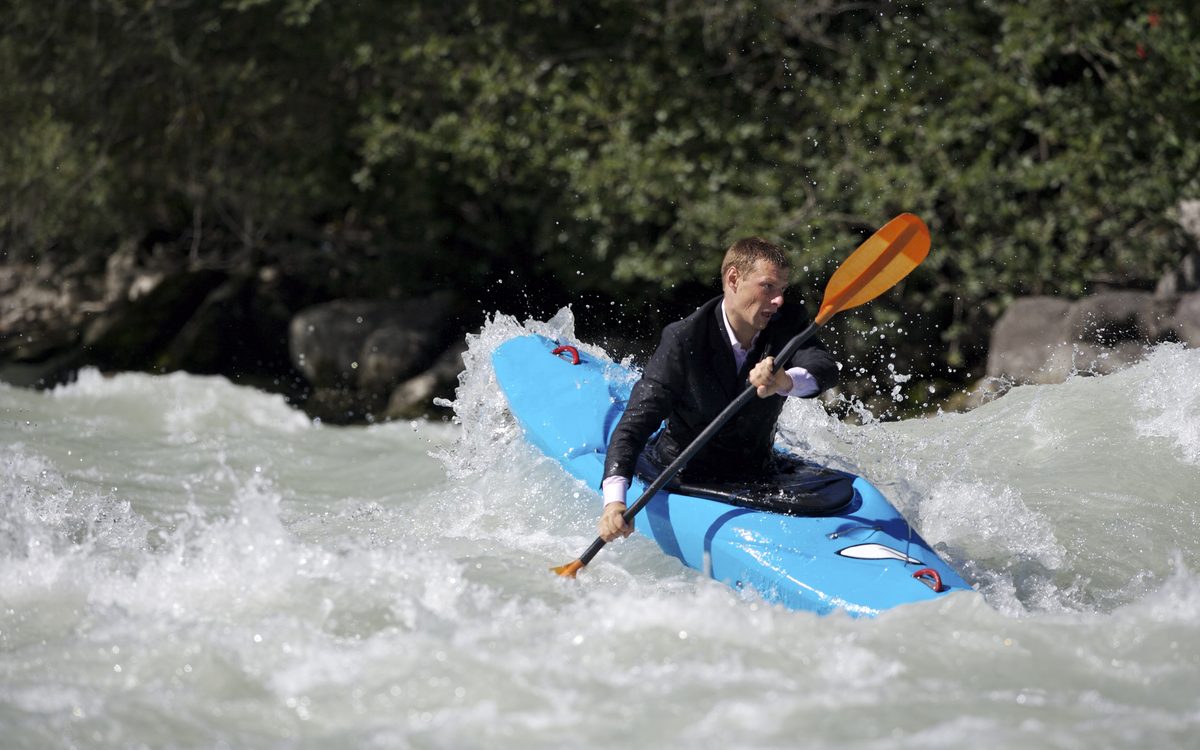
It is a cold morning at the slalom site, the water is up, and the coach has set a six-gate sequence with a hard upstream move in the middle. Run it twelve times, rest, run it again. By the end the arms are heavy and the turns still have to be clean. Canoe slalom training is the blend of boat skill on moving water, aerobic and strength work, and enough rest for it all to stick. This page covers what research on slalom athletes has found, then a sensible weekly shape. Rules are on the rules page, and the sport’s parent hub is canoeing.
Quick answer: Slalom runs last roughly 90 to 110 seconds at the top level, so the sport mixes short high-force strokes with a strong aerobic base. Research on slalom paddlers links upper-body power and aerobic fitness to performance, and finds whitewater runs harder than flatwater drills. A sensible week mixes gate work, technique, strength and easy aerobic paddling, with rest days.
What the sport asks of the body
Paddle Worldwide says leaders finish a course in about 90 to 110 seconds. In that time a paddler produces powerful strokes, turns and sprints between moves, keeps balance in turbulent water and makes decisions. A 2021 systematic review (Messias et al.) found only eight eligible studies, covering 117 male athletes. It concluded that high force development during a race is a relevant performance parameter and that aerobic metabolism is highly required and inversely related to race time, although it may not raise the chance of winning medals. In plain words: you need both power and endurance, and the science on slalom is still thin.
What tests of slalom athletes found
- National team lab tests (2025): researchers looked back over 20 years of tests on 153 national-team athletes (110 men, 43 women). In all four categories, senior athletes had higher peak power and total work in a 30-second upper-body test than juniors (Sitkowski et al.).
- Strength and medals (2020): among 43 Slovak junior and under-23 paddlers (19 slalom, 24 sprint), bench press mean power was higher in international medallists, and the authors called it a prerequisite for success. The abstract reports no medal-by-discipline interaction for running VO2max (Bielik et al.).
- Flatwater tests (2025): in 34 elite slalom paddlers, 15 m shuttle sprints with turns on flat water correlated with bench press and bench pull power and with kayak ergometer 200 m performance. The authors recommend regular off-water testing to find strengths and weaknesses (Vajda et al.).
- Body size (2024): 63 female competitors at a 2023 World Cup and ranking race were on average about 165 cm and 60 kg with about 20 percent body fat; the top 10 had the largest arm and forearm circumferences. This describes athletes, not a target to aim for (Busta et al.).
These are mostly cross-sectional studies. They show what fast paddlers have, not that training to match them makes you fast, and most data are from national-level athletes.
Whitewater is not flatwater
A 2024 study of 20 C1 athletes (Wakeling et al.) measured paddle force with sensors in the shaft. Average pull force was similar on a flatwater figure-of-eight and during whitewater race simulations, but longer pulls on whitewater produced more impulse per stroke. The authors conclude that all-out whitewater runs are more demanding than all-out flatwater trials. For training, that suggests flatwater work builds technique and fitness but should not fully replace river or course time.
The same group found paddle-force asymmetries between sides of 11 to 17 percent in K1 paddlers (42 athletes in all), and larger off-side deficits in C1 women. The study does not show asymmetry causes injury or slower times, only that both sides are worth training deliberately.
A sensible week (general coaching practice)
No published study prescribes one weekly template for slalom, so what follows is common coaching practice, not a research finding. Adjust it with your coach, and for youth keep volume modest. The American Academy of Pediatrics advises one to two rest days per week for young athletes (Brenner 2016).
- Two or three water sessions: gate sequences or race-pace runs on a course; one session of technique drills such as ferries, eddy turns and edges; and, when you can, practice on moving water.
- One flatwater or ergometer session: short intervals and turns, as in the 15 m shuttle tests above, or easy aerobic paddling.
- Two strength sessions: pulling, pressing, trunk and shoulder-stability work; see below.
- One or two rest or easy days.
Strength and conditioning
Given the research links to bench pull and bench press power, upper-body strength is a sensible focus, but a strong shoulder girdle also protects the joints. Coaches commonly pair pulling exercises (rows, pull-ups) with scapular and rotator-cuff work, and trunk rotation, because the paddle stroke is driven from the torso. Our injury prevention page explains the shoulder side. Start light, learn the lift and add load gradually.
Periodisation and load
Periodisation simply means planning the year: build fitness and strength in the off-season, add race-pace work as the season nears, then sharpen and rest before key races. The International Olympic Committee consensus on load in sport (Soligard et al., 2016) says poor load management is a major risk factor for injury and recommends monitoring training, competition and psychological load. In practice that means increasing volume gradually, tracking how hard sessions felt, and spacing hard days. Because slalom water levels and course access change the plan, many athletes keep a simple log.
Common mistakes
- Doing every session at the same medium effort.
- Skipping the off-side or switch practice in C1.
- Adding gym volume right before a race block.
- Ignoring shoulder pain that returns every week. See injuries and rehabilitation.
For recovery between sessions see recovery and mobility, and for fuel see nutrition and athlete health. Mental routines for race days are on the mental training page.
Canoe slalom training FAQs
How long is a canoe slalom run?
Paddle Worldwide says leaders finish in roughly 90 to 110 seconds. Club courses and junior courses may be shorter.
Is slalom more about strength or endurance?
Both. A 2021 review found high force development and aerobic metabolism are both relevant, with aerobic fitness linked to faster times but perhaps not to medal chances.
Can I train slalom only on flat water?
Flatwater drills build skills and fitness, but a 2024 study of C1 paddlers found whitewater runs more demanding per stroke. Ask your coach how to mix them.
How many days a week should a young paddler train?
There is no slalom-specific rule. The AAP advises one to two rest days a week for young athletes; follow your coach and your own signals.
Do I need an ergometer?
It is optional. Clubs use kayak ergometers as a test and training tool, and the 2025 study above found ergometer 200 m times related to flatwater turning tests.
Sources
- Messias et al. 2021, systematic review (PMID 34867443)
- Sitkowski et al. 2025, exercise capacity of national team athletes (PMID 40852461)
- Bielik et al. 2020, junior/U23 slalom and sprint (PMID 33551845)
- Vajda et al. 2025, on-water and off-water tests (PMID 40458483)
- Busta et al. 2024, female slalom paddlers (PMID 38444765)
- Wakeling et al. 2024, paddle forces C1 (PMID 39311275)
- Wakeling et al. 2023, paddle force asymmetries (PMID 38074336)
- Soligard et al. 2016, IOC consensus on load and injury (PMID 27535989)
- Brenner 2016, AAP overuse injuries in young athletes (PMID 27573090)
- Paddle Worldwide, canoe slalom
General information for education only, not medical advice. It does not diagnose, treat or replace care from a sports medicine doctor, physical therapist or athletic trainer. See our editorial policy for how we research and write.