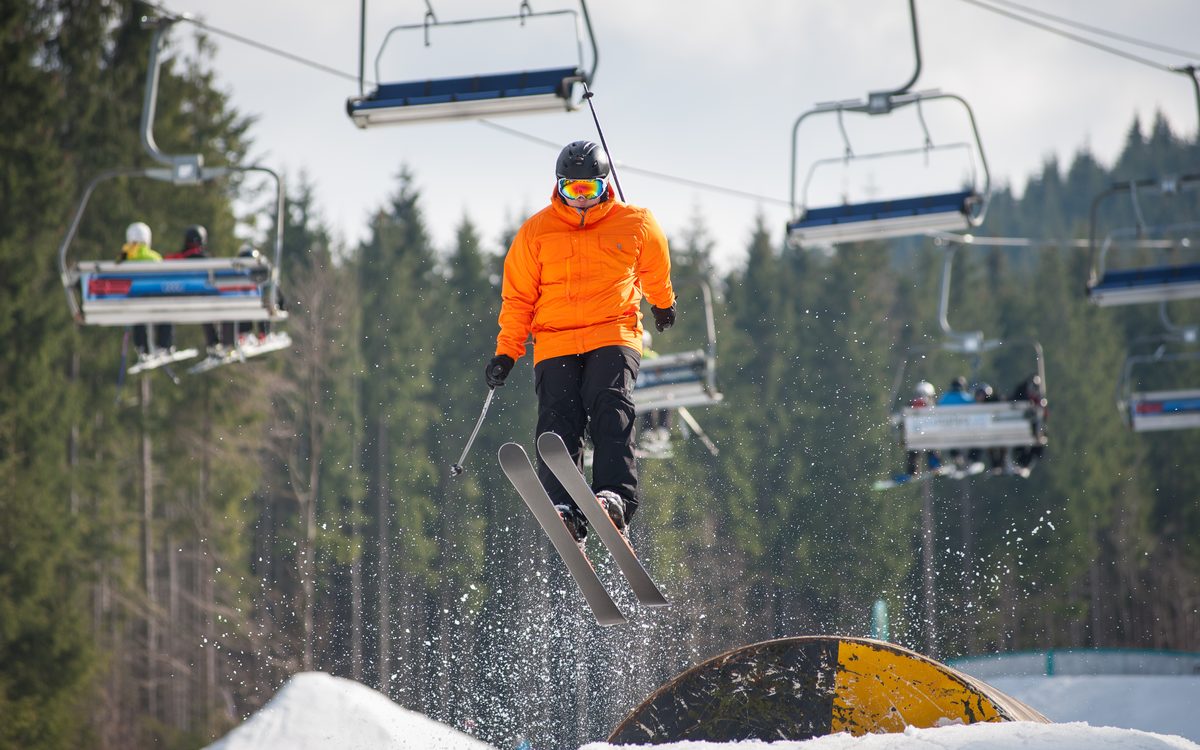
The crash is rarely dramatic from the bottom of the hill. A skier lands a little back, the skis keep going, and the knee twists. Then the patrol sled comes. Freestyle skiing injuries are the sprains, tears, fractures and head injuries that happen in moguls, aerials, ski cross, halfpipe, slopestyle and big air. This page explains the patterns the research shows, how concussion is handled, and what rehabilitation generally involves. It is information, not a diagnosis. To lower the chance of getting hurt, see our injury prevention page.
Quick answer: Research on elite freestyle skiers finds the knee is the most commonly injured body part, followed by the head, and that about a third of injuries cause more than 28 days away from sport. Concussion needs immediate stop-and-check care, and a healthcare provider decides when to return. Rehabilitation is individual: see a sports medicine doctor, physical therapist or athletic trainer, and do not rely on any universal recovery time.
What the numbers say
- World Cup freestyle (three seasons). Flørenes and colleagues interviewed World Cup freestyle skiers from 20 nations and recorded 291 acute injuries among 662 skiers: 14 injuries per 100 athletes per season. 93 (32%) were severe, meaning more than 28 days away. The knee accounted for 77 injuries (27%), 37 of them severe, and the head for 39 (13%). 36% of injuries happened in World Cup or World Championship competition, 15.6 injuries per 1,000 runs. Men and women did not differ significantly (British Journal of Sports Medicine, 2010).
- Compared with other snow sports. The same group’s comparison of World Cup disciplines found 27.6 time-loss and 14.4 severe injuries per 100 freestyle athletes per season, against 29.8 and 11.3 in alpine and 37.8 and 13.8 in snowboarding. About one in three alpine, freestyle and snowboard athletes had a time-loss injury each season, versus a low risk in Nordic disciplines (Flørenes and colleagues, 2012).
- The Olympics. At Beijing 2022, the IOC study found injury incidence of 30% in ski halfpipe, 28% in ski big air and 22% in ski slopestyle. A systematic review and meta-analysis of Winter Olympic studies reported 28.6% for freestyle aerials, with the knee, head and ankle the most common sites across all Winter Olympic sports (Wu and colleagues, 2023). Ski aerials had the highest illness incidence in Beijing, at 10%.
- Narrative review. A 2020 review of 39 studies of elite snow sport found the highest incidence in freestyle skiing, with knees the most commonly and severely injured body part, at 29.9% (Xu and colleagues).
These are elite figures from different periods, systems and definitions, so the percentages should not be compared head to head, and they are not what a recreational skier should expect. We did not find a recent public breakdown by event for moguls versus aerials versus ski cross that we could verify.
Knee injuries
The knee is the repeat finding. In World Cup freestyle skiers it was the most commonly injured body part, and many of those injuries were severe. The American Academy of Orthopaedic Surgeons (AAOS) lists ACL injuries among typical skiing injuries, along with shoulder injuries and skier’s thumb. A 2026 retrospective study of 99 Turkish national snow-sport athletes (mixed disciplines, not freestyle only) found that ankle sprain was the highest-incidence injury across most groups and that ACL rupture carried the highest burden for women (Sevindik Aktas and colleagues). Signs that need a medical check: a pop, rapid swelling, a knee that gives way or locks, or being unable to bear weight.
Head injuries and concussion
Head injuries were the second most common site in World Cup freestyle skiers (13% in the Flørenes study). Helmets lower the odds of head injury but cannot guarantee protection (see the prevention page). The CDC’s HEADS UP program lists headache, dizziness, confusion, nausea and balance problems among concussion signs. Its guidance is to remove the athlete from play and have a healthcare provider check them, and not to return until a provider says it is safe. Call 911 for danger signs: repeated vomiting, a seizure, one pupil larger than the other, a headache that gets worse, or increasing confusion.
Back, neck, shoulder and wrist
Fast landings put load on the spine, shoulders and wrists. Pain after a fall with numbness, tingling, weakness or neck pain needs urgent evaluation. The 2025 study of back protectors found no significant reduction in spinal injury among users in one hospital’s patients, so protectors are not a substitute for care (Tinner and colleagues).
How rehabilitation generally works
Your clinician sets the plan, but a few general principles show up across sources and sports medicine practice:
- It is a process, not a date. An interview study of high-performance snow sports stakeholders described return to sport as a continuous process to bring the athlete back as fast and safely as possible (Müller and colleagues, 2024).
- Steps and criteria. FIS commissioned a consensus statement on return-to-performance in competitive alpine and freestyle skiers and snowboarders (Spörri and colleagues, 2026; 23 experts, 196 statements). It was written for competitive athletes with medical teams, so recreational skiers should ask their own clinician what applies.
- Pain, swelling and strength are guides, not clocks. General practice: progress when swelling is controlled, motion has returned and strength and control match the other side, as judged by a clinician (labelled general practice).
- Confidence matters. Fear of re-injury is real; our mental training page covers the mental side.
Nobody can responsibly give a universal timetable, so we do not. If a surgeon, physical therapist or athletic trainer is guiding you, their plan for your injury overrides anything here.
When to see a professional
- Any suspected concussion, or head injury with danger signs: emergency care.
- Knee swelling, instability or locking; any suspected fracture or dislocation.
- Pain that lasts more than a few days, wakes you at night or changes how you ski.
- Neck or back pain after a fall, especially with numbness or weakness.
See also the recovery page for sleep and load management, and the freestyle skiing hub.
Freestyle skiing injuries FAQs
What is the most common freestyle skiing injury?
In World Cup freestyle skiers the knee was the most commonly injured body part, at 27% of injuries (Flørenes 2010). A 2020 review gave 29.9% for knees across elite snow sports.
How many freestyle skiers get hurt?
The 2010 study recorded 14 injuries per 100 World Cup freestyle athletes per season, and about one in three athletes had a time-loss injury in the 2012 comparison. Elite results do not apply directly to recreational skiers.
Which freestyle events have the most injuries?
At Beijing 2022 the highest incidence was in ski halfpipe (30%), ski big air (28%) and ski slopestyle (22%). We could not verify a full event-by-event comparison for moguls, aerials and ski cross.
Can I keep skiing after a head hit?
No. The CDC says anyone with a suspected concussion should stop and be checked, and a provider decides when return is safe.
How long does recovery take?
It depends on the injury, the treatment and the person. There is no universal timeline; follow your clinician.
Sources
- Flørenes et al. 2010, Injuries among World Cup freestyle skiers
- Flørenes et al. 2012, Injuries among World Cup ski and snowboard athletes
- Soligard et al., injuries and illnesses at Beijing 2022
- Wu et al. 2023, Winter Olympics injuries meta-analysis
- Xu et al. 2020, injury in elite snowsport, narrative review
- Sevindik Aktas et al. 2026, lower extremity injuries in elite snowsport athletes
- Tinner et al. 2025, back protectors and spinal injuries
- Müller et al. 2024, return to sport in high-performance snowsports
- Spörri et al. 2026, FIS consensus statement on return-to-performance
- CDC HEADS UP, signs and symptoms
- CDC HEADS UP, concussion response
- AAOS OrthoInfo, skiing injury prevention
General information for education only, not medical advice. It cannot replace a sports medicine doctor, physical therapist or athletic trainer who knows you. Read how we work in our editorial policy.