This article contains affiliate links: if you buy through them we may earn a commission, at no extra cost to you. Read our affiliate disclosure.
Myrtle Beach, South Carolina, April 2026: the final of the World’s Strongest Man, a contest that began in Hollywood, California in 1977 with Bruce Wilhelm as its first winner, according to the Strongman Archives. This year the final was won by Mitchell Hooper, with Rayno Nel second and Trey Mitchell third. Behind the TV drama is a sport that ordinary lifters compete in at local shows, with weight classes, novice divisions, teen and masters classes. Strongman (also called strongman competition; the women’s version is often called strongwoman) is a strength sport where athletes lift, carry, pull and throw heavy, awkward objects and are scored on their placing in each event.
Strongman guides: what do you need?
New to strongman? Start with the first card. Everything here is general education, not medical advice.
History & Origins of Strongman
Feats of strength have been part of fairs and festivals for a very long time, but modern strongman as a televised, multi-event sport is usually traced to the first World’s Strongest Man contest, held on 8 July 1977 in Hollywood, California, and won by Bruce Wilhelm (Strongman Archives). Unlike Olympic sports, strongman has no single world federation that we could confirm, so its history is told mostly through its events and organizers. We cover documented contests only.
In the decades since, the sport has been shaped by a handful of repeat champions from Europe, North America and beyond, and by amateur and professional organizations such as Strongman Corporation, which runs qualifying standards and pro cards in the United States (Strongman Corporation). Strongman is not an Olympic or Paralympic sport as far as we know; we did not find an IOC or IPC statement either way.
- 8 July 1977: first World’s Strongest Man contest, Hollywood; Bruce Wilhelm wins (and wins again in 1978).
- 1980 to 1982: Bill Kazmaier wins three consecutive titles.
- 1984 to 1990: Jon Pall Sigmarsson wins four titles.
- 1991 to 1996: Magnus Ver Magnusson wins four titles.
- 2002 to 2008: Mariusz Pudzianowski wins five titles.
- 2009 to 2016: Zydrunas Savickas and Brian Shaw win four titles each.
- 2021 to 2024: Tom Stoltman wins three titles.
- 2023 and 2026: Mitchell Hooper wins two titles; the 2026 final was held 26 April in Myrtle Beach.
Source: Strongman Archives, World’s Strongest Man.
Notable Athletes
Athletes with multiple World’s Strongest Man titles, from different eras, in no particular order. This is not a ranking.
- Bruce Wilhelm (USA): winner of the first World’s Strongest Man in 1977 and again in 1978.
- Bill Kazmaier (USA): three titles, 1980, 1981 and 1982.
- Jon Pall Sigmarsson (Iceland): four titles, 1984, 1986, 1988 and 1990.
- Magnus Ver Magnusson (Iceland): four titles, 1991, 1994, 1995 and 1996.
- Mariusz Pudzianowski (Poland): five titles, 2002, 2003, 2005, 2007 and 2008.
- Zydrunas Savickas (Lithuania): four titles, 2009, 2010, 2012 and 2014.
- Brian Shaw (USA): four titles, 2011, 2013, 2015 and 2016.
- Tom Stoltman (Scotland): three titles, 2021, 2022 and 2024.
- Mitchell Hooper (Canada): titles in 2023 and 2026.
Source: Strongman Archives, an independent contest archive rather than a federation.
Official results and records
Strongman has no single governing body whose results we could confirm, so we do not publish a champions or records table. For contest results see the Strongman Archives list of World’s Strongest Man contests, and for amateur qualifying standards see Strongman Corporation.
How we keep this current: we re-check facts after each major championship and update this page. Spot an error? See our editorial policy.
This page is for curious beginners, parents of teens, lifters thinking about trying a show, and fans. It covers how a contest works, how the amateur system is organised in the US, what the body is asked to do, and the injury evidence, which is honest but limited. Strongman is not an Olympic or Paralympic sport, and we found no official source saying otherwise.
Strongman at a glance
| What it is | A competition of strength events using implements such as stones, logs, yokes, vehicles and heavy carries. |
|---|---|
| How it is won | Athletes earn points based on their placing in each event; the highest total wins (Wikipedia summary). |
| Participants | Men and women, teens (19 or younger on competition day), open and novice athletes, masters 40+/50+. Strongman Corporation athletes must be at least 12; under-18s need a parent or guardian. |
| Where it is played | Gyms, outdoor lots and arenas; events at local, regional, national and professional shows. |
| Governing bodies | No single global body. In the US, Strongman Corporation runs the amateur and pro system; the World’s Strongest Man is a separate invitational contest. |
| Season | Contests are held through the year; Strongman Corporation lists qualification events for national, Arnold and teen/masters events into 2027. |
How strongman works
A contest is a series of events, each testing a different kind of strength. Typical staples from international competition include:
- **Lifts to overhead:** log press, axle press and Viking press.
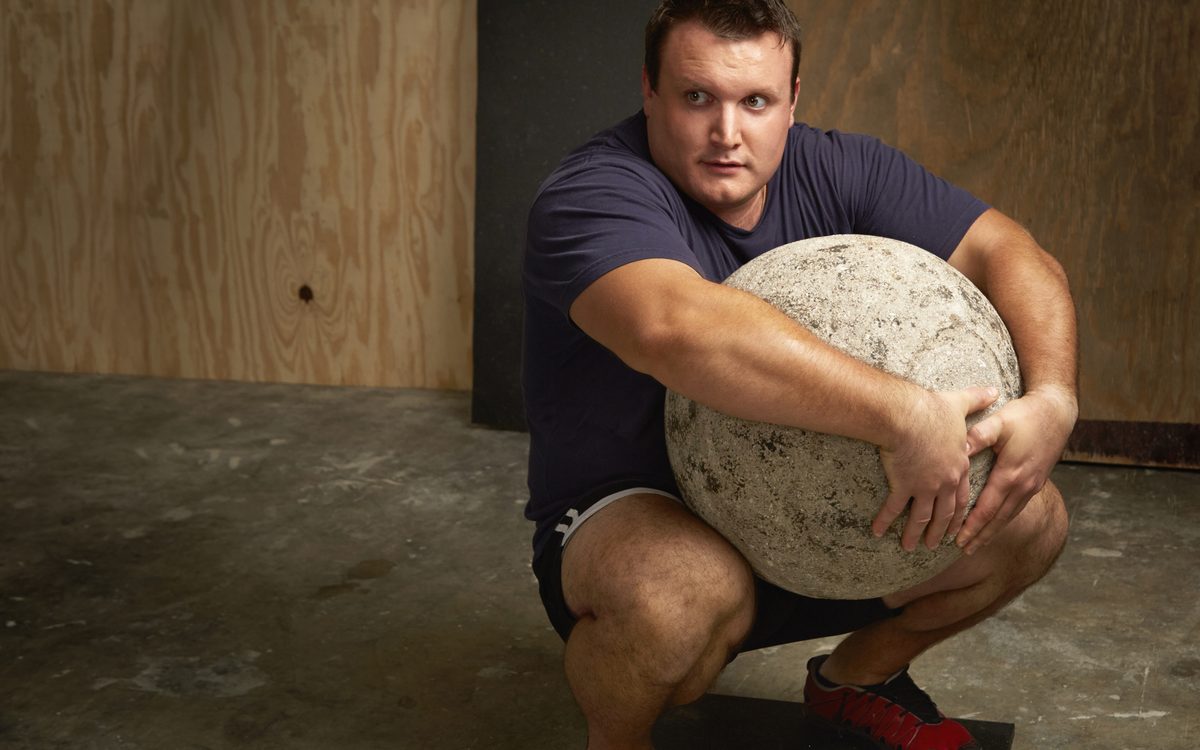
- **Stones:** atlas stones (lift a heavy round stone to a platform) and other natural stones.
- **Deadlift and squat variants:** such as the elephant bar, a barrel or a car.
- **Carries:** farmers walk, super yoke, timber carry and frame carry.
- **Pulls:** vehicle pulls and sled pulls.
- **Throws and medleys:** keg toss, weight over bar, loading medley.
- **Grip and bending events.**
(Event list: Wikipedia’s Strongman article; events and weights change from contest to contest, and we are not quoting weights because they differ by class and show.)
Scoring in the usual WSM-style format is simple: the winner of an event gets points equal to the number of competitors, last place gets one point, a failed lift earns zero, and ties share points (Wikipedia, not independently confirmed). Athletes in the same class are ranked by total points.
Who competes, and at what level
Starting out
Local and regional contests in the US are open to all; no qualification is needed. Strongman Corporation, which sets the amateur system, says that effective 1 January 2026:
- Athletes must be at least 12. Under-18s need parent or guardian permission and waivers.
- Teen division: 19 or younger on competition day.
- Novice is meant for first-time competitors; consider moving up to Open after placing top 3 in a field of 8 or more, top 2 in a field of 5 to 7, or winning a field of 3 or 4. The promoter decides.
- Weight classes (kg only from 2026): women 57 (amateur only), 64, 73, 82 and over 82; men 80, 90, 105, 120 (amateur only) and over 120. Masters classes also exist.
- Weigh-in can be up to 24 hours before the contest, with no rounding or clothing allowance.
Qualifying
For Amateur Nationals, Strongman Corporation sets placing thresholds by event type. At a local show, first place wins qualification in a class of 2 to 4, first and second in a class of 5 to 9, and top three in a class of 10 or more. Pro cards are earned at Nationals, the Arnold and select Pro/Am events and give access to invitation-only events. Qualifying lists are updated manually, so there can be delays.
Pro and international
The most famous contest is the World’s Strongest Man, first held in 1977 (Strongman Archives). Other contests mentioned in the Wikipedia summary include the IFSA World Championships and the Strongman Champions League. Women’s international competition began in the 2000s, with World’s Strongest Woman and the Arnold Strongwoman Classic among major events (Wikipedia, uncited).
Olympic and Paralympic status
None. Strongman is not on the Olympic or Paralympic programme as far as we can tell; we did not find an IOC or IPC statement either way. Check the official programme for the current Games. Closest Olympic relatives are weightlifting and, outside the Games, powerlifting.
What strongman asks of the body
Strongman mixes maximal strength with short bursts of power and repeated grip, trunk and leg work, often with awkward implements. A systematic review of strongman exercise biomechanics (11 studies) found that in the farmer’s walk and heavy sled pull, higher-performing athletes had a greater stride length and stride rate and less ground contact time; in the tire flip, higher performers had a shorter second pull. A small study of 20 experienced athletes divided the atlas stone lift into five phases (recovery, initial grip, first pull, lap and second pull), starting from maximal hip flexion. Another showed the yoke walk uses a high stride rate and short stride length. The reviewers say published evidence is still limited.
Health and safety for strongman athletes
This section is general information, not medical advice. If you are hurt, see a sports medicine doctor, physical therapist or athletic trainer.
Injury patterns
A 2017 systematic review of injuries in weight-training sports (20 eligible studies, only five rated low risk of bias) found the highest injury rates in strongman (4.5 to 6.1 injuries per 1,000 training hours) and Highland Games (7.5 per 1,000 hours), and the lowest in bodybuilding. The shoulder, lower back, knee, elbow and wrist or hand were the most commonly injured places, and strains, tendinitis and sprains were the most common injury types. A 2025 series in the Orthopaedic Journal of Sports Medicine notes that elbow injuries are common among strength athletes, particularly distal biceps tendon ruptures, and reviewed 183 athletes who had repairs; those athletes were in strength sports such as weightlifting and powerlifting, so apply it to strongman with caution.
Because strongman implements shift, roll and drop, many events carry a risk that routine barbell training does not. General good practice is to progress loads gradually, learn each implement with a coach and train with spotters or catchers. That is general advice, not a guarantee; we did not find a strongman-specific safety standard from a federation.
Heat and hydration
Many contests are outdoors on long days. The National Athletic Trainers’ Association (NATA) position statement on exertional heat illnesses is the standard reference; see it for recognition and response, and call emergency services for confusion, collapse or very high body temperature.
Head and neck
Strongman is not a head-contact sport, but falls from stones, yokes or vehicles happen. Follow the CDC HEADS UP advice: stop, and let a healthcare provider decide when to return.
Supplements and weight cutting
Because classes are set by body weight (weigh-in can be up to 24 hours before the contest, with no rounding), some athletes consider cutting weight. Talk to a doctor or registered dietitian before cutting weight or using supplements, and prefer products that are third-party tested for sport.
Training, recovery and nutrition pointers
Strongman training usually blends heavy barbell lifts with event practice. Many athletes also taper before a contest. A 2026 systematic review of tapering in weight-lifting sports (including strongman) found tapering was common, with step tapers the most reported and lengths typically five to nine days. For sourced training basics, see our powerlifting training and weightlifting training pages; recovery ideas are on powerlifting recovery; and food and supplement basics are on powerlifting nutrition. The CDC’s sleep page is a good starting point for sleep. See also our recovery tools guide.
Gear for strongman
Gear is simpler than for most sports: lifting shoes or flat shoes, a belt, wrist wraps and chalk or grip aids. Rules about belts, tapes and grip aids differ by contest, so read the rules for your show. Three common items:

Gymreapers 10mm Lever Belt
- 4 in wide, 10 mm leather
- Steel lever buckle
- IPF Approved List brand

Gymreapers 18" Wrist Wraps
- 18 x 3 in
- Reinforced thumb loop
- IPF and USPA approved (maker)
$19.99 at Amazon, as of Nov 17, 2026 01:07 UTC
Check price on Amazon
Cannon Sports Gym Chalk
- Magnesium carbonate
- Eight 2 oz blocks
- Chalk for grip
$17.99 at Amazon, as of Nov 17, 2026 01:07 UTC
Check price on AmazonRelated sports and disciplines
Powerlifting, weightlifting, bodybuilding, CrossFit and track and field (for the throws).
Strongman FAQs
What are the events in strongman?
Common ones are log press, atlas stones, farmers walk, yoke carry, deadlift variants and vehicle pulls. Events change by contest.
How do I get started?
Find a local gym or club that trains strongman events, learn the lifts with a coach, and enter a local or novice show. Strongman Corporation members must be at least 12.
Are there weight classes?
Yes. In Strongman Corporation events, men’s classes are 80, 90, 105, 120 (amateur only) and over 120 kg; women’s are 57 (amateur only), 64, 73, 82 and over 82 kg, with masters classes (2026 rules).
Is strongman dangerous?
Across weight-training sports, one systematic review found strongman’s injury rate among the highest, 4.5 to 6.1 per 1,000 hours, with shoulder, back, knee, elbow and wrist most affected. Coaching and gradual progression matter.
Is strongman in the Olympics?
No. We found no Olympic or Paralympic strongman event. Check the official programme for the current Games.
Can women and older athletes compete?
Yes. There are women’s classes, a teen division and masters classes for athletes 40+ and 50+.
Keep exploring the sports hub, wrist wraps guide, knee sleeves guide and powerlifting injuries.
Sources
- Strongman Archives, World’s Strongest Man: strongmanarchives.com
- Strongman Corporation: home, athlete info, qualification standards
- Wikipedia, Strongman (events list and scoring, secondary): en.wikipedia.org
- The Epidemiology of Injuries Across the Weight-Training Sports (2017): PubMed 27328853
- The Biomechanics and Applications of Strongman Exercises (2019): PubMed 31820223
- The biomechanical characteristics of the strongman atlas stone lift (2021): PubMed 34557349
- The Biomechanical Characteristics of the Strongman Yoke Walk (2021): PubMed 33981993
- Distal Biceps Tendon Repair in Competitive Strength Athletes (2025): PubMed 40182566
- Tapering and Peaking in the Weight Lifting Sports (2026): PubMed 42611173
- NATA, exertional heat illnesses: nata.org (PDF)
- CDC: HEADS UP, sleep