This article contains affiliate links: if you buy through them we may earn a commission, at no extra cost to you. Read our affiliate disclosure.
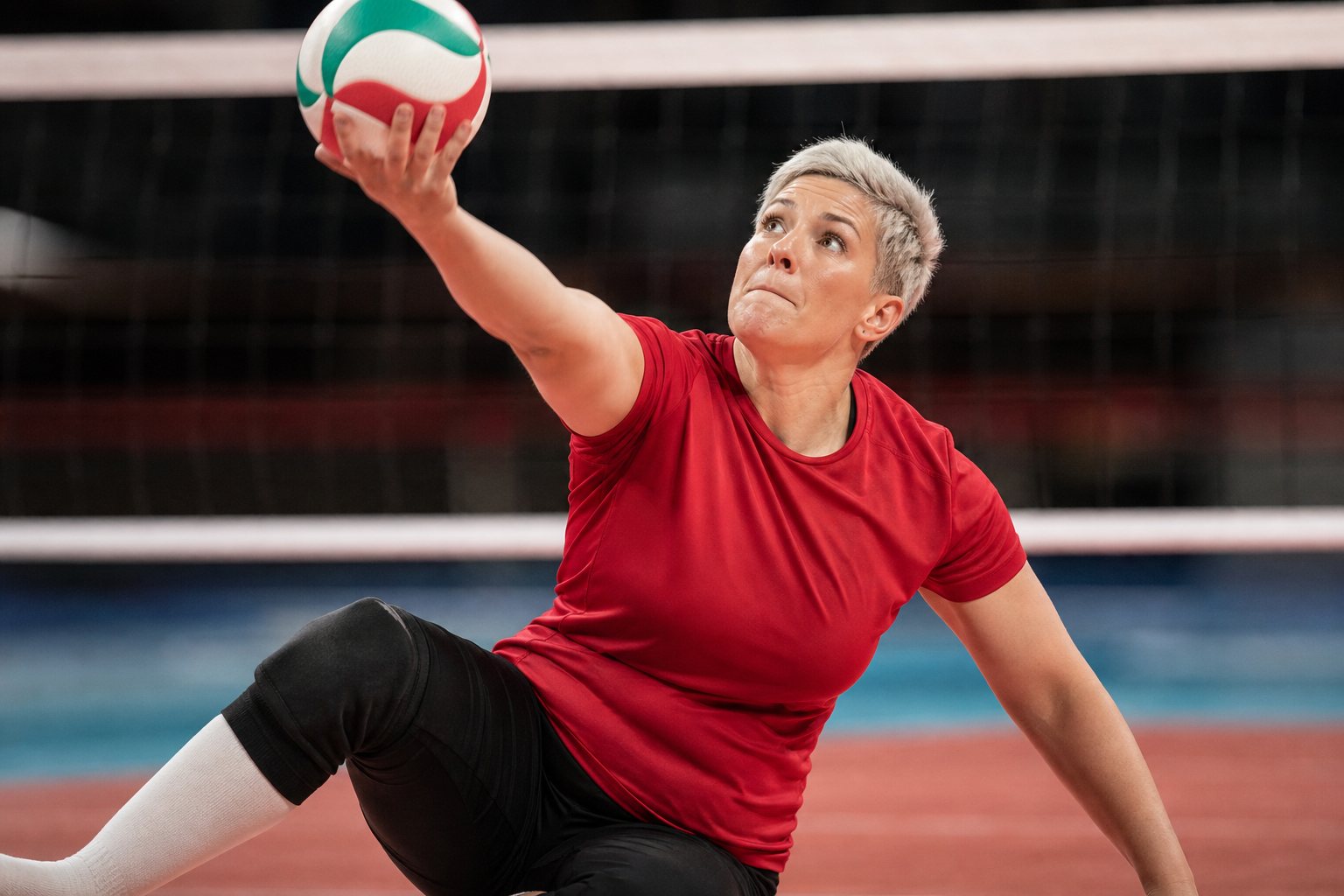
Paris 2024, a rally on a 10 by 6 metre court with the net barely over a metre high and every player on the floor. Iran beat Bosnia and Herzegovina 3-1 to win its eighth Paralympic men’s title, and the United States women won gold. Sitting volleyball is volleyball played on a smaller court, on the floor, by athletes with a physical impairment, and it has been a Paralympic sport since 1980.
Sitting Volleyball guides: what do you need?
New to sitting volleyball? Start with the first card. Everything here is general education, not medical advice.
History & Origins of Sitting Volleyball
The Paralympic movement says sitting volleyball was first played in the Netherlands in 1956, started for wounded soldiers and blending elements of sitzball and volleyball (paralympic.org). Men’s sitting volleyball debuted at the Arnhem 1980 Paralympic Games, and women’s events were added at Athens 2004. World ParaVolley is today’s international federation. At Paris 2024 Iran beat Bosnia and Herzegovina 3-1 on 7 September for its eighth Paralympic men’s title, with Egypt taking bronze over Germany (paralympic.org Paris 2024). The sport is confirmed for LA28 with two events (see our hub page). We only state facts found on those pages.
- 1956: First played in the Netherlands (paralympic.org).
- 1980: Men’s sitting volleyball debuts at the Arnhem Paralympics.
- 2004: Women’s event added at Athens.
- 7 September 2024: Iran wins its eighth men’s Paralympic gold, 3-1 over Bosnia and Herzegovina.
Notable Athletes
Para-athletes named by paralympic.org and its Paris 2024 report. Fewer than ten are listed because we only include what we could verify. Not a ranking.
- Davoud Alipourian (IRI): described by paralympic.org as the sport’s most successful athlete, with four Paralympic golds.
- Morteza Mehrzadselakjani (IRI): led all scorers with 27 points in the Paris 2024 final and was on Iran’s Rio 2016 and Tokyo 2020 gold-medal teams.
- Hesham Elshwikh (EGY): bronze at Athens 2004 and Rio 2016, and part of the Paris 2024 bronze-medal story.
- Emile Cadet Vuningabo (RWA): captain of his national team, whose career paralympic.org calls trailblazing.
- Eva Szabóné Sipos (HUN): the oldest player at the 2026 World Championships, according to paralympic.org.
Official results and records
We list no results tables here; check the official pages for current champions.
- Paralympic.org sitting volleyball: Paralympic results and athletes.
- Paris 2024 men’s final report.
- World ParaVolley: World Championships and rankings.
How we keep this current: we re-check facts after each major championship and update this page. Spot an error? See our editorial policy.
Below: the rules in plain words, how classification works, how to get started, and what the injury research says. It is general information, not medical advice; for a personal question see a sports medicine doctor, physical therapist or athletic trainer who works with para athletes.
Sitting volleyball at a glance
| What it is | Volleyball played seated: two teams of six on a small court, separated by a low net. |
|---|---|
| How you win | Rally scoring. A set goes to the first team to 25 points with a two-point lead; a deciding fifth set goes to 15. Win three sets in a best-of-five match. |
| Court and net | 10 m by 6 m (compared with 18 m by 9 m for standing volleyball), with a 2 m attack line. Net height 1.15 m for men and 1.05 m for women. |
| Players | Athletes with a physical impairment, such as limb deficiency, impaired muscle power or range of movement. Six on court; up to 14 players on an international match roster. |
| Defining rule | Part of the body between the buttocks and the shoulders must stay in contact with the floor during playing actions. |
| Governing body | World ParaVolley; USA Volleyball runs the sitting national teams in the US. |
| Paralympics | Men’s sitting volleyball since Arnhem 1980, women’s since Athens 2004; confirmed for LA28 with two events and eight teams each. |
How sitting volleyball works
The game follows the same structure as standing volleyball: serve, receive, set and attack, with three touches per side plus the block, and the team that wins a rally scores the point. The differences come from the floor. The court is 10 by 6 metres and the net is only 1.15 m (men) or 1.05 m (women), so attackers hit flat and fast, and blocking the serve and attacking the serve are both legal in sitting volleyball, unlike standing volleyball.
The seated rule is the heart of it. World ParaVolley’s rulebook says that at all times during playing actions, players must keep contact with the court with some part of the body between the buttocks and the shoulders. A short loss of contact is allowed in a few cases, for example when a defender dives for a ball that is not entirely above the top of the net, but lifting to hit an attack is a fault. Legs can cross the attack and centre lines as long as they don’t interfere with an opponent. Players sit, slide and push with their hands and hips; a quick shuffle across the floor is as important as a strong arm. Teams may also use up to two liberos, specialist defenders, as in standing volleyball.
Classification in plain words
Classification groups athletes by how their impairment affects the sport. World ParaVolley’s rules refer to players with a “minimal impairment” as sport class VS2 and limit them so the game stays fair: no more than one VS2 player on the court at a time, and no more than two on a match roster. (We did not find the name of the other class in the rulebook text, so we leave it out.) Only athletes with an eligible physical impairment can play at the Paralympic level, and USA Volleyball brings a World ParaVolley classifier to its development camps. The IPC also lists the types of impairment that qualify: ataxia, athetosis and hypertonia, impaired muscle power, impaired passive range of movement, limb deficiency and leg length difference.
Who plays it and at what level
- Starting out: the USOPC recommends connecting with a local adaptive sports organisation that offers sitting volleyball or a local volleyball club (find one at uspara.us/findaclub). The USOPC notes that all you need is a volleyball, a court and a net, and that games can be played 4 v 4 or 2 v 2 on smaller courts.
- Regions and clubs: some USA Volleyball regions run open sitting clinics and field a team at the USAV Open Nationals; availability varies by region.
- National pathway: USA Volleyball’s Sitting National Team Development Program takes athletes who do not need prior volleyball experience; interested athletes can email [email protected].
- International: World ParaVolley runs the world championships. The US women’s team named its roster for the 2026 World ParaVolley World Championship in July 2026.
We could not find a confirmed school or NCAA sitting volleyball pathway, so we don’t list one. Ask your state or regional volleyball association what exists locally.
Paralympic status, edition by edition
Standing volleyball appeared first at Toronto 1976; sitting volleyball joined the Paralympic programme at Arnhem 1980, and the first women’s tournament took place at Athens 2004. At Paris 2024, Iran won the men’s gold over Bosnia and Herzegovina, and the US women won the women’s tournament, with China taking silver and Canada bronze. The IPC’s LA28 programme (15 to 27 August 2028) confirms two medal events, men’s and women’s, with eight teams and 96 athletes in each. For anything later, check the official programme for the current Games.
Physical demands
Players hit, block and defend while staying in contact with the floor, so they move by pushing and sliding on the hands and hips. We did not find a published breakdown of the sport’s energy systems or strength demands, so the best guide is how injuries cluster, below: the shoulders, wrists and fingers do much of the work.
Health and safety for sitting volleyball
Sitting volleyball showed one of the higher injury rates at the Paris 2024 Paralympics. In the British Journal of Sports Medicine surveillance study of 4,450 athletes monitored over 62,300 athlete days, the Games-wide injury incidence was 8.6 per 1,000 athlete days, while sitting volleyball was 19.9 (95% CI 14.8 to 26.7), along with taekwondo (27.3) and football 5-a-side (22.3). Higher rates are not the same as severe injuries; the study counts every reported injury, and 19.1% of injuries across all sports led to time lost from training or competition.
A study of 56 players in the Iran Sitting Volleyball Super League 2023-2024 reported 80 injuries in 30 athletes (53.6% of the group), with 16.2 injuries per 1,000 athlete days. The injury rate during competition (33.5) was higher than in pre-competition (14.5), most were re-injuries, and the fingers, wrist and shoulder were the most affected areas. In a study of 35 elite Polish para athletes (21 sitting volleyball players and 14 para swimmers), the most common pain complaints were in the neck (37%) and the lower back (34%). These are single-country samples, but the pattern is consistent: hands, shoulders, neck and back.
- Court and equipment rules matter: World ParaVolley’s rulebook says the surface must be flat, horizontal and uniform and must not present any danger of injury, and net posts at its events are padded and placed 1 m outside the sidelines. Players may wear compression pads for protection or support, and may play without shoes.
- Re-injury: because many injuries in the Iran study were re-injuries, talk to a clinician about a gradual return after any hand, wrist or shoulder problem. We don’t give return-to-play timelines here.
- Head impacts: the Concussion in Para Sport Group says concussion is common in para athletes and that return to sport is decided case by case. CDC HEADS UP: anyone who may have a concussion stops playing and sees a healthcare provider before going back.
Training, recovery and nutrition pointers
Because the data point to shoulders, wrists and fingers, a warm-up that includes the hands, forearms and shoulders is a sensible habit. A coach or therapist can tailor the details to your impairment. Our standing-volleyball pages cover the general ideas, but they were written for standing players: volleyball training, volleyball recovery and volleyball nutrition and supplements. Supplements follow the rule used across this site: check with a doctor or dietitian first, and look for third-party testing for sport.
Gear
- Ball: the same kind of ball as standing volleyball; at World ParaVolley events it must be a World ParaVolley approved ball. For practice, any good indoor volleyball works.
- Net and court: a lowered net (1.15 m men, 1.05 m women) and a 10 by 6 m court.
- Clothing and padding: light, flexible clothing and, if you wish, compression pads for protection or support. Players may play without shoes or in light pliable shoes.
For practice at home or at the club, a quality indoor ball is the main purchase: the Mikasa V200W is a size 5 indoor ball that the maker says exceeds FIVB standards (we have not confirmed World ParaVolley approval, so check the event rules before using it in competition). A THERABAND resistance band kit is a low-cost way to do the light shoulder work a clinician may suggest. Our resistance band guide has more.

Mikasa V200W
- Size 5, 18 panels
- Exceeds FIVB standards (maker)
- Indoor volleyball
$63.91 at Amazon, as of Nov 17, 2026 01:07 UTC
Check price on Amazon
THERABAND Resistance Band Beginner Kit
- 3 latex bands
- Yellow, red, green
- For light strength work
$11.99 at Amazon, as of Nov 17, 2026 01:07 UTC
Check price on AmazonRelated sports and disciplines
- Volleyball: the standing game, with its own rules, leagues and injury patterns.
- Wheelchair basketball and wheelchair rugby: other Paralympic team sports.
- Goalball: a Paralympic team sport for blind and visually impaired athletes, also played on a volleyball-sized court.
Sitting volleyball FAQs
How is sitting volleyball different from regular volleyball?
The court is 10 by 6 m, the net is 1.15 m for men and 1.05 m for women, players must keep part of the body between the buttocks and shoulders on the floor, and blocking and attacking the serve are allowed.
Who can play?
Athletes with an eligible physical impairment can compete in World ParaVolley events. USA Volleyball says eligibility is limited to athletes with physical impairments and that previous volleyball experience is not required to be considered for its development camps.
How many players are on court?
Six per team. The rules allow a maximum of one minimal-impairment (VS2) player on the court at a time, and recreational games can be played 4 v 4 or 2 v 2 on smaller courts.
Is sitting volleyball in the Paralympics?
Yes, for men since 1980 and for women since 2004. It was on the Paris 2024 programme and is confirmed for LA28. Check the official programme for the current Games.
Is it a risky sport?
Injury rates at Paris 2024 were higher in sitting volleyball than in most Paralympic sports (19.9 against 8.6 per 1,000 athlete days overall), mostly hands, wrists and shoulders in the studies we found. Playing on a safe floor with a proper warm-up and seeing a clinician for pain that doesn’t settle is the sensible approach.
Sources
- World ParaVolley: Official Sitting Volleyball Rules 2025-2028
- IPC: Introduction to sitting volleyball
- IPC: LA28 medal event programme and athlete quotas
- USOPC: Sport overview, sitting volleyball
- USA Volleyball: Sitting National Team Development Program
- Derman et al. 2026, injury and illness at Paris 2024 (PubMed)
- Injuries in the Iran Sitting Volleyball Super League (PubMed)
- Musculoskeletal pain in elite Para athletes (PubMed)
- Concussion in para sport: position statement (PubMed)
- CDC HEADS UP
Keep exploring: the volleyball hub, volleyball injuries (written for standing players), our recovery tools guide, and every other sport on our sports hub.