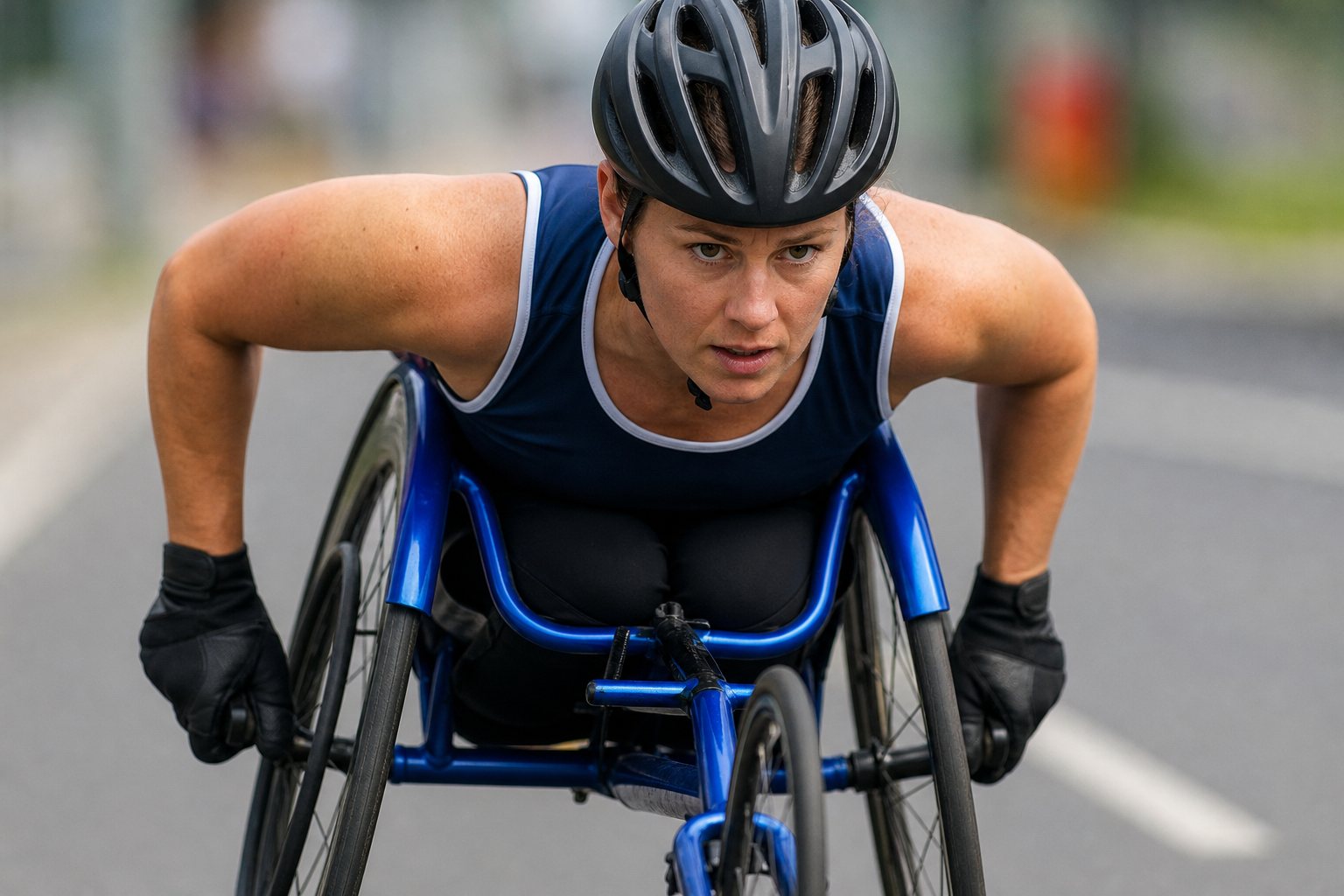
The horn is a minute away on the Seine pontoon, or the beach at a local race, and the athlete is running through a checklist: goggles, tether, the handler waiting at the swim exit, the guide at her shoulder. Mental training for Para triathletes means practising attention, routines, self-talk and planning so that moment feels a little more manageable. It is separate from mental health care, and no technique guarantees a result. Research specific to Para triathletes is very limited, so much of this page draws on general sport psychology and on research in triathlon, and says so.
Quick answer: Routines, short cue words, imagery and a plan for setbacks are the best-supported mental skills in sport generally, and a meta-analysis of self-talk found a moderate positive effect on sport tasks. We found no trial of mental training in Para triathletes, so treat these as general tools. Anxiety, low mood, disordered eating or burnout are health matters, not performance problems: see a doctor or licensed mental health professional. In the United States you can call or text 988 at any time.
General information, not medical advice. Race logistics are on the rules page; the physical plan is on the training page. Back to the Para triathlon hub.
What research says about triathletes
A survey of 401 triathletes (Dolan and colleagues, Journal of Sports Sciences, 2011) found most set training and competition goals and used mental strategies in training and in the hour before racing; positive self-talk was the most used strategy; female triathletes were more likely to use mental preparation strategies and to report feeling anxious before competitions; and athletes consulted triathlon coaches more than sport psychology professionals. The survey did not focus on Para athletes. A meta-analysis of 32 studies (Hatzigeorgiadis and colleagues, 2011) found self-talk interventions had a positive moderate effect (ES 0.48) on sport task performance, were more effective for fine-motor than gross-motor tasks, and more effective for new tasks than well-learned ones. Triathlon swims, rides and runs are mostly gross-motor skills, so do not expect large effects, but self-talk may help with transitions and technique cues.
Confidence, focus and routines
The following ideas are common coaching practice in sport psychology and not tested in Para triathlon.
- Process goals: pick two or three things you control (a smooth swim exit, calling gears with your pilot, a relaxed push) rather than only a finishing time.
- Cue words: a short phrase for each leg (“long and easy,” “smooth,” “light hands”) that you rehearse in training.
- Pre-race routine: the same order of checks, breathing and warm-up each time, including how you and your handlers or guide communicate. Routines reduce decisions on a stressful morning.
- Imagery: walk through the race in your mind, including the swim exit, handler help and the first minute on the handcycle. Include a mistake and your plan to recover from it.
- Rehearse the team: for PTVI and PTWC athletes the guide, pilot or handler is part of the performance. Trust is built by practising together, not on race day.
Pacing and decisions
Pacing across three sports is a mental task too. A review by Tucker (2009) proposes that the brain regulates effort on the basis of perceived exertion in anticipation of the finish, which is one reason experienced athletes learn to judge effort rather than only watch a watch. We found no pacing study in Para triathletes. In heat, heart-rate and power targets may mislead after spinal cord injury or with other impairments, so agree a plan with your coach and doctor, and be willing to slow down. Decisions in a race, such as when to drink, when to stop for a mechanical problem or how to respond to a tight bike course, are best planned in advance and practised in training.
Pressure, nerves and setbacks
Nerves before a race are common. For many athletes a slow breath out, a cue word and a routine help; this is general practice. After a mistake, such as a slow transition or a dropped chain, a common coaching approach is to name it, fix what you can, and focus on the next task. Setbacks also include illness, equipment issues, and for some athletes classification outcomes. The 2026 Team USA qualitative study (19 Paralympic athletes) described ongoing challenges around classification transparency and uneven access to sports medicine and coaching, together with expanded mental-health services; it is a small interview study, so it shows themes, not rates. If a setback leaves you stuck, talk to your coach, a sport psychologist or a counselor.
Mental performance is not mental health care
Routines, cue words and imagery are performance tools. Persistent anxiety, low mood, loss of interest, panic, an unhealthy focus on food or weight, or exhaustion are health matters. The 2026 International Olympic Committee consensus statement on mental health in elite athletes says mental health symptoms and disorders are common in elite athletes, may have sport-related causes and can affect performance, and that with appropriate support and treatment many athletes can continue to train and compete. A 2019 narrative review of Paralympic athletes (Swartz and colleagues) found only seven publications addressing Paralympic athletes specifically and said data on rates of symptoms were scarce, so we do not quote Para-specific rates. Take concerns to a doctor or licensed mental health professional. In the United States, call or text the 988 Suicide and Crisis Lifeline any time; the Association for Applied Sport Psychology lists resources for finding a sport psychologist. In an emergency call your local emergency number. For eating concerns, see the nutrition page.
Preparing for competition
Logistics such as arriving early, walking the transition and swim exit, and checking equipment belong in your race-week checklist on the rules page and gear list on the gear page. Mentally, aim to make the race feel like a rehearsal: practise the routine in training races, tell your handlers or guide the plan, and decide in advance what you will do if the swim course, weather or equipment changes. Rest and sleep are part of mental preparation too (see recovery).
Related: triathlon, Para swimming.
Para triathlon mental training FAQs
Do mental skills work for Para triathletes?
We found no trial in Para triathletes. A meta-analysis found self-talk had a moderate positive effect on sport tasks in general, so the tools are reasonable to try, but they carry no guarantee.
How do I handle pre-race nerves?
Use a fixed routine, a slow breath out and a short cue word. These are general coaching tools. If anxiety is overwhelming or constant, talk to a doctor or licensed mental health professional.
Should I work with a sport psychologist?
It can help, especially for persistent worry, motivation loss or a fear of open water. Surveys show triathletes consult coaches far more often than sport psychologists, so many athletes never ask.
How do I build trust with a guide or handler?
Train together often and rehearse race routines, including transitions and communication. This is general practice, not a tested protocol.
Where can I get help right now?
In the United States call or text 988. If you are in danger, call your local emergency number.
Sources
- Dolan et al., survey of training, nutrition and mental preparation of triathletes, J Sports Sci 2011 (PMID 21623532)
- Hatzigeorgiadis et al., Self-talk and sports performance: a meta-analysis, Perspect Psychol Sci 2011
- Tucker, The anticipatory regulation of performance, Br J Sports Med 2009
- IOC consensus statement: Mental health in elite athletes (2026)
- Swartz et al., Mental health symptoms and disorders in Paralympic athletes: a narrative review, Br J Sports Med 2019
- Team USA Paralympic athletes: resources and recommendations, BMJ Open 2026 (PMID 42767747)
- 988 Suicide and Crisis Lifeline
- Association for Applied Sport Psychology resources
General information for education only, not medical advice. It does not replace a visit with a doctor, physical therapist or athletic trainer. See how we write and check our pages in our editorial policy.