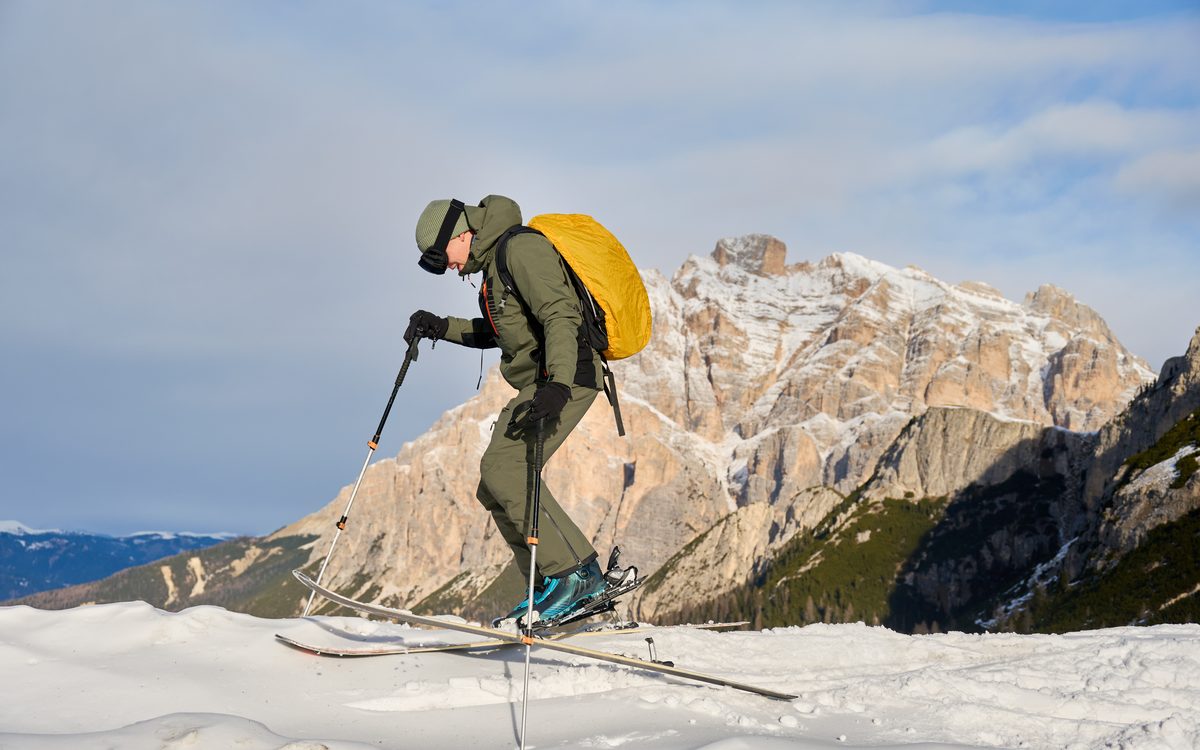
The start gate opens and forty people shuffle uphill at once, skins whispering on the snow, poles clicking. Ten minutes later one of them is on a ridge with her skis on her pack, boots crunching up a staircase of footsteps, and then she is kneeling in a marked box ripping skins off in about ten seconds. Ski mountaineering, or skimo, is a timed race up and down snowy mountains on skis, and the skills are learnable. This page covers how racing works, the basic skills, how a beginner starts and where the official rules live. For the full overview, see the ski mountaineering hub.
Quick answer: Skimo is won by being first across the line on a course that mixes skinning uphill, a short climb on foot and a ski descent. Beginners usually start at a ski area that allows uphill travel, with gear they already have, and enter a local race in a recreational category. Race directors set the required gear, which often includes a helmet and an avalanche beacon, so read the event rules first. Practicing transitions is the cheapest way to get faster. Leaving a marked course for the backcountry needs formal avalanche education, not just this page.
How a race works
NBC Olympics’ rules summary describes four phases: a climb on skis with adhesive skins, a stretch where the skis go on the backpack and the athlete climbs in boots (with crampons if required), a transition zone where skins come off, and a ski descent through gates. The Olympic sprint at Milano Cortina 2026 ran about 2:30 to 3 minutes with about 70 m of climbing; the mixed relay lasted about 30 minutes with about 140 m of climbing, in the order woman, man, woman, man, with a physical-touch handover. ISMF’s World Cup also holds individual, team and vertical races, which are longer.
Scoring is simple: the fastest time wins, and rules produce time penalties or disqualification. NBC Olympics notes that equipment may only be changed inside the marked transition zone and that skins sticking out of a suit or pack cost 10 seconds. A missing avalanche beacon (a DVA, with batteries), a helmet not worn correctly, missing ski brakes, or missing crampons in a required section can mean disqualification. Racing uses no ropes or climbing equipment.
The basic skills
- Skinning uphill. Glide the ski forward without lifting it much, keep the heel free, and use kick turns on steeper slopes. This is the main skill in a race, because the uphill sections matter most (see our training page).
- Transitions. Skins on, skins off, boots and bindings switched between walk and ski mode, skis onto the pack and back. The USA Skimo first-race guidance calls practicing transitions one of the biggest ways to get ahead, and it can be done at home. This is general coaching practice rather than a published rule.
- Booting. Walking steep snow with skis on the pack, using crampons where required and the cleanest line.
- Skiing down tired. The descent comes after hard uphill work, so ski control on tired legs is part of the sport. Skiers new to it often benefit from lessons.
- Cold-weather habits. Layers you can shed on the climb and add on the descent. See our gear page.
How a beginner starts
USA Skimo and other guides suggest starting at a ski resort that allows uphill travel, where the slopes are groomed and patrolled and conditions are more controlled for both climbing and skiing down. Check the resort’s uphill policy first, because rules differ and some restrict hours or routes. Many people begin with touring or lighter alpine-touring gear they already own, or rent demo gear, then add race equipment later.
USA Skimo’s first-race guide suggests the recreational (“Rec”) category if you are unsure about fitness or gear and the “Race” category for lighter gear and faster competitors; all categories start together. USA Skimo’s equipment guide lists a helmet (a bike helmet is acceptable in some events), an avalanche beacon, shovel, probe and skins as typical mandatory items, but not every event requires all of them. One beginner event we found did not require a beacon, shovel or probe, so only the race director’s rules count. Read them before you pack.
Levels and who runs the sport
- Local and regional races. Many are sanctioned by USA Skimo, the US national body (also called USSMA). A USA Skimo license number is required to register for sanctioned races in the US. Check the USA Skimo site for current fees and rules.
- Youth. USA Skimo has shortened-course youth divisions (U14, U16 and U18 in the sources we found), but sources disagreed on the exact age cutoffs, so check the current rules. Skimo was part of the 2020 Winter Youth Olympic Games in Lausanne, according to ESPN.
- National and World Cup. International ISMF races run through national federations, so US athletes enter through USA Skimo.
- Olympics. Skimo debuted at Milano Cortina 2026 with the sprint and mixed relay. For the 2030 French Alps Games, check the official programme for the final list of events.
For a US program near you, look at USA Skimo’s race calendar and local ski areas, and for how this connects to other ski disciplines see our skiing hub and cross-country skiing.
The official rulebook
The International Ski Mountaineering Federation (ISMF) publishes its Rules and Guidelines for each season; the 2026/27 edition is listed on its Sport Rules page. We could not read the equipment tables ourselves, so we do not quote specific helmet or beacon standards from it. Event rules often cite helmet certifications and a beacon that transmits and receives on 457 kHz, but check the ISMF document and your race’s own regulations for the current requirements.
Safety rules that apply even on a race course
Racing happens on marked, controlled courses, but the mountain does not become risk-free. The US avalanche information site avalanche.org says avalanches kill 25 to 30 people in the US each winter and describes three steps for backcountry travel: get the forecast, get the gear, get the training, and it calls avalanche education a life-long process. If you want to tour outside a controlled area, take a formal avalanche course from a recognized provider. This page is not a substitute. Our injury prevention page covers the general risk-lowering habits.
See our mental training, nutrition and recovery pages for the rest of the picture.
Frequently asked questions
How do I start skimo racing?
Begin at a ski area that allows uphill travel, practice skinning and transitions, and enter a local recreational-category race. Check the race directors’ gear list first.
What gear do I need for my first race?
It depends on the event. USA Skimo’s guidance lists a helmet, avalanche beacon, shovel, probe, skins and a small pack as typical items, but a beginner event may require fewer. Always follow the race director’s list.
Do I need a license?
For USA Skimo-sanctioned races in the US, a USA Skimo license number is required to register. Check USA Skimo for the current process and fees.
How is a skimo race scored?
By time. The first athlete across the line wins, and rule breaks add time penalties or lead to disqualification.
Are there youth races?
Yes. USA Skimo offers shortened-course youth divisions. Check its current rules for the age cutoffs.
Sources
- NBC Olympics: official rules for Olympic ski mountaineering
- ESPN: What is ski mountaineering?
- ISMF: Sport Rules (Rules and Guidelines 2026/27)
- USA Skimo: What to expect in your first skimo race
- USA Skimo: mandatory gear
- USA Skimo membership and licenses
- Avalanche.org: avalanche education
General information for education only, not medical advice. It does not replace a visit with a doctor, physical therapist or athletic trainer, and it is not avalanche training. See how we write and check our pages in our editorial policy.