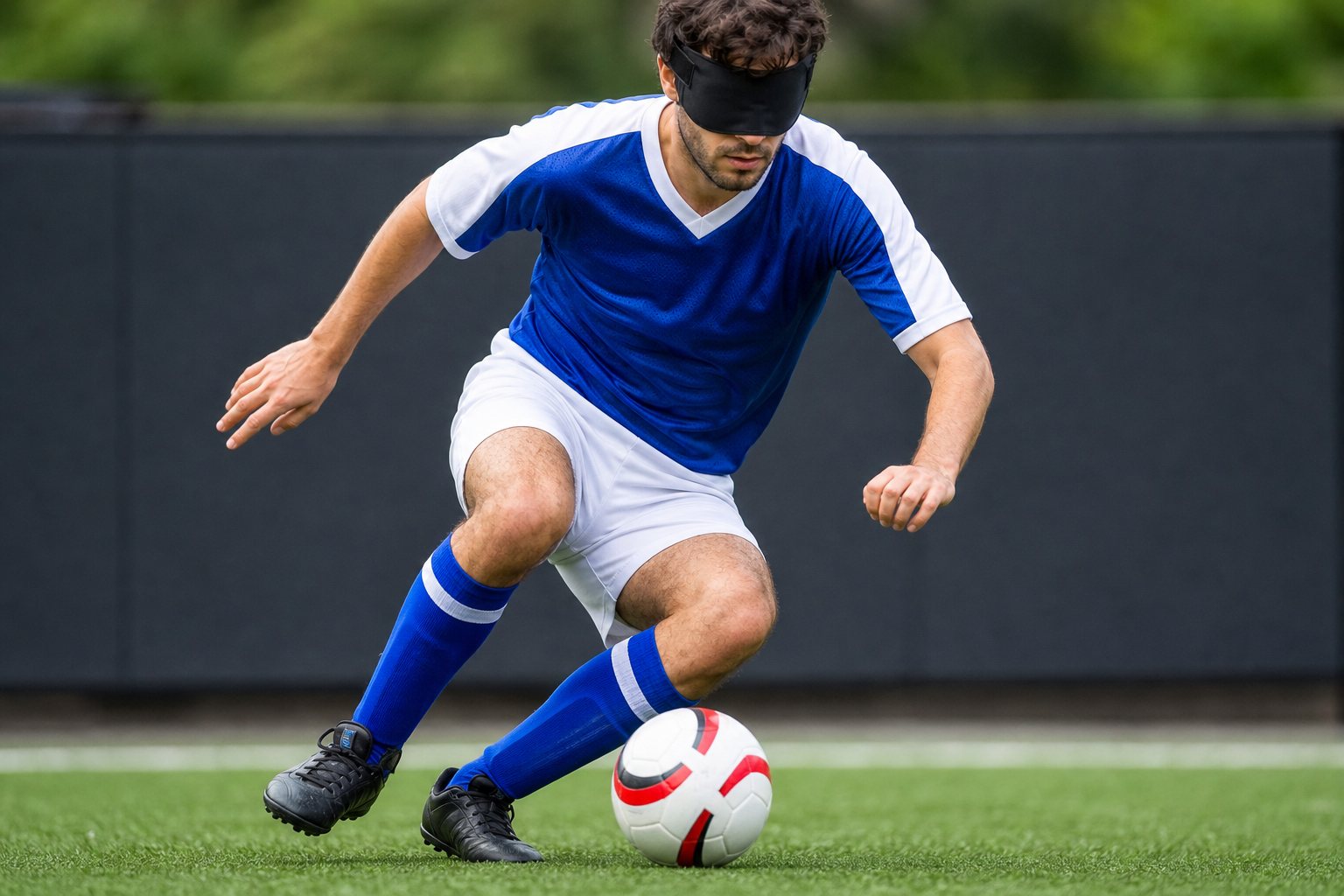
It is the middle of a match and nobody in the stands is making a sound. A ball rattles across the floor, a player calls “voy,” and two defenders turn their heads toward it before the shot goes in. Blind football (also called blind soccer or football 5-a-side) is a five-a-side game for athletes who are blind or have a severe vision impairment, played with a ball that makes noise. This page covers the rules, the basic skills and how a beginner can start. It sits inside our blind football hub; for the sighted game see soccer.
Quick answer: Each team has four outfield players in eyeshades and a goalkeeper who is sighted or partially sighted. The ball has bells or another sound system, players call “voy” when they go for it, and a guide behind the opposing goal helps the shooter aim. To start, contact the U.S. Association of Blind Athletes (USABA) or a local adaptive sports group. Check the current official rulebook for your competition, because details vary by event.
The game in plain words
The International Blind Sports Federation (IBSA) describes the game this way: five players a side, four outfield players and a goalkeeper, on a 40 m by 20 m pitch with goals 3.66 m wide and 2.14 m high. Each half is 20 minutes and each team can ask for one one-minute time-out per half. Paralympic.org adds that half-time may not exceed ten minutes. The ball must have bells or another system that lets players hear it move along the ground or through the air. Kickboards run along the sidelines, so the ball stays in play and there are no throw-ins. There is also no offside, but corner kicks and penalties are used, and a medal match that needs a winner can go to penalties.
Teams may carry four outfield substitutes and one substitute goalkeeper, with up to six substitutions per half. USABA says the surface should be solid, smooth, flat and non-abrasive. Paralympic.org notes that yellow cards can be shown for unsporting behaviour; we did not find a plain-language list of fouls on the official pages, so read the rulebook if you referee or coach.
Who plays where, and classification
Classification is the system that decides who is eligible. In IBSA’s overview, blind football is for players with severe visual impairments, class B1. Outfield players wear eye patches and eyeshades, so everyone on the pitch is equally unsighted, even if some have a little light or shadow perception. The goalkeeper can be sighted or partially sighted (B2 or B3) and must stay inside the goal area. IBSA runs a separate partially sighted futsal game for B2 and B3 players. USABA has a visual classifications page for athletes who want to understand their class; one thing we could not confirm is how each federation currently handles a first classification, so ask USABA.
The three voices on the pitch
Sound does the job that sight does in the sighted game, and three voices matter.
- The “voy” call. Paralympic.org says players call “voy” (Spanish for “I’m going”) when they decide to approach the ball, so that teammates and opponents can adjust. It is the main collision-avoidance habit in the sport.
- The goalkeeper. The goalkeeper can see, at least partly, and shouts instructions to defenders about where the ball and opponents are.
- The guide. Behind the opposing goal, an offensive guide makes noise to give shooters a reference for where the goal is, according to Paralympic.org. Guides are a role that sighted friends and family can often learn.
The crowd and the benches matter too. Spectators are asked to stay quiet until a goal, so that players can hear.
The basic skills a beginner learns
Blind football skills are football skills adapted to sound and touch. The usual early building blocks are:
- Listening. Locating the ball by its rattle, and a teammate by “voy.” A 2024 study in PLOS ONE reported that blind football players who turned their heads toward the ball were better at trapping it, so head position is part of the skill.
- Close control. Short, low touches that keep the ball near the foot, because a ball that travels away is hard to find again.
- Passing and receiving by sound. A passer calls or taps for the receiver; the receiver gets the body in line with the sound.
- Turning and protecting the ball. Small, controlled turns, with an arm out to sense where others are.
- Shooting with the guide. Lining up on the guide’s voice, then striking.
- Goalkeeping. Reading the ball by sight, positioning, and talking to defenders constantly.
A coach quoted by Paralympic.org says guiding differs from coaching sighted players: players should not be steered like a joystick, and detailed descriptions help. Bad guiding can risk serious injury, so guides should learn the role from a program.
How a beginner starts
- Contact USABA. USA Blind Soccer is a USABA program. USABA lists a Men’s National Team, a Development Program and Coaches & Referees resources, and says that it runs free blind and visually impaired youth soccer clinics in partnership with the City of Los Angeles Recreation and Parks (PlayLA Adaptive Program).
- Try a local adaptive sports group or school for the blind. Many introductory sessions are run through these.
- Bring sighted helpers. Friends and family can often join as guides or wear eyeshades to take part.
- Ask about equipment. The club or program usually provides the noise ball and eyeshades. Our gear page covers what to bring yourself.
Elite play is organized by IBSA and the Paralympic movement. The United States named its first national team in November 2022 and has said it must qualify for 2032 after hosting at LA28; check the official programme for the current Games. See the hub for more on levels and status.
Where to find the official rules
IBSA hosts the current official rules of blind football and partially sighted futsal on its “Rules & Downloads” page, listed in the sources below. We link to it because details such as exact foul rules, equipment checks and competition formats are set by the rulebook and the event organizer, and they change.
Once you know the rules, training is the next page; for staying safe in a collision-heavy game, see injury prevention.
Blind football rules FAQs
How long is a blind football match?
IBSA’s overview says two 20-minute halves. Paralympic.org also mentions a fifteen-minute half in one place, so check the rules for your competition.
Can sighted people play blind football?
Sighted players can take part in introductory sessions in eyeshades or as guides. In IBSA competition, outfield players are B1 athletes, and a goalkeeper may be sighted or partially sighted.
Are there women’s competitions?
Paralympic.org says there has never been a women’s event at the Paralympic Games. Other women’s and mixed opportunities vary by country, so ask your federation or USABA.
Why do players say “voy”?
It is Spanish for “I’m going.” Players say it as they approach the ball so that others know where they are and can avoid collisions.
Is it the same as goalball?
No. Goalball is a different IBSA sport where teams of three throw a ball with bells along the floor. Both rely on sound; see goalball.
Sources
- IBSA: football overview
- IBSA: football rules and downloads
- Paralympic.org: blind football
- USABA: blind soccer
- Paralympic.org: US blind football team prepares for LA28
- PLOS ONE 2024: head movements and ball trapping in blind football
General information for education only, not medical advice. It does not replace a visit with a doctor, physical therapist or athletic trainer. See how we write and check our pages in our editorial policy.