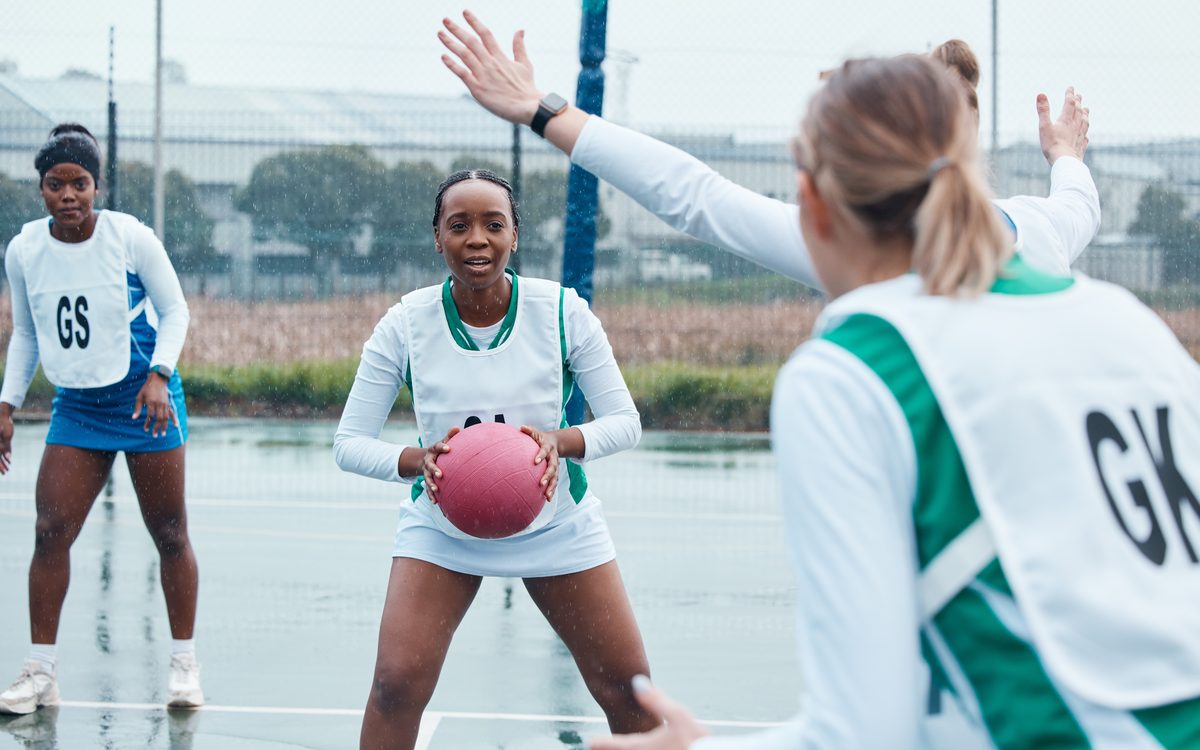
Sunday evening after a tournament weekend, three games in two days, the bag is by the door and the calves feel like wood. Netball recovery is everything a player does between sessions and games to be ready for the next one: sleep, food and fluid, easy movement, mobility and enough rest. Much of it is simple, and some popular tools have weaker evidence than their marketing suggests. This page says which is which.
Quick answer: Sleep is the best-supported recovery habit for netballers: studies link short or poor sleep with more injury and illness and with lower finishing places at tournaments. Rest days, enough food and fluid, and easy movement come next. Massage, cold water and compression garments may reduce soreness or fatigue a little, but evidence for faster return to performance is mixed. Soreness that fades in a day or two is normal; pain in one spot, swelling, or pain that changes how you land is not, and needs a sports medicine doctor, physical therapist or athletic trainer.
General information, not medical advice. Food and fluids are on our nutrition page, training load on the training page, and what to do about injuries on the injuries page.
Sleep is the first recovery tool
Three netball studies point the same way. In 536 elite and pre-elite female netballers (Horgan and colleagues, Scandinavian Journal of Medicine and Science in Sports, 2021), low sleep in the previous 48 hours was associated with more injury, and very poor sleep quality and extremes of sleep (under 5 hours or over 10) were associated with more illness; the authors recommend monitoring sleep and recovery. In 42 netballers monitored through a six-day national tournament (Juliff and colleagues, Journal of Strength and Conditioning Research, 2018), the top two teams slept about 8 hours on average and the bottom two about 7, and longer sleep tracked with a better final placing. In 14 elite players across 26 matches (O’Donnell and colleagues, International Journal of Sports Physiology and Performance, 2018), a pre-match nap under 20 minutes was linked with higher jump velocity and higher coach-rated performance than no nap. All are observational or small, so they show an association, not proof.
For how much to aim for, the American Academy of Sleep Medicine consensus, endorsed by the American Academy of Pediatrics, recommends 9 to 12 hours for children 6 to 12 and 8 to 10 hours for teens. The adult consensus (American Academy of Sleep Medicine and Sleep Research Society, 2015) is 7 hours or more. The CDC gives the same ranges. Practical points: a regular wake time, no caffeine late in the day, screens away before bed, and a plan for late-night games and travel.
Rest days and load
The American Academy of Pediatrics (Brenner, 2016) recommends at least 1 to 2 days off a week from the main sport for young athletes. Rest days are part of training. Our training page covers adding load slowly, including the 2015 Jayanthi finding that young athletes training more hours a week than their age in years had about twice the odds of a serious overuse injury.
Tournament weekends
A study of 11 female players (Birdsey and colleagues, Journal of Sports Sciences, 2019) played three matches on consecutive days. External load was similar across the matches, but muscle-damage and cortisol measures rose and well-being fell, and three days after the tournament well-being, jump height and some hormone measures were still lower than before. Netball tournaments are easy to treat as one big day; this study suggests the body feels the sum. Eat and drink between games, sleep as well as the schedule allows, keep warm-downs easy and do not schedule hard training on the day after.
Mental fatigue counts too
In 154 elite Australian players followed over two seasons (Russell and colleagues, 2022), mental fatigue rated daily changed across the season in its own way, separate from physical fatigue. In a smaller study of 12 players (Russell and colleagues, 2020), ratings of mental and physical fatigue rose across a match, with only a weak link between them. A tired head is a reason to ease off as well as a tired body. See our mental training page.
Mobility and flexibility
We did not find a netball-specific study showing that mobility or stretching routines prevent injury or speed recovery. Reasonable general practice for a game with so much landing and cutting is to keep ankle, hip and calf range of motion good, use dynamic movement before games and keep any static stretching for the cool-down. The AAOS says that after an ankle sprain, gentle controlled movement helps prevent stiffness, and that incomplete rehab is a common reason sprains return. A physical therapist can check whether tightness is real and what to do about it. Our injury prevention page covers warm-ups.
Recovery tools: what the evidence says
- Massage and massage guns. A 2018 review of 99 studies (Dupuy and colleagues, Frontiers in Physiology) found massage the most effective of the methods compared for soreness and perceived fatigue. See our massage gun guide; a 2026 meta-analysis of 12 trials of percussive devices found improved jump recovery but no clear benefit for strength recovery or soreness.
- Cold water immersion. A 2016 meta-analysis (Machado and colleagues, Sports Medicine) found it slightly better than passive rest for soreness, with the best results at 10 to 15 degrees Celsius for 10 to 15 minutes. But a 2015 study (Roberts and colleagues, Journal of Physiology) found that cold water after strength sessions blunted strength and muscle gains over 12 weeks, so it is not for every phase of training. People with heart conditions, high blood pressure, circulation problems or pregnancy should check with a doctor first, and nobody should plunge alone.
- Compression garments. A 2017 meta-analysis (Brown and colleagues, Sports Medicine) found small benefits, largest for strength recovery 2 to 8 hours and beyond 24 hours after exercise.
- Recovery shoes and gadgets. They are comfort tools. See our recovery tools guide and recovery shoes guide.
In a field with so little netball-specific evidence (a 2021 scoping review found 9 of 150 netball studies on fatigue and recovery), tools are a bonus on top of sleep, food and rest days, not a substitute.
Soreness or injury?
Sore, heavy muscles a day or two after a hard game or a new session are common. Warning signs that suggest something else, and a reason to see a sports medicine doctor, physical therapist or athletic trainer, include pain in one spot, swelling, pain at rest or at night, a joint that feels unstable, pain that changes how you land or pivot, or pain that does not improve. After any head injury, follow the CDC HEADS UP steps on our injuries page.
Netball recovery: FAQs
How much sleep does a netball player need?
The American Academy of Sleep Medicine consensus is 9 to 12 hours for ages 6 to 12, 8 to 10 for teens and at least 7 for adults. In a six-day national netball tournament, the top two teams slept more than the bottom two.
Should I nap before a netball match?
A study of elite players found a nap under 20 minutes before matches was linked with higher jump velocity and coach-rated performance. It was small and observational, so try it in training first.
Are ice baths good for netball recovery?
Cold water may slightly ease soreness, but it can blunt strength gains when used after strength sessions. People with heart or circulation problems should ask a doctor first.
How long should I rest between netball games?
There is no universal number. Tournament data show effects still present three days later, so plan easy days, sleep and food, and see a professional for persistent soreness.
Is stretching necessary after netball?
We found no netball study showing it prevents injury or speeds recovery. Many players find easy movement and gentle stretching comfortable.
Sources
- Horgan et al., impaired recovery, injury and illness in 536 netballers, 2021
- Juliff et al., sleep and finishing place at a national netball tournament, 2018
- O’Donnell et al., match-day napping in elite netballers, 2018
- AASM pediatric sleep duration consensus
- AASM and SRS adult sleep duration consensus, 2015
- CDC: About Sleep
- AAP, Brenner, sports specialization and intensive training, 2016
- Jayanthi et al., sports specialization and overuse injury, 2015
- Birdsey et al., responses to an elite netball tournament, 2019
- Russell et al., mental fatigue over 2 elite netball seasons, 2022
- Russell et al., mental and physical fatigue during netball games, 2020
- Whitehead et al., netball scoping review, 2021
- Dupuy et al., recovery methods review, Front Physiol 2018
- Percussive therapy meta-analysis, Chiropr Man Therap 2026
- Machado et al., cold water immersion meta-analysis, 2016
- Roberts et al., cold water immersion and strength training adaptation, 2015
- Brown et al., compression garments meta-analysis, 2017
- AAOS OrthoInfo: Sprained Ankle
General information for education only, not medical advice. It does not replace a visit with a doctor, physical therapist or athletic trainer. See how we write and check our pages in our editorial policy.