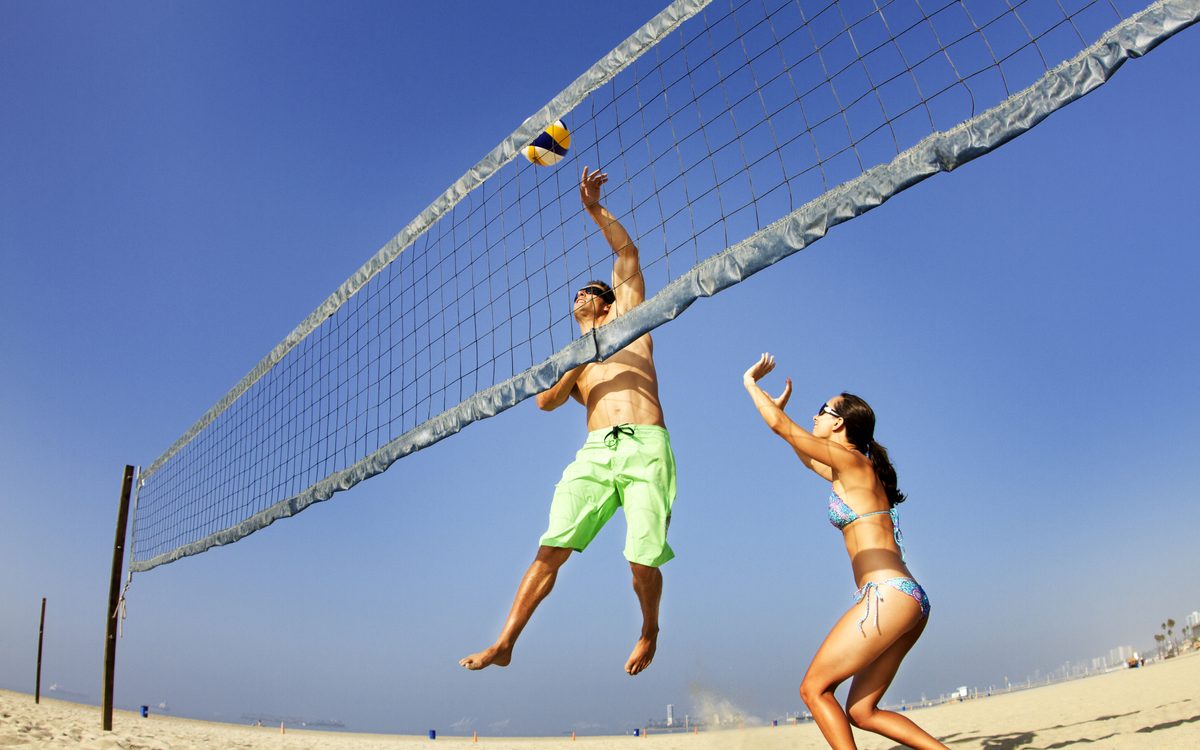
A rally on sand is over in seconds, but the day is not. A pair plays two or three matches in the heat, with rests of a minute or so between rallies, and by the last set the legs feel it more than the lungs. Beach volleyball training is the mix of sand skills, jumping, speed, strength and recovery that prepares two players to repeat short explosive efforts on an unstable surface. This page describes what research says about those demands and offers a general weekly shape. For rules and skills see Skills, Rules and Getting Started; for the indoor game see the volleyball hub.
Quick answer: Beach matches are many short bursts, mostly under about ten seconds, played on sand that slows you and raises heart rate. Research suggests training should build jumping, short-distance speed, leg and shoulder strength, and a base of fitness, and it should rise gradually. A sample week (general coaching practice, not a prescription) mixes two to four sand sessions, one or two strength sessions and at least one lighter day. Juniors and anyone with pain should ask a coach or a sports medicine professional before increasing load.
What a match demands
In a 2024 study of elite female players in playoff matches, 80 percent of rallies in both beach and indoor volleyball lasted up to 10 seconds, and players covered 4.5 to 10 meters in 60 percent of rally play (Hank and colleagues, PeerJ, 2,336 trajectories from eight beach and fourteen indoor players). Distance covered and Player Load, a measure of accumulated movement, were higher on sand, by up to 23 percent, and sand produced more explosive accelerations. A 2024 study comparing men’s matches found that active phases averaged about 6.0 seconds in beach and passive phases about 34 seconds (Durkovic and colleagues, J Funct Morphol Kinesiol).
Match length varies. An analysis of 14,432 men’s and 14,175 women’s FIVB World Tour matches from 2000 to 2010 found match durations averaging 30 to 64 minutes, with two-set matches averaging 78 to 80 rallies and three-set matches 94 to 96 (Palao and colleagues, J Hum Kinet 2012). Heart rate is high: in 16 Portuguese elite men playing a three-set match, mean heart rate was 146 beats per minute, about 75 percent of maximum, and players spent 34 percent of match time above 80 percent of maximum (Magalhaes and colleagues, J Sports Med Phys Fitness 2011). A 2025 comparison of twelve national-level men found more time at 90 to 100 percent of maximum heart rate on sand than indoors (Figueira and colleagues, BMC Sports Sci Med Rehabil).
Position matters. A study of 42 elite players filmed at a 2016 event found that jumps differed between blockers and defenders rather than between men and women (Natali and colleagues, J Sports Med Phys Fitness 2019). Among male players aged under 19, under 21 and senior, defender jumps were higher in seniors, and total rest time rose from the youngest group to the oldest (Medeiros and colleagues, J Sports Sci Med 2014).
Jumping on sand
Sand takes power away from the jump. In 15 elite male beach players, squat jump height was lower on sand than on a rigid surface, with maximal force and power also lower, and the authors attributed this to the compliance and instability of sand (Giatsis and colleagues, Sports Biomech 2004). A 2023 study of 11 young women with both indoor and beach backgrounds found the stretch-shortening cycle contributed more to jump height on sand (15.4 percent) than on a rigid surface (7.5 percent) (Giatsis and colleagues, J Funct Morphol Kinesiol). Practically, training on both surfaces seems sensible, but the studies are small and none says how to split the time.
A sensible weekly shape
No federation publishes a weekly plan for beach volleyball, and the studies above are descriptive. What follows is a general coaching template, offered as an example and not a prescription.
- Sand skills (two to four sessions). Serving, passing, setting, attacking and defending in two-player drills, with live games on at least one day. Keep sessions shorter when the sand is hot.
- Strength and power (one to two sessions). Lower-body lifts, jumps, trunk work and shoulder and upper-back strength. Youth lifting should be coached; the international consensus on youth resistance training says it is safe and beneficial when well supervised (Lloyd and colleagues, Br J Sports Med 2014).
- Conditioning (optional, one session). Repeated short sprints and agility on sand, or other aerobic work, matched to the long days of tournaments.
- Lighter day (at least one). Easy movement, mobility, or full rest, so hard days stay hard. See recovery.
Strength, speed and what the trials say
The evidence for specific methods is thin and small. In a 2026 trial of 22 adolescent beach players over 4 weeks, maximal power training had a large effect on jump height on both rigid and sand surfaces, while maximal strength training had a large effect on knee extensor torque (Li and colleagues, Res Q Exerc Sport). A 2025 study of 16 men found a half-squat session with low velocity loss gave 3.7 cm higher countermovement jumps 4 minutes later than a higher velocity-loss session (Aquino and colleagues, Int J Exerc Sci). In 11 indoor players, 12 weeks of beach training improved knee extensor and plantar flexor endurance and strength (Balasas and colleagues, J Sports Med Phys Fitness 2018). A pilot of six elite men found balance training improved static balance control (Sebastia-Amat and colleagues, Int J Environ Res Public Health 2020), but the authors called the sand-training results unproven.
Periodisation and load basics
Periodisation means planning the year in blocks, for example a build phase, a pre-competition phase, a tournament phase and an off-season, so that hard weeks are followed by lighter ones. That structure is general practice in sport, not specific to beach volleyball research. The 2016 IOC consensus statement on load in sport (Soligard and colleagues, Br J Sports Med) says that rapid increases in load raise injury risk and that athletes are better protected when load rises gradually; it does not give a single percentage rule, and neither do we. A 2021 study of 20 NCAA Division I women found competition load exceeded practice load once warm-ups were counted, and the authors called for careful load and fueling management (Bozzini and colleagues, J Strength Cond Res).
Tournament weekends add their own load. If you play on Saturday and Sunday, treat the training week before as part of the preparation, and do not add a hard session the day before a tournament. Youth players should have a day off each week and breaks from the sport, in line with the American Academy of Pediatrics statement on sport specialization (Brenner, Pediatrics 2016).
Training for the sun and heat
Heat is part of the training plan on sand. In a study of 47 male players over 50 matches at an average 33.6 degrees C, mean sweat rate was 1,440 ml per match and fluid intake 731 ml (Zetou and colleagues, J Sci Med Sport 2008). More on nutrition and hydration and injury prevention.
Beach volleyball training FAQs
How many days a week should I train for beach volleyball?
There is no official number. A common template is two to four sand sessions, one or two strength sessions and at least one lighter day, adjusted for age, season and how you feel. Juniors should ask a coach and keep a day off each week.
Is sand training better than gym training for jumping?
Neither replaces the other. Studies show lower jump height on sand, and sand adds load and instability, but the evidence on how to split time is limited and mostly small. Strength and power work off the sand is common practice.
How physically demanding is a beach match?
Heart rate averaged about 75 percent of maximum in one study of elite men, with about a third of match time above 80 percent. Most rallies lasted under about 10 seconds, with about half a minute between rallies on average in men’s matches.
Do I need to lift weights for beach volleyball?
Strength training is widely used, and short trials in beach players have found jump and strength gains, but the trials are small. Youth should lift only with qualified coaching.
How do I avoid overtraining?
Raise load gradually, include lighter days, sleep enough and report pain early. The IOC load statement links rapid load increases to injury, but it gives no single percentage rule.
Sources
- Hank et al., external load in indoor and beach volleyball, PeerJ 2024 (PMID 38188147)
- Durkovic et al., game dynamics, J Funct Morphol Kinesiol 2024 (PMID 38390928)
- Palao et al., match duration and rallies, J Hum Kinet 2012 (PMID 23486703)
- Magalhaes et al., physiological impact of beach volleyball, 2011 (PMID 21297565)
- Figueira et al., BMC Sports Sci Med Rehabil 2025 (PMID 41088313)
- Natali et al., physical and technical demands, 2019 (PMID 29199783)
- Medeiros et al., age groups, J Sports Sci Med 2014 (PMID 25177196)
- Giatsis et al., squat jump on sand, Sports Biomech 2004 (PMID 15079993)
- Giatsis et al., vertical jump kinetics, 2023 (PMID 37606410)
- Li et al., strength versus power training, Res Q Exerc Sport 2026 (PMID 42462264)
- Aquino et al., velocity-based training, 2025 (PMID 41079535)
- Balasas et al., beach training and muscle performance, 2018 (PMID 28558445)
- Sebastia-Amat et al., balance and sand training, 2020 (PMID 33276623)
- Soligard et al., IOC consensus on load in sport, 2016 (PMID 27535989)
- Bozzini et al., NCAA D1 women, 2021 (PMID 33927118)
- Lloyd et al., youth resistance training consensus, 2014 (PMID 24055781)
- Brenner, sports specialization and intensive training, Pediatrics 2016 (PMID 27573090)
- Zetou et al., body weight changes and fluid intake, 2008 (PMID 17363327)
General information for education only, not medical advice. It does not replace a visit with a sports medicine doctor, physical therapist or athletic trainer. See how we write and check our pages in our editorial policy.