This article contains affiliate links: if you buy through them we may earn a commission, at no extra cost to you. Read our affiliate disclosure.
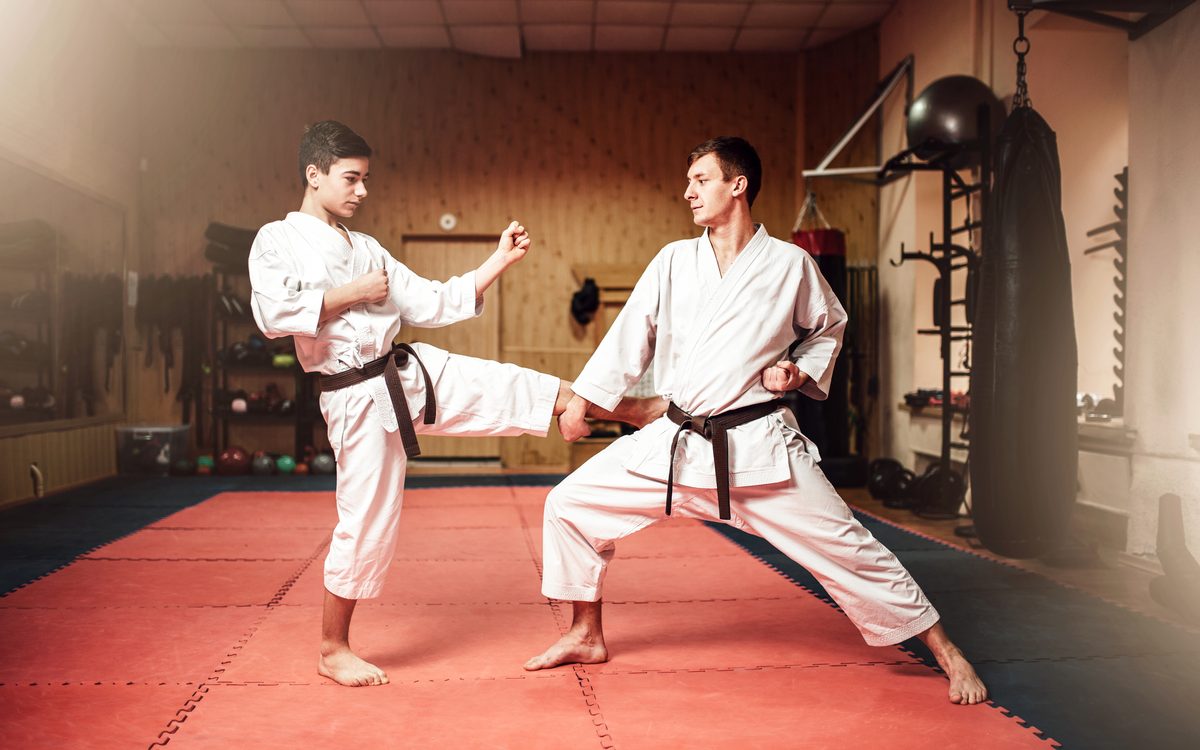
A karateka stands alone in the middle of the floor. A breath, a shout, and then two minutes of snapping punches, sharp stances and a spinning kick that finishes dead still, every line exact. Judges raise their scores. Twenty minutes later, on the next mat, two fighters in red and blue belts trade quick punches and score with a snap of the leg, and the referee halts it the instant one lands. That is karate (“empty hand”), an art that began in Okinawa, with two sides, kata (forms) and kumite (sparring), and a short but famous Olympic story.
Karate guides: what do you need?
New to karate? Start with the first card. Everything here is general education, not medical advice.
History & Origins of Karate
Karate began on Okinawa, the main island of the Ryukyu chain in southern Japan, and was introduced to mainland Japan in the 1920s, and university students there wrote competition rules in the 1950s (Olympics.com). Competition grew from there: the World Union of Karatedo Organizations (WUKO), the forerunner of today’s WKF, was founded on October 10, 1970, and Tokyo hosted its first World Championships the same year, with 33 countries and only men’s individual and team kumite (WKF). Karate then reached the Olympics on its home ground, at Tokyo 2020 (held in August 2021), in the Nippon Budokan, the venue of that first World Championships (WKF). Modern competition has two parts: kata, a judged performance of set forms, and kumite, sparring in weight categories. Karate’s older Okinawan roots are described in several traditions that differ in detail; we cover only documented milestones here.
- 1920s: Karate is introduced to mainland Japan from Okinawa.
- 1950s: University students on the mainland write competition rules.
- October 10, 1970: WUKO is founded; the first World Championships follow in Tokyo, with men’s kumite only.
- 2021 (Tokyo 2020): Karate makes its Olympic debut, with kata and kumite for men and women, on August 5 to 7 at the Nippon Budokan.
- 2024: Karate is not on the Paris 2024 programme (Olympics.com).
- November 2025: The World Senior Championships are held in Africa for the first time, in Cairo (press report on the WKF’s statement).
Legends of the Sport
Athletes from the Olympic and world-championship era, in no ranking.
- Ryo Kiyuna (JPN): won the first Olympic men’s kata title at Tokyo 2020, ahead of Spain’s Damián Quintero (Olympics.com).
- Sandra Sánchez (ESP): won the first Olympic women’s kata title at Tokyo 2020 as defending world champion, beating Japan’s Kiyou Shimizu in the final (Olympics.com).
- Steven Da Costa (FRA): Olympic men’s -67 kg champion in 2021 and world champion in the same category again in 2023 (Olympics.com, WKF).
- Luigi Busa (ITA): Olympic men’s -75 kg champion, winning the final 1-0 over Azerbaijan’s Rafael Aghayev (Olympics.com).
- Sajad Ganjzadeh (IRI): Olympic men’s +75 kg champion at Tokyo 2020 (Olympics.com).
- Feryal Abdelaziz (EGY): Olympic women’s +61 kg champion, winning the final 2-0 over Azerbaijan’s Iryna Zaretska (Olympics.com).
- Irina Zaretska (AZE): won women’s -68 kg at the 2023 World Championships, her second straight world title (WKF).
- Youssef Badawy (EGY): three-time world champion at -84 kg after Cairo 2025 (WKF).
- Kakeru Nishiyama (JPN): men’s kata world champion at Cairo 2025 after a bronze at Budapest 2023 (WKF).
Official results and records
We only list champions and records here after checking them on the official source. For the latest results, go to:
- Olympics.com Tokyo 2020 karate results
- Sánchez
- Busa
- Ganjzadeh
- WKF: Meet the new World Champions
- WKF
- WKF
- WKF
How we keep this current: we re-check facts after each major championship and update this page. Spot an error? See our editorial policy.
This page is for beginners, parents and fans: how competition works, the main styles of training, who practices karate from child classes to the world stage, what Olympic status it has, what the sport asks of the body, injuries to know about, and the gear that matters. It is general information, not medical advice.
Karate at a glance
| What it is | A striking martial art using punches, kicks and strikes, practiced in a white karategi (uniform) with a colored belt. |
|---|---|
| How it is scored | Kumite: 1 point (yuko) for a punch, 2 (waza-ari) for a kick to the body, 3 (ippon) for a kick to the head or a strike on a thrown or fallen opponent; an 8-point lead ends the bout. Kata: judges score technique and athletic performance. |
| Disciplines | Kata (forms) and kumite (controlled sparring). |
| Participants and levels | Children’s dojos, school and club teams, adult recreational classes, national and world championships. |
| Where it is played | A dojo; competition on a mat area with referees and judges. |
| Governing bodies | The World Karate Federation (WKF) is the international body for competition karate; USA Karate (USA National Karate-do Federation) for Olympic-style karate in the US. |
| Seniors’ bout time | 3 minutes for kumite (WKF rules). |
How karate works
Olympics.com notes that karate emerged in Okinawa several hundred years ago. In WKF competition, kumite fighters score with controlled techniques, meaning clean, accurate, well-timed strikes that stop at or near the target rather than knock an opponent out. In the WKF rules, a punch scores one point, a kick to the body two, a kick to the head three (or a strike on a fallen opponent), and a bout ends early if one fighter leads by eight points. In kata, athletes perform a set sequence of techniques against imaginary attackers; the WKF says there are 102 approved kata and that seven judges score, with 70% of the mark for technical performance and 30% for athletic performance.
Outside tournaments, karate classes often combine basics (kihon), forms and partner drills, with light sparring added over time. Schools follow different traditional styles, and their rules, uniforms and belts can differ, so ask a dojo about its style. Belts are called kyu (colored) and dan (black belt grades).
Formats and disciplines
Kumite is divided by weight and by age. Under WKF rules, athletes under 14 must wear a helmet and chest protector, head techniques are limited to a light touch in the rules, and fingernails must be short. Kata is judged, not fought. Other karate competitions use their own rule sets, so check which one an event uses before entering.
Who plays karate and at what level
Children and teens
Karate is among the most common children’s martial arts. The American Academy of Pediatrics reports that karate has lower and less severe injury rates than taekwondo because most karate is non-contact or light-contact, and that WKF rule changes in 2000 lowered risk for athletes under 18. It found 5.6 injuries per 100 youth athletes over 12 months. Its advice: qualified instructors and delaying contact until a child has the maturity and skill, plus caution about training more than three hours a week.
Adults and clubs
Adult classes are a mix of fitness, discipline and technique, and many students never compete. Karate is practiced mostly through dojos and club teams. USA Karate is the US body for WKF-style competition and runs national championships.
Olympic and Paralympic status
Karate made its Olympic debut at Tokyo 2020 in Japan, with kata and kumite events. Olympics.com lists kumite in three weight classes each for men and women and one kata event for each, with around 80 athletes. Karate was not on the Paris 2024 program, and it is not on the LA28 program: in October 2023, USA Karate relayed a World Karate Federation notice that karate would not be included in the final selection of additional sports for LA28. The WKF has since said it keeps working for inclusion in later Games, but we could not confirm a decision for Brisbane 2032. Karate is not a Paralympic sport as far as we can confirm. Check the official programme for the current Games.
Physical demands of karate
Karate combines speed, balance, flexibility and power. Kumite is explosive: short bursts of footwork and quick strikes with brief pauses. Kata needs strength to hold low stances, control of the hips and core, and focus. A 2026 study of elite karate athletes found men had more explosive leg power while women showed more hip abduction range of motion, a reminder that training should fit the person. A good class warms up the hips, hamstrings and shoulders first.
Health and safety in karate
The AAP found karate carries lower injury risk than taekwondo, but injuries still happen. This section is general information, not medical advice. If you are hurt, see a sports medicine doctor, physical therapist or athletic trainer.
Injury patterns
An analysis of four World Karate Championships (2010 to 2016, Orthopaedic Journal of Sports Medicine, 2019) found about 1.4% of athletes had a time-loss injury; among those, fractures made up 41%, dislocations 20% and concussions 12%. At the 2023 Iranian junior championships (1,391 athletes, 1,544 bouts), the injury rate was 18.94 per 1,000 athlete-exposures. The face accounted for 46% of injuries, contusions for 48%, over half occurred in the first minute, and losing athletes had 59% of the injuries. A study of Japanese university competitions from 2000 to 2014 found the face was the most common injury site, followed by lower limbs. The AAP’s review of emergency department data found karate made up 79.5% of US children’s martial arts visits from 1990 to 2003.
Concussion and protective rules
Head contact is limited by rule, especially for younger athletes, yet concussions occur. Use the CDC HEADS UP approach: recognize the signs (headache, dizziness, confusion, balance problems), remove the athlete from practice or competition, and have a healthcare provider decide when to return. Call 911 for danger signs such as repeated vomiting, a seizure, or one pupil larger than the other. The AAP says there is no evidence that headgear reduces concussion, and that mouthguards reduce dental injuries; in a 2026 Brazilian study of martial artists, about 79% of those who had dental trauma were not wearing a mouthguard at the time.
Training, recovery and nutrition pointers
Karate training builds on repetition: stances, basics, kata and partner work. Many students add mobility work for hips and hamstrings and leg strength for deep stances. See the martial arts training page, the recovery page and nutrition and supplements page. The CDC recommends 9 to 12 hours of sleep for ages 6 to 12, 8 to 10 for teens and at least 7 for adults. A foam roller or a massage gun is a comfort tool after a long class, not a treatment. Athletes who compete by weight should avoid rapid weight cutting and ask a doctor or sports dietitian for help.
Karate gear
You need a karategi and belt to start; many dojos sell them. For WKF-style competition, check the current WKF equipment list, since tournaments may require approved uniforms and mitts, and “WKF approved” on a retail listing is the seller’s claim. Mitts (hand protectors) and a mouthguard are part of sparring gear; kids under 14 also need a helmet and chest protector under WKF rules. Buy gear that fits and replace padding when it flattens or cracks.

Ronin Lightweight Karate Gi
- 100% cotton
- Student training uniform
- Kids and adult sizes

Daedo Shodan Karate Uniform
- WKF approved (listing)
- 80/20 poly-cotton
- Check your tournament's rules
$98.99 at Amazon, as of Nov 17, 2026 01:07 UTC
Check price on Amazon
Daedo WKF Approved Karate Gloves
- WKF approved (listing)
- Padded sparring mitts
- Check size and rules

Shock Doctor Gel Max Mouthguard
- Boil-and-bite gel-fit liner
- Breathing channels
- Youth and adult
$11.99 at Amazon, as of Nov 17, 2026 01:07 UTC
Check price on AmazonRelated sports and disciplines
Karate sits within martial arts. Its neighbors include taekwondo, judo, Brazilian jiu-jitsu, kickboxing and Muay Thai.
Karate FAQs
Is karate in the Olympics?
It was at Tokyo 2020 only. It was not on the Paris 2024 program and is not on the LA28 program. We could not confirm anything for Brisbane 2032. Check the official programme.
What is the difference between kata and kumite?
Kata is a solo (or team) performance of a set sequence, judged on technique and athletic performance. Kumite is sparring against an opponent, scored on controlled strikes.
Is karate safe for kids?
The AAP says karate has lower and less severe injury risk than taekwondo, but risk is not zero. Look for qualified instructors, age-appropriate contact and a school with a clear concussion policy.
Karate or taekwondo for my child?
Karate uses hands and feet and, in many classes, light or no contact; taekwondo is kick-focused with full-contact Olympic sparring. Visit both schools, watch a class and ask about contact rules for your child’s age.
Do I need a mouthguard?
For sparring, a mouthguard helps protect teeth. Ask your dojo what it requires, and see a dentist for a custom fit if you wear braces.
Sources
- World Karate Federation: what is kumite and what is kata
- WKF Kumite Competition Rules 2026
- Olympics.com: Karate and Karate at Tokyo 2020
- USA Karate: Update on 2028 (7 October 2023)
- American Academy of Pediatrics: Youth Participation and Injury Risk in Martial Arts
- Injuries at four World Karate Championships (PubMed 31489331)
- Injuries in junior karate athletes, Iran (PubMed 41582186)
- Injuries in Japanese university karate competitions (PubMed 42835481)
- Dental trauma in martial arts practitioners, Brazil (PubMed 42645484)
- Sex differences in elite karate athletes (PubMed 42197970)
- CDC HEADS UP: signs and symptoms
Keep exploring: the martial arts hub, martial arts injuries, martial arts gear, our recovery tools guide, and every sport on our sports hub.