This article contains affiliate links: if you buy through them we may earn a commission, at no extra cost to you. Read our affiliate disclosure.
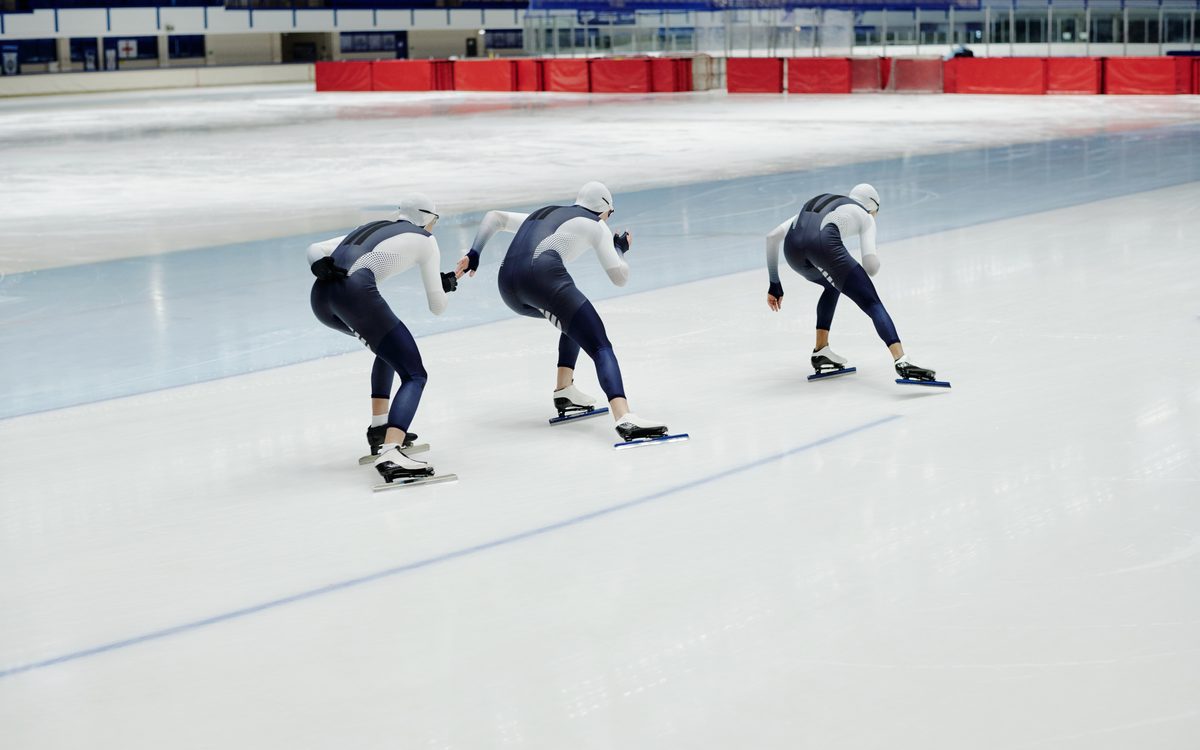
Several skaters lean through the same corner of a hockey rink, one hand brushing the ice, blades inches apart, and the whole pack is traveling at speeds a 2025 study of international races says are often above 50 km/h (about 31 mph). A race can turn on a single pass, or on a fall. That is short track speed skating (often just “short track”), the pack-racing version of speed skating that US Speedskating calls “NASCAR on ice.” Its best-known American star, Apolo Ohno, is the most decorated US Winter Olympian, with eight medals.
Short-Track Speed Skating guides: what do you need?
New to short-track speed skating? Start with the first card. Everything here is general education, not medical advice.
History & Origins of Short Track Speed Skating
Short track grew out of ice speed skating as a pack-racing format on a small oval, run on a hockey-size rink. We found no official page that documents where the first short track races were held, so we do not give an origin story. What is documented: the International Skating Union (ISU) recognised short track as a separate sport in 1967, the first World Championships were held in 1981, it was a demonstration event at the 1988 Calgary Olympics, and it became a full medal sport at Albertville in 1992 with individual and relay events for men and women (Olympedia). The mixed 2000 m relay was first held at Beijing 2022. Today’s Olympic program has nine short track events.
- 1967: ISU recognises short track as a separate sport.
- 1981: First World Championships.
- 1988: Demonstration event at the Calgary Olympics.
- 1992: Full Olympic medal sport at Albertville.
- 2022: First mixed relay at the Beijing Olympics.
- 2026: At Milano Cortina, Corinne Stoddard wins bronze in the women’s 1500 m, Team USA’s first medal in that event (US Speedskating).
Notable Athletes
Olympic medal counts are from Olympedia; the list is not a ranking.
- Apolo Anton Ohno (USA): eight Olympic short track medals, the most of any US Winter Olympian (US Speedskating).
- Viktor An (Korea, later Russia): six Olympic golds and eight medals in total.
- Marc Gagnon (Canada): five Olympic medals, three of them gold.
- Wang Meng (China): six Olympic medals, four of them gold.
- Charles Hamelin (Canada): six Olympic medals, four of them gold.
- Jeon Lee-Gyeong (Korea): five Olympic medals, four gold.
- Suzanne Schulting (Netherlands): six Olympic medals, three gold, including the Netherlands’ short track success.
- Arianna Fontana (Italy): among the most decorated short track Olympians in Olympedia’s table, with medals across several Games.
- Choi Min-jeong (Korea): four golds and three silvers in Olympedia’s table.
Official results and records
For current champions and standings, use the official pages:
- International Skating Union (ISU): rules and championships
- ISU results: World Tour and World Championships results
- Olympics.com short track: Olympic results
- US Speedskating: US short track team news
How we keep this current: we re-check facts after each major championship and update this page. Spot an error? See our editorial policy.
This page explains how short track differs from long track speed skating, how racing and Olympic events work, what the research says about falls and blade cuts, and the safety gear that is required in competition. It is general information, not medical advice.
Short track at a glance
| What it is | Pack racing on ice: several skaters start together, skate counterclockwise and race to the finish line. |
|---|---|
| How it is won | First across the line, with elimination rounds leading to a final. A skater who breaks the racing rules can be disqualified from that race. |
| Track | 111.12 m oval on a rink at least 60 x 30 m, the size of an Olympic hockey rink, with padded mats along the boards. |
| Distances | 500 m, 1000 m, 1500 m and relays (3000 m women, 5000 m men, 2000 m mixed team). |
| Governing bodies | The International Skating Union (ISU) worldwide; US Speedskating in the US. |
| Season | Winter; the ISU World Tour has seven events in the 2026-27 season, starting in Vancouver on October 23 to 25. |
How short track works
Because the oval is only 111.12 m around, a 500 m race is four and a half laps, a 1000 m race nine laps and a 1500 m race thirteen and a half (our arithmetic from the ISU’s track length). Skaters race in a pack rather than in lanes, which is why tactics matter as much as speed: hang back and save energy, or break away and hold the lead through the corners. Under ISU Rule 295, skaters go counterclockwise, overtaking is allowed at any time, and the overtaker is responsible until they are alongside. Penalties are enforced by disqualification from that race.
The ISU’s 2026 guidance lists common calls: skating off the track, impeding, taking assistance, kicking out a skate and embellishing a fall. Relays are team events, and the mixed relay combines men and women.
Who plays it, and at what level
Learning to skate. US Speedskating points beginners to the Learn to Skate USA program, endorsed with US Figure Skating and USA Hockey, and lists just over 60 ice clubs. For the youngest racers, the US Speedskating “Devo” track uses shorter straights with a full-size turn radius and emphasizes skills, racing strategies and fun over times.
Age groups and clubs. US Speedskating’s 2025-26 short track regulations set Age Group Nationals divisions: Junior E (ages 7 to 10), D (11-12), C (13-14), B (15-16), A (17-18) and Senior (19-29), plus masters divisions.
National and international. The US Short Track Championships (the 2026 edition in Kearns, Utah, where Brandon Kim and Kristen Santos-Griswold won the overall titles) lead to national teams. The ISU runs the World Cup, the World Tour, junior events and the World Championships; for 2026-27 the ISU calendar lists the short track World Championships in Seoul and the Junior Worlds in Astana. Under ISU rules, a country can send up to 10 skaters to the Olympics, with quota decided by World Tour results.
Olympic status
- Since 1992: short track has been an Olympic Winter Games sport, according to US Speedskating. Long track has been Olympic since 1924.
- Events: the ISU’s 2026 rules list nine Olympic events: 500 m, 1000 m and 1500 m for women and men, the women’s 3000 m relay, the men’s 5000 m relay and the 2000 m mixed team relay.
- Next Games: for the current Olympic Winter Games program and any change to the event list, check the official programme for the current Games.
Physical demands
Short track is a sprint sport with a surprising endurance side. In a 2026 study of nine national-level elite men, the estimated aerobic contribution was 22.2% of the energy in a 500 m race, 35.3% in a 1000 m and 44.3% in a 1500 m. Skaters stay in a deep crouch, and a study of elite short-track skaters found local leg-muscle oxygen levels dropped to their lowest values much faster than whole-body oxygen uptake peaked, which is part of why holding the position hurts. A 2026 review of Olympic ice sports describes high annual training volumes (900 to 1,100 hours a year) with polarized, mixed training. A small study of a dry-land start-training block found a small on-ice improvement in start time, which gives coaches a reason to include start practice off the ice.
Health and safety for short track
This section is general information. If something hurts, see a sports medicine doctor, physical therapist or athletic trainer.
Falls and injury patterns
A 2025 video analysis of every short track fall in 16 international competitions from 2021 to 2023 counted 1,505 falls in 18,631 race entries, an average of 94 per competition. About 61% were group falls, and the authors identified skater interactions as the main cause. For the Canadian team, 7.1% of falls led to injury, mostly spinal strains and bruises on the lower legs. A 2025 study of 69 German national short-track athletes recorded 371 injuries needing medical consultation, about 0.53 per 1,000 hours, with about 70% in the lower body, mainly knee and ankle. An older survey of 95 elite skaters found 64.2% had been injured in a season, and the most common past on-ice injuries were lacerations from the knee down (11.1%) and ankle fractures (10.2%). A 2024 scoping review found few high-quality studies of prevention in speed skating.
Cut protection and equipment rules
The ISU’s protection communication (No. 2636, May 2024) says short track races involve risks of cuts, concussions and puncture wounds, particularly from skates in a collision or fall. It sets cut-resistant fabric levels based on the EN 388 standard, covers risk areas such as the neck, groin, armpits, lower arms, hands, front of the knees and ankles, and adds that no equipment can assure full protection. The ISU 2026 short track rules require, among other items, a helmet that meets the ASTM standard or is ISU-approved, cut-resistant gloves, shin and padded knee protection, long sleeves and legs, cut-resistant neck protection that fully covers the neck, approved eye protection and blades with closed tubes and rounded ends. US Speedskating requires members to wear full-body cut-resistant protection and sets higher levels for selection events than for regional and club racing; it also names a helmet to the current ASTM short track standard. Check your club’s and event’s rules before buying anything.
Two studies in the 2024 review found short-track helmets performed poorly compared with helmets in other sports. For concussion, the CDC’s HEADS UP guidance is to recognize the signs, stop play immediately, and have a healthcare provider decide when the athlete may return. If a skater is cut or bleeding heavily, apply direct pressure and call 911.
Training, recovery and nutrition pointers
Training mixes on-ice and dry-land work, and the demands above are a starting point for a coach. For basics, use the speed skating hub pages for training, recovery and nutrition and supplements, and see our speed training equipment guide.
Gear for short track
- Skates: a boot with a blade mounted to the ISU’s rules (closed tubes, rounded ends). Fit matters most; ask a club coach or a specialist retailer.
- Helmet: to the ASTM standard named in the ISU and US Speedskating rules. Check the event’s rules for the level you race at.
- Cut protection: a cut-resistant suit or underlayer, gloves, neck protection and ankle protection at the level your event requires.
Three picks from Amazon listings: the LAND Glacier Youth Short Track helmet, listed as tested to ASTM F1849-23 and F1446-20 (it is not on the ISU’s recognized-helmet list in Communication 2636, so treat it as a training or club option and check your event’s rules); the Bauer NLP21 cut-resistant neck guard, a hockey product, so confirm it meets your event’s neck coverage requirement; and the SPRI slide board for off-ice training. Details come from the listings, not our testing. More in our speed skating gear page.

LAND Glacier Youth Short Track Helmet
- Listing: tested to ASTM F1849-23
- EPS liner, adjustable fit
- Check your event's rules

Bauer NLP21 Cut Resistant Neck Guard
- Cut-resistant hockey neck guard
- Youth 10-14 in, senior 13.5-17 in
- Check event requirements

SPRI Slide Board
- 71 x 20 in, 4 lb
- Booties and bag included
- Lateral leg work
$45.28 at Amazon, as of Nov 17, 2026 02:07 UTC
Check price on AmazonRelated sports and disciplines
- Speed skating: the parent sport, with rules, youth and injuries pages.
- Long-track speed skating: the 400 m oval and timed races.
- Ice hockey and figure skating: other sports on the ice.
Short track FAQs
What is the difference between short track and long track?
Short track is pack racing on a 111.12 m oval on a hockey-size rink. Long track is a 400 m oval where skaters race in pairs against the clock. Long track has been Olympic since 1924 and short track since 1992.
How long is a short track race?
It depends on the distance. A 500 m race is four and a half laps and a 1000 m race is nine.
Is short track speed skating dangerous?
It carries real risks: falls are frequent at high speeds, and blades can cut. That is why cut-resistant suits, gloves, neck protection, helmets and eye protection are required in competition. Beginners start with coaching and club rules, so ask what protection your club requires.
What equipment is required?
US Speedskating requires a helmet to the ASTM short track standard, cut-resistant gloves and neck protection, shin and padded knee protection, eye protection and cut-resistant clothing. The level depends on the event; ask your club.
Is short track in the Olympics?
Yes, since 1992, with nine events in the ISU’s 2026 rules. Check the official programme for the current Games for the next program.
Sources
- ISU 2026 Short Track Sport Rules
- ISU Short Track Guidance to the Racing Rules 2026
- ISU Communication No. 2636, Protection equipment (2024)
- US Speedskating, Speedskating 101
- US Speedskating Short Track Rules and Regulations 2025-26
- US Speedskating at the Olympics
- ISU 2026-27 season calendar
- Clément et al. 2025, short track falls (PubMed)
- Quinn et al. 2003, injuries in short track (PubMed)
- Hendricks et al. 2024, scoping review of speed skating injuries (PubMed)
- Hesford et al. 2013, muscle oxygenation in short track (PubMed)
- Sperlich et al. 2026, Olympic ice sports review (PubMed)
- CDC HEADS UP
Keep exploring: the speed skating guide, speed skating injuries, compression boots, recovery tools, and every other sport on our sports hub.