This article contains affiliate links: if you buy through them we may earn a commission, at no extra cost to you. Read our affiliate disclosure.
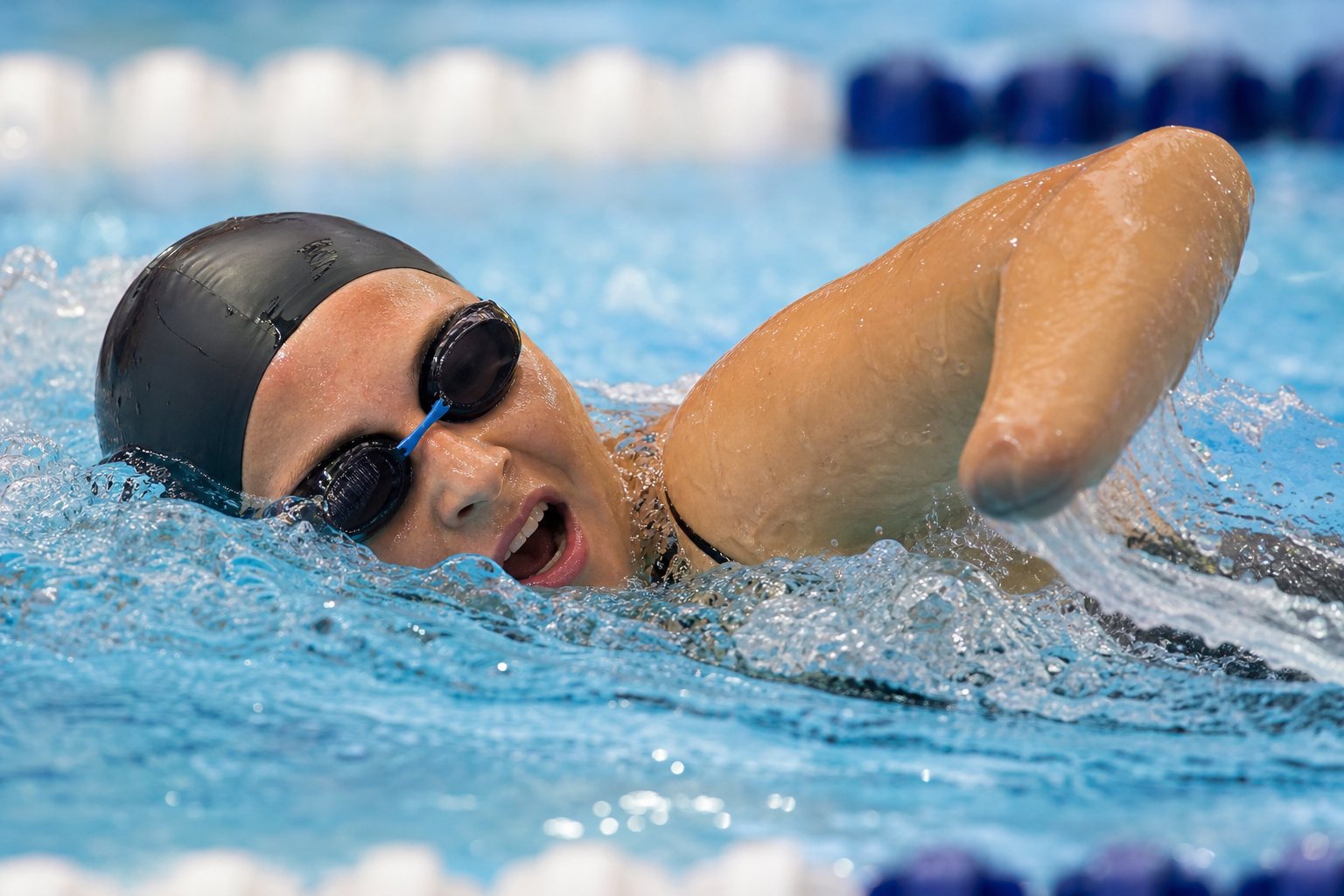
The swimmer in lane four is blind, and she is about to turn. As she nears the wall, an assistant at the end of the pool taps her to signal the turn. A lane over, a swimmer with one arm launches from a dive, and in the next lane a swimmer starts from the water, holding a grip at the end of the pool. Para swimming (Paralympic swimming) is competitive swimming for athletes with physical, vision or intellectual impairments, raced in the same strokes and pools as Olympic swimming but with a classification system that groups swimmers by how an impairment affects their swimming.
Para Swimming guides: what do you need?
New to para swimming? Start with the first card. Everything here is general education, not medical advice.
History & Origins of Para Swimming
Para swimming was one of eight sports at the first Paralympic Games, Rome 1960, where 77 swimmers from 15 countries competed in 62 medal events. All of them had spinal cord injuries and the longest race was 50 m (Paralympic.org). The sport has grown by opening to more impairment groups: amputee and vision impaired swimmers joined in 1976, athletes with cerebral palsy in 1980, the Les Autres group in 1984 and swimmers with an intellectual impairment in 2000. By Tokyo 2020 there were 604 swimmers from 74 countries in 146 medal events. In 2017 a World Series was launched to give more classification opportunities and top-level competition.
- 1960, Rome: 77 swimmers, 15 countries, 62 medal events; all had spinal cord injuries.
- 1964, Tokyo: racing takes place in a 50 m pool because the Olympic pool had been converted to an ice rink.
- 1976, Toronto: amputee and vision impaired athletes join; 146 golds on offer, up from 56 in Heidelberg 1972.
- 1980, Arnhem: athletes with cerebral palsy compete for the first time.
- 1984: Games split between Stoke Mandeville and New York; Les Autres added as a new group.
- 2000, Sydney: swimmers with an intellectual impairment compete for the first time.
- 2017: World Series launched.
- 2020, Tokyo: 604 swimmers from 74 countries in 146 medal events.
Official results and records
- Paralympic.org: Para swimming results
- Paralympic.org: Para swimming
- World Aquatics: swimming (includes Para swimming records and results pages)
Legends of the Sport
Para swimmers with the most Paralympic medals, as listed by Paralympic.org. This is not a ranking.
- Trischa Zorn (USA): 32 gold and 46 total Paralympic medals between 1980 and 2004, including 7 golds in 1980 and 10 in 1988.
- Jessica Long (USA): 29 medals including 16 golds, competing from 2004.
- Béatrice Hess (FRA): 25 medals including 20 golds between 1984 and 2004.
- Daniel Dias (BRA): 27 medals including 14 golds between 2008 and 2020.
- Mike Kenny (GBR): 16 golds, all won between 1976 and 1988.
How we keep this current: we re-check facts after each major championship and update this page. Spot an error? See our editorial policy.
Para swimming at a glance
| What it is | Freestyle, backstroke, breaststroke, butterfly, individual medley and relays, swum in a sport class with other swimmers whose impairments affect swimming in a similar way. |
|---|---|
| How it is won | Fastest time in each event and class, as in other swimming. No prostheses or assistive devices may be worn during competition. |
| Participants and levels | Swimmers with physical, vision or intellectual impairments, from local clubs to the Paralympic Games. |
| Where it is played | 50 m pools. At Paris 2024, an Olympic-sized pool of 10 lanes with eight lanes used. |
| Governing body | World Para Swimming, part of the International Paralympic Committee, based in Bonn, Germany. In the US, USA Swimming and US Paralympics. |
| Games | Paralympic sport since Rome 1960; 141 medal events at Paris 2024. |
How it works: strokes, classes and starts
The strokes and distances are the familiar ones. The difference is in the code that follows the event: S for freestyle, backstroke and butterfly, SB for breaststroke and SM for individual medley. After the letter comes the number of the swimmer’s sport class. Paralympic.org says there are ten classes for physical impairment (1 to 10, with breaststroke classes SB1 to SB9), three for vision impairment (11 to 13) and one for intellectual impairment (14).
- Physical classes, 1 to 10: based on how the impairment affects swimming, not on the impairment itself, so swimmers with different impairments can compete against each other. Classifiers score the swimmer’s body functions and watch a water assessment; the swimmer’s S and SB classes can differ.
- Vision, 11 to 13: class 11 means very low visual acuity or no light perception; 12 has higher acuity and/or a visual field under 5 degrees radius; 13 is the least severe eligible impairment (visual field under 20 degrees radius).
- Intellectual, 14: swimmers typically have difficulty with pattern recognition, sequencing and memory, or slower reaction times.
- SM is an index: the medley class is not a separate class. It is calculated as (3 x S class + SB class) divided by 4, per Paralympic.org.
Starts are adapted. Paralympic.org says swimmers can start with a dive, from in the water, holding a grip, or even holding a rope with the mouth. Swimmers in class 11 must have a tapper for safety and wear blackened goggles so competition is fair; classes 12 and 13 may choose whether to use a tapper. No prostheses are allowed in competition. For the general rules of the pool see our swimming rules page.
Who swims, and at what level
Getting started. US Paralympics says the sport is open to male and female athletes with physical disabilities including dwarfism, limb loss, visual impairment, spinal cord injury or wheelchair use, cerebral palsy, brain injury or stroke, and cognitive impairment. The same site lists getting-started pages, classification, camps and clinics, a resident team program, and “Swimming in College”. We did not confirm details of youth or club programs from it, so ask your local swim club, aquatics center or adaptive-sports group; many clubs coach swimmers with and without disabilities together. Our youth swimming page covers the general club route.
Competitions. World Para Swimming holds the Paralympic Games every four years, World Championships every two years, regional championships and the World Series, a set of meets launched in 2017 to offer more classification and top-level competition opportunities. The 2027 World Championships are listed as returning to Mexico on the World Para Swimming news page.
Paralympic status, by edition. Para swimming was one of eight sports at the first Games in Rome in 1960, where 77 swimmers, all with spinal cord injuries, from 15 countries raced in 62 medal events. Amputees and swimmers with a vision impairment joined at Toronto 1976, swimmers with cerebral palsy at Arnhem 1980 and swimmers with an intellectual impairment at Sydney 2000. At Tokyo 2020, 604 athletes from 74 National Paralympic Committees took part. At Paris 2024, over 600 swimmers raced in 141 medal events at Paris La Defense Arena, making it the second-largest Paralympic sport by athlete numbers. China topped the swimming medal table for a third Games in a row; the all-time leader by medals is the United States (724, with 283 golds). Para swimming is on the initial 22-sport program for the Los Angeles 2028 Paralympics (15 to 27 August 2028); we have not confirmed its medal-event count there, so check the official programme.
Physical demands
Swimming is a whole-body sport, but the demands depend on the swimmer’s body. Many swimmers rely heavily on the arms and shoulders for propulsion, and the pull phase puts repeated load through the shoulder. In a small study of 15 elite Paralympic swimmers, Cavaggioni and colleagues found that strength and power measured in the lat pull-down and bench press were related to 100 m freestyle speed, which is one reason many programs include strength training with the swimmer’s coach. Technique, streamlining and turns matter as much as strength. See our swimming training page.
Health and safety in Para swimming
This is general information, not medical advice; what applies depends on the swimmer’s impairment. See a sports medicine doctor, physical therapist or athletic trainer who knows Para sport.
Shoulders first
The shoulder is the joint to watch. In a one-year study of 102 Brazilian Para athletes across swimming, athletics, powerlifting and taekwondo, injuries to the shoulder complex had the greatest burden, followed by the ankle and knee. A 2026 ultrasound study of 43 elite Polish Para swimmers (classes S7 to S10 with lower-limb impairments) compared 22 swimmers with rotator cuff tendinopathy to 21 without and found differences in tendon thickness and structure, which shows that shoulder problems are a real issue at the top level. Pain that lingers, night pain, weakness or a shoulder that catches needs a professional, not more laps.
Pool safety and head injury
Agree signals with your coach and tapper, learn the layout of the wall, and keep the pool deck dry and clear. Athletes with a vision impairment may have a higher chance of concussion in some Para sports, according to a 2024 narrative review, though the evidence is limited and not specific to swimming. The CDC’s HEADS UP program lists headache, dizziness, confusion and balance problems as signs. Anyone who hits their head should leave the water and see a healthcare provider before returning; call 911 for danger signs such as repeated vomiting or a seizure. Swimmers who start from a dive or from the deck should be coached on safe entry for their body.
Training, recovery and nutrition
Sleep comes first: the CDC recommends at least 7 hours for adults and 8 to 10 for teens. After long sessions, many swimmers stretch, use a foam roller or wear soft recovery shoes; these are comfort tools, not treatment. See swimming recovery, swimming nutrition and supplements and the recovery shoes guide.
Gear
Competition equipment follows the federation’s rules; no prostheses may be worn during a race, and class 11 swimmers use blackened goggles. For training, the usual pool kit is the same as for any swimmer: goggles, cap and earplugs if you need them. Ask your coach what suits your body, and check the rules before competition.
Three picks for everyday training: the Speedo Vanquisher 2.0 Mirrored goggles, the Speedo silicone cap and Mack’s AquaBlock earplugs.

Speedo Vanquisher 2.0 Mirrored Swim Goggles
- Panoramic lens
- Anti-fog, UV protection
- Interchangeable nosepieces


Mack's AquaBlock Swimming Earplugs
- Silicone
- Reusable
- 2 pairs
$6.99 at Amazon, as of Nov 17, 2026 01:07 UTC
Check price on AmazonRelated sports
Parent: swimming. Siblings: open water swimming, Para athletics, Para triathlon, wheelchair basketball.
Para swimming FAQs
What do S, SB and SM mean?
S is for freestyle, backstroke and butterfly, SB for breaststroke and SM for individual medley. The number after it is the swimmer’s class: 1 to 10 for physical impairment, 11 to 13 for vision and 14 for intellectual impairment.
What is a tapper?
An assistant who taps a swimmer with a vision impairment to signal an approaching wall or turn. In class 11 a tapper is required for safety; in classes 12 and 13 swimmers choose.
Can Para swimmers wear prostheses in a race?
No. Paralympic.org and US Paralympics both say prostheses and assistive devices are not allowed during competition.
How do swimmers start if they cannot dive?
Rules allow a dive, a start from in the water holding a grip, or, for some swimmers, holding a rope with the mouth.
How do I get classified?
Classifiers assess body function and a water test; the process is run by the federation, and US Paralympics lists classification pages for athletes. Ask a coach or your national federation where the next evaluation opportunity is.
Sources
- Paralympic.org: Paris 2024, introduction to Para swimming
- Paralympic.org: Para swimming classification
- US Paralympics: about Para swimming
- World Para Swimming
- Paralympic.org: LA28 initial sport programme
- Madaleno et al. 2025, injuries in Para athletes across four sports (PubMed)
- Pozarowszczyk-Kuczko et al. 2026, rotator cuff in Para swimmers (PMC)
- Cavaggioni et al. 2024, dryland strength and Paralympic swimming (PubMed)
- Teodoro et al. 2024, concussion in Para athletes with vision impairment (PubMed)
- CDC HEADS UP: signs and symptoms
Keep exploring: the swimming hub, swimming injuries, swimming gear, our recovery tools guide, and every other sport on the sports hub.