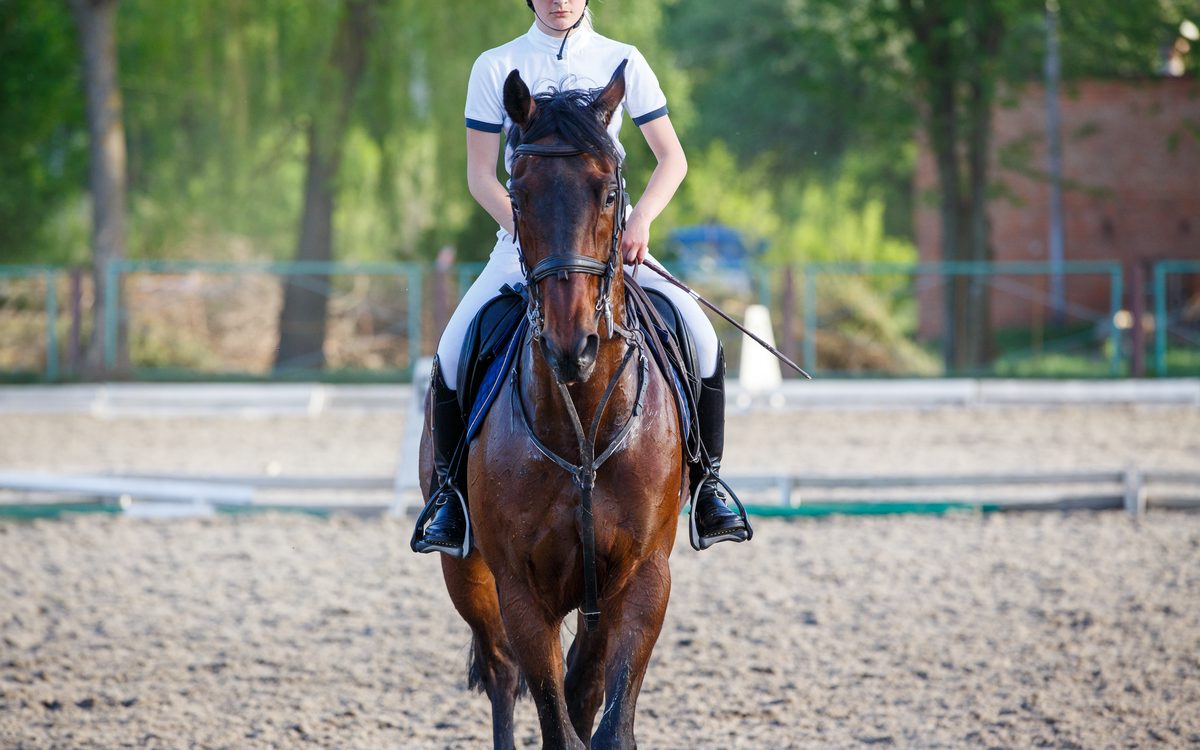
The rider walks down the long side, halts at X, and drops one hand to the rein to salute the judge at C. Then comes the bell, and a walk, trot and canter pattern that every rider at the same level will ride the same way. That is dressage: a ridden test where horse and rider perform set movements in a lettered arena while judges mark each one. This page is the beginner’s map: how a test is scored, what the levels mean, the basic skills to learn first, how to start, and where the rulebooks live. For the big picture, see our dressage overview, and for the whole family of riding sports start at horseback riding.
Quick answer: Dressage is judged one horse and rider at a time. Each movement gets a mark from 0 to 10, the marks become a percentage, and the highest percentage wins the class. In the U.S. you start with a qualified instructor and a lesson horse, then move to an Introductory or Training Level test at a local show. Rules change, so check the current US Equestrian (USEF) and FEI rulebooks before you enter.
How a dressage test works
Each level has an official test: a list of movements (circles, straight lines, changes of rein, transitions between gaits, and at higher levels movements such as pirouettes and flying changes) to be ridden in order at letters marked around the arena. According to US Equestrian’s dressage division rules, the standard arena is 20 by 60 meters and the small arena is 20 by 40 meters, and judges give each movement a mark from 0 (not executed) to 10 (excellent), with half marks allowed. Collective marks for the whole ride, such as the rider’s position and effectiveness, are added, the total is turned into a percentage, and errors of course (riding the wrong pattern) cost percentage points.
Because every rider at a level rides the same pattern, the question the judge answers is how well it is ridden. USDF describes its mission as education, recognition of achievement and promotion of dressage, and many riders compete mainly against their own earlier scores.
Scoring in plain words
- Movement marks: 0 to 10 for each listed movement, with the judge’s comment written down by a scribe.
- Collective marks: overall marks for things like the gaits, impulsion, the rider’s seat and the correct use of aids.
- Percentage: total points divided by the maximum possible. A higher percentage is better.
- Errors of course: going off pattern is penalized under the dressage rules.
Freestyle (to music)
A musical freestyle lets the rider design a pattern to music, within required elements for the level. A US Equestrian Open beginner’s guide describes freestyle marks as split into technical and artistic marks, and a 2024 test sheet shows artistic categories such as rhythm, energy and elasticity, and harmony between horse and rider. Those are secondary sources. USDF develops the freestyle tests used in the U.S., so read the test sheet for your level.
The levels
In the U.S., USDF develops the Introductory Level tests, and US Equestrian’s national ladder runs Training, First, Second, Third and Fourth Level. The FEI levels, which can also be ridden at national shows, start with Prix St. Georges and rise to Grand Prix. The levels build on one another: higher levels ask for more collection, more precise movements and more balance, so riders often spend years at one level.
| Stage | What riders typically work on |
|---|---|
| Introductory and Training | Walk, trot and (at Training) canter; steady rhythm; accurate circles and straight lines |
| First to Fourth | More suppleness and balance; lengthened strides; changes of lead; progressively more collection |
| FEI (Prix St. Georges up) | Advanced movements, such as pirouettes and flying changes, and the Olympic-level tests |
The rows above are a simple summary of how the ladder builds; the official test sheets for each level, available from USDF and the FEI, list the exact movements.
Basic skills a beginner learns first
These are general instruction topics, common in riding lessons, rather than rules from a rulebook:
- An independent seat: sitting balanced and relaxed so that your hands can be quiet. A 2025 narrative review of rider research found that correct pelvic orientation, trunk control and even weight distribution were linked with better saddle pressure and a better-moving horse.
- The aids: how seat, legs and hands ask the horse to go forward, turn and stop.
- Gaits and transitions: walk, trot and canter, and smooth changes between them.
- Geometry: riding a true 20-meter circle and a straight line, and knowing the arena letters.
- Safe horse handling: approaching, leading and tacking up. See the dressage injury prevention page.
How a beginner starts
- Find a qualified instructor. USDF has a “Find a Certified Instructor” search. USDF’s FAQ says certified instructors are current Participating Members, complete 16 hours of continuing education a year, hold first-aid training and sign a code of conduct. If none is near you, a local USDF club can help.
- Find a club. USDF lists over 100 affiliate clubs (Group Member Organizations, or GMOs) on its “Find a Local Affiliate” page.
- Ride lesson horses first. Most programs let you learn on a school horse before you buy or lease.
- Try a schooling show. Many clubs run low-pressure shows with Introductory and Training Level tests. Watch one first.
- Join USDF and USEF when you are ready to compete at licensed shows. Membership types are listed on the USDF “Join” page.
Young riders can also find dressage through the Interscholastic Equestrian Association (IEA), which lists dressage among its divisions for grades 4 to 12, and through Pony Club and 4-H.
Para dressage and access
Para dressage is open to riders with a physical or vision impairment. According to the Paralympic movement’s equestrian page, events are mixed and riders are grouped by functional profile into grades, and aids such as dressage crops, connecting rein bars and rubber bands are allowed within the rules. Classification is handled by the federation, so ask your national federation or the FEI. US Equestrian publishes a state-by-state directory of para coaches. Our para equestrian page has more.
Dress, equipment and rules to check
Competition clothing and tack are set by the rulebook, which changes during the year, so read the current USEF dressage chapter (DR) and the USEF dressage attire booklet before your first show. Two things do not change: protective headgear is required for anyone mounted on the grounds under the dressage rules (DR120), and the helmet must be correctly fitted. Our dressage gear guide goes through it.
Rulebooks and where to look
- USEF Rule Book, dressage division (DR) and general rules (GR)
- FEI Dressage Rules and test sheets, which the FEI is revising in 2026
- USDF test booklets and its “New to Dressage” page
Where it can take you
Dressage has been in the Olympics since 1912, and the IOC approved it for the Los Angeles 2028 Games, according to the FEI, though you should check the official programme for the current Games. Para dressage has been in the Paralympics since 1996. Beyond that, eventing begins with a dressage test, so the skills carry over. Read next about dressage training.
Dressage rules and getting started FAQs
How is a dressage test scored?
Judges mark each movement from 0 to 10, add collective marks, and the total becomes a percentage. Errors of course reduce the score.
What is the lowest level of dressage?
In the U.S. there are Introductory Level tests developed by USDF and then Training Level, the first level on the USEF national ladder.
Do I need my own horse to start?
No. Most riders begin with lessons on a school horse, and some riding programs and school teams provide horses.
How do I find a dressage instructor or club?
USDF has a certified instructor search and a club (GMO) finder on its website, and local clubs can point you to instructors near you.
Can I ride dressage with a disability?
Yes. Para dressage is open to riders with a physical or vision impairment, and riders are grouped by functional profile.
Where are the official rules?
In the USEF Rule Book (DR chapter) and the FEI Dressage Rules. The FEI is revising its rules in 2026, so check for updates.
Sources
- US Equestrian, Dressage division rules (DR)
- USDF, Dressage competition and About USDF
- USDF, certified instructor FAQ
- Eurodressage, FEI Dressage Rules revision, 2026
- US Equestrian Open, how Grand Prix dressage is scored (secondary)
- Paralympic.org, equestrian
- IEA, getting started
- FEI, history and Horse Illustrated on LA28
- Balog O et al., rider performance and horse welfare, narrative review, Front Sports Act Living 2025
General information for education only, not medical advice. It does not replace a visit with a doctor, physical therapist or athletic trainer. See how we write and check our pages in our editorial policy.