This article contains affiliate links: if you buy through them we may earn a commission, at no extra cost to you. Read our affiliate disclosure.
Bormio, Italy, in a February snowstorm. Skiers in skin-tight race suits sprint up a short slope on skis, rip the skins off in a marked box, and rocket back down through gates. When Spain’s Oriol Cardona Coll crosses first in the men’s sprint, Reuters noted, it is Spain’s first Winter Olympic gold in 54 years. Ski mountaineering, shortened to skimo, is racing up and down snowy mountains on skis, and it made its Olympic debut at Milano Cortina 2026.
Ski Mountaineering (Skimo) guides: what do you need?
New to ski mountaineering (skimo)? Start with the first card. Everything here is general education, not medical advice.
History & Origins
Ski mountaineering (“skimo”) racing grew out of ski touring and mountaineering in the Alps and other mountain ranges, combining uphill skiing, climbing on foot and a ski descent over a marked course (Olympedia). The sport has organised international racing for a long time: World Championships have been held since 2002 and a World Cup circuit since 2007. The International Ski Mountaineering Federation (ISMF) was formed in 2007 as the successor to the International Council for Ski Mountaineering Competitions, and in January 2026 it represented 55 national federations (Olympedia).
The sport reached the Olympic stage in two steps. It was on the program of the 2020 Youth Winter Olympic Games with boys’, girls’ and mixed events, and on 20 July 2021 the IOC approved adding it to Milano Cortina 2026. The Olympic debut took place at the Stelvio Ski Centre in Bormio on 19 to 21 February 2026, with a men’s sprint, a women’s sprint and a mixed relay (Olympedia). We have not confirmed the earliest origins of ski mountaineering racing from an official source, so no origin story is given here.
- 2002: World Championships have been held since this year (Olympedia).
- 2007: ISMF formed; World Cup circuit begins (Olympedia).
- 2020: ski mountaineering on the Youth Winter Olympic Games program (Olympedia).
- July 20, 2021: IOC approves ski mountaineering for Milano Cortina 2026 (Olympedia).
- February 19 to 21, 2026: Olympic debut in Bormio, three medal events (Olympedia).
Notable Athletes
The sport has only one Olympic edition so far, so this list is short. These are the athletes with the most Olympic medals as of the end of Milano Cortina 2026, in no order of rank, per Olympedia.
- Marianne Fatton (Switzerland): won the first Olympic women’s sprint; also silver in another event, two medals in all.
- Emily Harrop (France): silver in the women’s sprint and gold with France in the mixed relay.
- Oriol Cardona (Spain): won the first Olympic men’s sprint and a bronze with Spain in the mixed relay.
- Thibault Anselmet (France): bronze in the men’s sprint and gold with France in the mixed relay.
Official results and records
Because the sport has had one Olympics, we point to the official pages rather than build a records table.
- Olympedia: ski mountaineering at Milano Cortina 2026, all three events
- Olympedia: ski mountaineering overview and medal tables
- ISMF: World Cup and World Championships results
- Olympics.com: Milano Cortina 2026
How we keep this current: we re-check facts after each major championship and update this page. Spot an error? See our editorial policy.
Ski mountaineering at a glance
| What it is | A timed race that mixes climbing on skis with adhesive skins, a short climb on foot with the skis in a pack, fast gear transitions and a ski descent. |
|---|---|
| How it is won | First across the line. Olympic sprint: heats, semifinals and a final, each about 2:30 to 3 minutes with about 70 m of climbing. Mixed relay: two athletes (one woman, one man) each skiing two laps, about 30 minutes in all with about 140 m of climbing. |
| Participants | Recreational racers and uphill skiers, youth and junior racers, national teams and World Cup athletes. |
| Where | Ski areas and mountains. Recreational skimo overlaps with backcountry ski touring; racing uses marked courses. Italy, France and Switzerland have the deepest traditions. |
| Governing body | International Ski Mountaineering Federation (ISMF). In the US, USA Skimo and the United States Ski Mountaineering Association (USSMA) handle teams and race licenses. |
| Season | Winter and spring. |
How a skimo race works
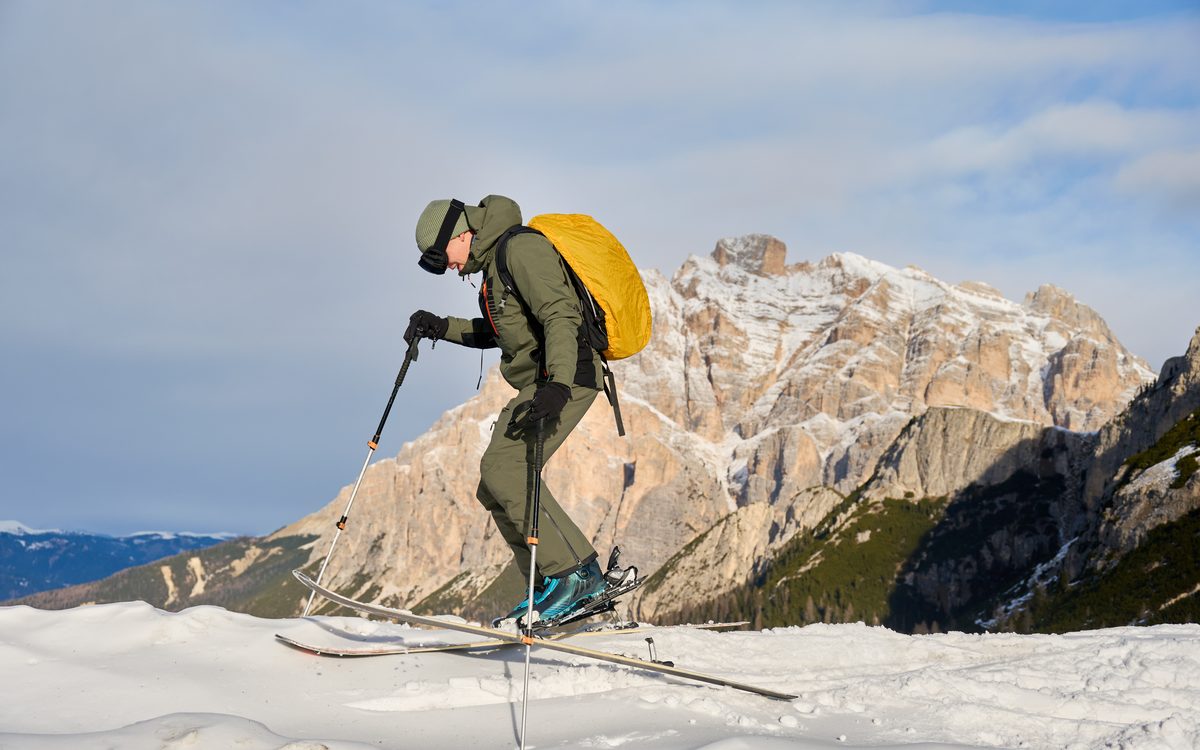
An Olympic course has four phases. First the athletes climb on skis fitted with skins, which grip the snow. Next comes the foot part: skis go on the backpack, and athletes hike up in ski boots, wearing crampons where required. In the transition zone the skins come off and the gear switches to downhill mode. Then they ski down through gates, a bit like a rugged giant slalom. The transition is where races are decided as much as won: equipment changes are only legal inside the marked zone, athletes must stay in one spot and plant their poles before they start, and skins sticking out of a suit or backpack cost 10 seconds.
Mixed relay teams of one woman and one man go in a fixed order (woman, man, woman, man). Partners hand over by physical touch inside a handover area. ISMF’s wider World Cup also has individual, team and vertical races, but only the sprint and the mixed relay were on the Milano Cortina program.
Required equipment and penalties
According to NBC Olympics’ summary of the rules, an athlete can be disqualified for a missing avalanche beacon (called a DVA, with batteries), a helmet not worn correctly, missing ski brakes, or non-compliant skis, bindings or boots, and for missing crampons in a required foot section. The racing kit is otherwise minimal. Competitive skimo uses no ropes or other climbing equipment.
Who does ski mountaineering, and at what level
Recreational and youth. Many people begin with uphill skiing and ski touring, then try a local race. The line between backcountry skiing and skimo is “fuzzy,” one outdoor-media explainer says, but racers care about speed and fast transitions. Youth clubs exist: the Park City Ski and Snowboard Club in Utah runs a youth skimo team. Skimo was also part of the 2020 Winter Youth Olympic Games in Lausanne. Race licenses for ISMF events in the US go through USSMA; check ussma.org for current rules.
School and college. We found no NCAA or high school championship for skimo, so skiers build experience through clubs, uphill-friendly resorts and races.
National team. USA Skimo launched “Project Podium” in August 2024, a donor-funded effort to make the team competitive for Winter Olympic qualification. Griffin Briley won three under-20 titles at the 2025 world championships. The US qualified for the Olympics in the mixed relay only, and Reuters reported that Americans Anna Gibson and Cam Smith surprised by finishing fourth in the Bormio relay.
Olympic and Paralympic status
- Milano Cortina 2026: debut sport with three events at the Stelvio Ski Centre in Bormio: the women’s sprint (Marianne Fatton, Switzerland), the men’s sprint (Oriol Cardona Coll, Spain) and the mixed relay on 21 February (France’s Emily Harrop and Thibault Anselmet won in 26:57.44; Switzerland silver, Spain bronze).
- French Alps 2030: the IOC voted in June 2026 to keep skimo on the program. Reports say the plan is five events, adding men’s and women’s individual races to the sprint and the mixed relay, but the final number of events is still to be confirmed by the IOC, so check the official programme for the current Games. USA Skimo has said it will also push for the sport at the 2034 Salt Lake City Games.
- Paralympics: we did not find a skimo event on the Paralympic program. Check paralympic.org for the current Games.
Physical demands
Skimo is an endurance sport, even in the short sprint. A 2026 study at the pre-Olympic sprint test event in Bormio (36 athletes) found that the uphill ski and foot sections explained 81.5% of the variation in sprint time, with the first climb alone strongly linked to the final result. In nine Swiss elite sprinters tested in the lab, uphill speed was best predicted by oxygen uptake relative to body mass and by the ability to clear lactate. The authors note that the fastest athletes lose less time in transitions, so skimo is “not only about physiological capacity but also about fast and error-free” gear changes under maximal effort. A smaller study of 13 male sprinters found that hamstring strength at high speed was strongly linked to performance. The descent adds skiing skill on tired legs.
Health and safety in skimo
General information only. If you are hurt, or you worry about breathing, bone health or eating, see a sports medicine doctor, physical therapist, athletic trainer or registered dietitian.
What the injury study found
A 2026 questionnaire study by Schöffl and colleagues, the first injury data in competitive skimo, surveyed 196 racers (85 World Cup athletes and 111 recreational). Fifty-nine injuries were reported by 43 people (21.9%), 59.3% acute and 40.7% chronic. The knee was injured most often, usually the ligaments and joint capsule. Of the acute injuries, 90.3% happened on the descent, and the authors say these resemble alpine skiing injuries. Of the overuse injuries, 90.9% happened on the ascent, and most were skin lesions and ulcers caused by full-carbon racing boots. The study also found asthma triggered by exercise in 16.5% of World Cup athletes versus 2.7% of recreational athletes, frequent colds and respiratory infections linked to heavy training, and signs of low energy availability in female World Cup racers (anorexia athletica in 17.9% of women and 5.3% of men).
Practical safety points
- Head injuries: the CDC’s HEADS UP says to recognize and remove. After a fall with a possible concussion, stop and see a healthcare provider, who decides about return. Call 911 for danger signs.
- Backcountry avalanche risk: racing uses controlled courses, but recreational touring leaves them. Skimo gear guides call a beacon, shovel and probe the minimum for backcountry travel, and training courses (such as Avalanche Canada’s AST 1 or AIARE courses) teach decision-making, not just gear use. Check your local avalanche center’s forecast; avalanche.org lists the centers in the US.
- Altitude: the CDC’s Yellow Book describes altitude illness and advises a gradual climb. Headache, nausea and dizziness at elevation are reasons to stop and descend.
- Cold and sweat: climbing makes you warm, then the descent chills you. The CDC’s hypothermia and frostbite pages cover warning signs.
Training, recovery and nutrition pointers
Most skimo training is aerobic: long easy climbs, some harder intervals, strength for the legs and trunk, and transition practice you can do in the living room. A heart-rate chest strap is a common way to pace climbs. For sleep, the CDC recommends at least 7 hours for adults and 8 to 10 for teens. Because the study above flagged energy availability, fuel deliberately on long days and talk with a dietitian who knows endurance sport. Our skiing training, skiing recovery and skiing nutrition pages have the general guidance, and cross-country skiing is the nearest cousin for endurance work.
Gear
Skimo equipment is its own specialist category: alpine-touring-style skis, bindings and boots, skins, poles, crampons and a beacon, shovel and probe. We do not review race skis or boots here. Races require a helmet worn correctly; we could not confirm which standard ISMF requires, so check your event’s rules. The items below are the clothing, hydration and comfort pieces that apply to uphill days in the cold.

Smith Mission MIPS Helmet
- ASTM F2040 + EN 1077 (maker)
- MIPS liner, dial fit
- 14 adjustable vents

CamelBak Zoid Snow Hydration Pack
- 70 oz Crux reservoir
- Insulated tube in shoulder strap
- Made for snow sports
$74.25 at Amazon, as of Nov 17, 2026 01:07 UTC
Check price on Amazon
Smartwool Classic Thermal Merino Base Layer Crew
- 100% merino wool
- Midweight
- Flatlock seams
$93.75 at Amazon, as of Nov 17, 2026 01:07 UTC
Check price on Amazon
Darn Tough Solstice OTC Lightweight Ski Sock
- Over the calf, lightweight
- Knit in Vermont
- Brand lifetime guarantee
The Smith Mission is an alpine ski helmet certified to ASTM F2040 and EN 1077 according to the maker. It is a sensible choice for resort and uphill days, but it is not a race-legal helmet recommendation. More in our skiing gear page and electrolyte powder guide.
Related sports and disciplines
- Skiing, the parent sport, with alpine skiing, freestyle skiing, ski jumping and Nordic combined.
- Cross-country skiing and biathlon, other winter endurance sports.
- Snowboarding and hiking, for more mountain days.
Ski mountaineering FAQs
What is the difference between skimo and ski touring?
Ski touring is a recreational trip into the mountains, often for the powder descent. Skimo is the racing side, with lighter gear, timed courses and quick transitions. Off the racecourse, the line is fuzzy.
How long is an Olympic skimo race?
The sprint lap is about 2:30 to 3 minutes with about 70 m of climbing; the mixed relay is about 30 minutes with about 140 m of climbing.
Do I need avalanche training?
If you go beyond a controlled course or a resort uphill route, yes. A beacon, shovel and probe are the minimum gear, and a course teaches how to decide where it is safe to go.
Is skimo in the Olympics for 2030?
The IOC voted in June 2026 to keep it on the French Alps 2030 program, with reports of five events. Check the official programme for the final list.
Sources
- NBC Olympics: official rules for Olympic ski mountaineering
- ESPN: What is ski mountaineering?
- NBC Olympics: Team USA and qualification
- Reuters via The Star: skimo debut
- NBC Sports: skimo stays for 2030
- Schöffl and colleagues (2026): ski mountaineering anthropometry, injuries and illnesses
- Mottet and colleagues (2026): sprint performance determinants at the pre-Olympic test event
- Schorderet and colleagues (2026): aerobic and haematological parameters in elite skimo
- Kural and colleagues (2025): isokinetic knee strength in skimo sprinters
- CDC HEADS UP, CDC sleep, CDC preventing hypothermia and CDC Yellow Book: altitude illness
More to explore: the skiing hub, skiing injuries, the sports hub, and our recovery tools guide and HRV for athletes.