This article contains affiliate links: if you buy through them we may earn a commission, at no extra cost to you. Read our affiliate disclosure.
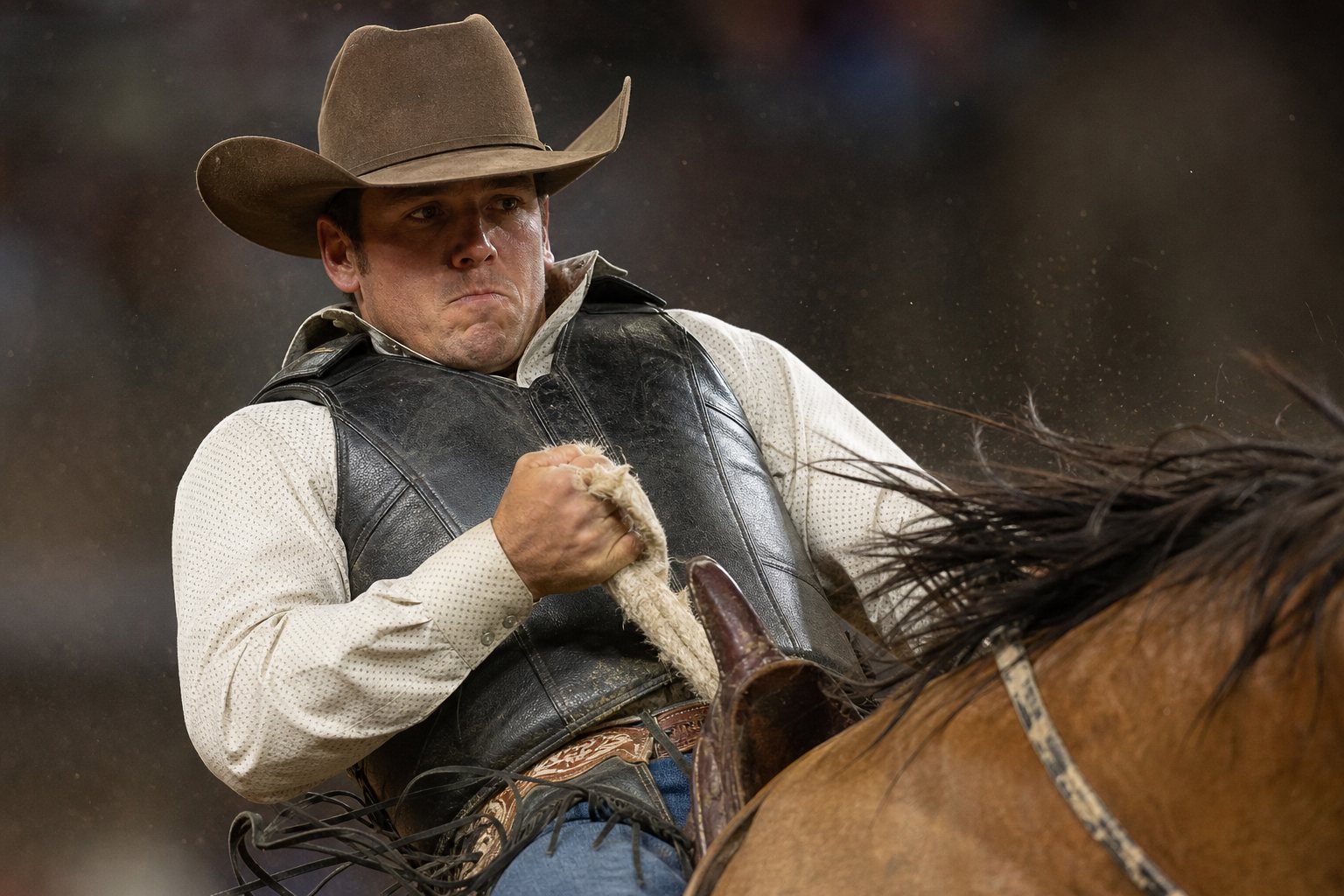
Ten nights every December, the best rodeo athletes in the world fill the Thomas & Mack Center in Las Vegas for the National Finals Rodeo. The 2026 edition is scheduled for December 3 to 12, and the field is the top 15 in each event. In the chute, a bull rider wraps his hand into the rope, nods, and the gate swings open: eight seconds, one hand, and a judge’s score on both rider and animal. Rodeo is a ranch-born sport of riding and roping contests against the clock and against the animal, sometimes called professional rodeo, pro rodeo or “cowboy sports.”
Rodeo guides: what do you need?
New to rodeo? Start with the first card. Everything here is general education, not medical advice.
History & Origins of Rodeo
Rodeo grew out of the work of ranch hands in the American West, who tested their riding and roping skills against each other. Where and when the first organized rodeo took place is disputed by towns and historians, so we do not name one. The modern professional sport has a clearer paper trail. On October 30, 1936, sixty-one cowboys voted to strike the Boston Garden Rodeo to protest low prize money, and on November 6, 1939, they formed the Cowboys Turtle Association to represent contestants. It was renamed the Rodeo Cowboys Association in 1945 and later became the Professional Rodeo Cowboys Association (PRCA) (Oklahoma Historical Society).
In 1959 the association added a National Finals Rodeo (NFR) to crown its yearly world champions, first in Dallas, then Los Angeles (1962 to 1964) and Oklahoma City. After a close board vote in 1984, the NFR moved to Las Vegas in 1985, where it is held at the Thomas & Mack Center; the 2020 edition was played in Arlington, Texas (NFR Experience).
- October 30, 1936: Sixty-one cowboys strike the Boston Garden Rodeo over prize money.
- November 6, 1939: The Cowboys Turtle Association is formed.
- 1945: Renamed the Rodeo Cowboys Association.
- 1959: The National Finals Rodeo is added; first held in Dallas.
- 1985: The NFR moves to Las Vegas after Oklahoma City’s long run.
- 1989: Ty Murray becomes the youngest all-around world champion in PRCA history, at age 20.
- 2008: The NFR marks its 50th anniversary.
- 2020: The NFR is held in Arlington, Texas.
- 2025: Stetson Wright sets a single-season all-around earnings record of $817,088.
Official results and records
We do not print a champions table, because world champions are decided each year on a points and earnings system and differ by event and association. For current standings and past world champions, use the organizers’ own pages:
- ProRodeo (PRCA): standings and world champions
- NFR Experience, Las Vegas: National Finals Rodeo schedule and history
- Professional Bull Riders (PBR): bull riding results
Legends of the Sport
- Trevor Brazile: 26 world titles, 14 of them all-around; completed the Triple Crown (all-around, tie-down roping and team roping) in 2010 and was inducted into the ProRodeo Hall of Fame in 2022 (NFR Experience).
- Ty Murray: seven all-around world titles (1989 to 1994 and 1998), a record that surpassed the six held by Larry Mahan and Tom Ferguson (NFR Experience).
- Charmayne James: barrel racer who won her first world title in 1984 at age 14 and an 11th in 2002; the first barrel racer to pass $1 million in career earnings (NFR Experience).
- Jim Sharp: in 1988, the first bull rider to ride all 10 bulls at an NFR (NFR Experience).
- Fred Whitfield: in 1997 roped and tied 10 head in 84.0 seconds to win the tie-down roping aggregate (NFR Experience).
- Stetson Wright: set a single-season all-around earnings record of $817,088 in 2025 (NFR Experience).
How we keep this current: we re-check facts after each major championship and update this page. Spot an error? See our editorial policy.
This page covers rodeo for newcomers, parents and athletes: the events, who competes at which level, the injury patterns that research has documented, and the gear and recovery basics. The health section is honest about the risks of working with large animals. Animals are also part of rodeo’s public debate; this page is about the athletes.
Rodeo at a glance
| What it is | A set of events in which a rider or roper works with, or against, a horse, bull, steer or calf. Two families: roughstock (bareback riding, saddle bronc riding, bull riding) and timed events (steer wrestling, team roping, tie-down roping, barrel racing, and in some associations breakaway roping and goat tying). |
|---|---|
| How it is won | Roughstock: stay on for eight seconds with the required hand position and earn a judged score (rider and animal each count, out of 100 total). Timed events: the fastest time wins, with penalties for rule breaks such as a knocked barrel. |
| Participants and levels | Youth and junior programs, high school and college rodeo, amateur and “open” rodeos, and professional rodeo. Men and women compete; barrel racing is the women’s event at the professional level. |
| Where | Mainly the United States and Canada, plus Mexico and other countries, in arenas with bucking chutes and roping boxes. |
| Governing bodies | Professional Rodeo Cowboys Association (PRCA) for pro rodeo in North America; Women’s Professional Rodeo Association (WPRA) for women’s pro events; National Intercollegiate Rodeo Association (NIRA) for college; National High School Rodeo Association (NHSRA). Professional Bull Riders (PBR) is a separate bull-riding organization. |
| Season | Year-round at the professional level, with the PRCA’s National Finals Rodeo in early December. College rodeo runs on a fall-spring schedule and ends with the College National Finals Rodeo every June. |
How rodeo works: the events
A rodeo is a program of separate contests, and a competitor usually enters one or two. In roughstock the animal is half of the score, so the draw (which bull, which horse) matters as much as the rider.
Roughstock events
- Bareback riding: the rider holds on with one hand and has to stay on a bucking horse for eight seconds. Judges score the rider and the horse’s action.
- Saddle bronc riding: the same eight seconds on a saddled horse, judged for control, timing and style as the rider stays in rhythm with the horse.
- Bull riding: eight seconds on a bucking bull, one hand only. Scoring rewards the rider’s skill and the bull’s power, so a harder-bucking bull can raise the score.
Timed events
- Steer wrestling: the cowboy rides alongside a steer, leaves his horse and brings the animal to the ground as fast as possible.
- Team roping: a header ropes the steer’s horns and a heeler ropes its hind legs. The fastest successful run wins.
- Tie-down roping: the roper catches a calf, dismounts and ties three of its legs. The clock runs until the tie is done.
- Barrel racing: horse and rider run a cloverleaf pattern around three barrels. Fastest time wins, and tipping a barrel hurts the run.
- Breakaway roping and goat tying: the rope breaks away from the saddle horn when it catches a calf, which stops the clock. Goat tying is a college event. Both are in the nine events of college rodeo, with bareback, saddle bronc, bull riding, calf roping, steer wrestling, team roping and barrel racing.
Rules differ by association, so read the rulebook of the rodeo you are entering.
Who competes, and at what level
Youth and high school
Many rodeo athletes start on a family ranch or with a local 4-H or junior rodeo program. The National High School Rodeo Association runs junior high and high school divisions with state associations in dozens of states and Canadian provinces; the NHSRA says its roots go back to a 1947 Texas state championship and a first national competition in 1949 (as of 2026 it reports members in 43 states, five Canadian provinces and a few other countries). Programs differ on events and protective gear, so ask your state association first.
College
The NIRA says it is the governing body of college rodeo, with more than 135 colleges and universities that have a recognized rodeo organization. Members compete in about ten rodeos a year to qualify for the College National Finals Rodeo, held each June in Casper, Wyoming. Eligibility is academic as much as athletic: students must carry at least 12 credit hours and keep at least a 2.0 GPA, and have six years from high school graduation to use their four NIRA membership cards. College rodeo is run through the NIRA.
Professional
The PRCA traces back to 1936, when cowboys walked out of a rodeo at Boston Garden. It became the Rodeo Cowboys Association in 1945 and took its current name in 1975. It sanctions rodeos in the United States, Canada and Mexico, and earnings over the season decide who qualifies for the National Finals Rodeo, which has been held at the Thomas & Mack Center in Las Vegas since 1985. Bull riders also have the separate PBR circuit.
Olympics and Paralympics
Rodeo is not an Olympic or Paralympic sport, and we found no sign of it on the 2028 Los Angeles programme. For the current Games, check the official programme at olympics.com and paralympic.org.
Physical demands
A 2010 two-part review of rodeo science by Meyers and Laurent describes the sport as intermittent, with short bursts of intense activity, and basically anaerobic. They note that practice, with its repeated runs against livestock, resembles a sport-specific form of interval training, and that rodeo athletes’ body size and performance measures are comparable to those of athletes in more traditional sports.
The events stress the body in different ways: roughstock is a hold-on-and-absorb effort, steer wrestling and roping add speed and dismounts, and barrel racing is about balance on a fast horse. A 2025 screening of 162 college rodeo athletes suggested event-specific movement patterns.
Health and safety for rodeo
This section is general information, not medical advice. If you are hurt, or you take a hard fall or a kick, see a sports medicine doctor, physical therapist or athletic trainer.
What the injury research shows
- Bull riding, Canada: a five-year prospective study by Butterwick and Meeuwisse followed 4,375 bull-riding exposures at 63 professional rodeos, with certified athletic therapists collecting the data. They reported that 36% of injuries were severe, fractures were the most common severe injury, concussions made up 10.6% of all injuries, and neck injuries plus concussion with other head and facial injuries made up 28.9%. The knee and shoulder were the most commonly injured joints.
- The whole sport: Meyers and Laurent’s review reports that contact between athlete and animal accounts for about 80% of reported injuries, that head and neck trauma is 10% to 29% of the total, and that concussion rates have been reported at 3.4 per 1,000 competitive exposures. They add that injuries are probably under-counted.
- Legs: a 2026 meta-analysis of seven studies found lower-body injuries make up about 28% of injuries in college and pro rodeo athletes, most often thigh/knee, then ankle. Timed-event athletes had about nine percent higher prevalence of thigh/knee and ankle injuries than roughstock athletes.
- Head movement: in 2026, researchers fitted instrumented mouthguards to 13 collegiate roughstock athletes. Across 112 rides at five sanctioned college rodeos they recorded 344 head acceleration events. Bareback had the most events, and the most common cause was whiplash rather than direct head contact.
- Kids and teens: a 2026 case series from one pediatric trauma center looked at 41 patients aged 18 or younger hurt in organized rodeo between 2017 and 2023. Just over half had orthopedic injuries, and in 5 of 13 operatively treated fractures the surgeons needed an open operation because closed alignment had failed.
Protective equipment and rules
Protection varies by group. The PBR made protective vests mandatory in 1996, and since the 2013 season it has required a full bull-riding helmet for riders born on or after October 15, 1994; older riders may choose their headwear. Some youth and high school rodeo associations require helmets, mouthpieces and vests, so check your rulebook. Meyers and Laurent’s review says helmets, taping, bracing, protective vests, neck collars and mouthpieces are gaining popularity but have not been thoroughly studied, and a rider who wears protection is still exposed to the hardest hits.
Concussion: recognize and remove
The CDC’s HEADS UP program lists headache, dizziness, confusion, balance problems and feeling slowed down as signs of concussion; symptoms can show up hours later. The rule is to recognize and remove: anyone who may have a concussion stops for the day and is cleared by a healthcare provider before going back. Call 911 for danger signs such as repeated vomiting or a seizure. The Justin Sportsmedicine Team provides free care to PRCA and WPRA athletes at sanctioned events.
Heat, sun and the ground
Many rodeos are outdoors in summer. The CDC recommends shade, a hat, sunscreen and water; build in rest between events.
Training, recovery and nutrition
Event-specific preparation makes more sense than a generic routine, and a coach or athletic trainer who knows your event can build it. Meyers and Laurent note that adherence to organized conditioning programs is limited, and that signs of overtraining deserve attention. Sleep, food and fluids come first: the CDC recommends at least seven hours for adults and 8 to 10 for teens. More on our horseback riding training, recovery and nutrition pages, and our recovery tools guide covers rollers and massage tools. Any supplement is a conversation with a doctor or dietitian first, and athletes who are drug tested should choose products certified for sport.
Gear that matters
- Protective vest and helmet (roughstock): buy from a rodeo or bull-riding supplier, fit it in person, and confirm that your association accepts it. We could not confirm a single universal certification standard for rodeo vests or helmets, so treat maker claims as claims.
- Mouthpiece: a fitted mouthguard protects teeth and is required by some youth associations.
- Boots, gloves and chaps: standard rodeo clothing; fit and grip matter more than brand.
- Ankle and knee support: ask a clinician what fits your history before taping or bracing.

Shock Doctor Gel Max Mouth Guard
- Youth and adult sizes
- Gel-fit liner
- Exoskeletal shock frame
$11.99 at Amazon, as of Nov 17, 2026 01:07 UTC
Check price on Amazon
ASO EVO Ankle Stabilizer
- Lace-up with figure-8 straps
- Fits left or right foot
- Low profile, fits in boots and shoes

SSG Digital Riding Gloves
- Digital grip palm
- Grips when wet
- Machine washable
Related sports and disciplines
- Horseback riding, the parent family of horse sports, including the Western riding disciplines.
- Horse racing, polo and dressage, other sports built on a rider and a horse.
Rodeo FAQs
How is bull riding scored?
The rider must stay on for eight seconds with one hand. Judges score the rider’s control and style and the bull’s performance, and the two are combined into a score out of 100. A ride that ends before eight seconds does not score; the rulebook has the details.
Is rodeo an Olympic sport?
No. We found no record of rodeo on the Olympic or Paralympic programme. Check the official programme for the current Games.
What is the safest way for a kid to start?
Ask the state junior or high school rodeo association for its rulebook and for programs near you, take lessons from an experienced coach and learn on seasoned animals. Make sure the program requires the protective gear your child’s event calls for. If a child takes a hard fall, a medical check is the first step before more rides.
Can women compete in rodeo?
Yes. The WPRA is the women’s professional association, and barrel racing is the women’s event at the pro level. College rodeo has nine events, including barrel racing, breakaway roping and goat tying; check the NIRA rulebook for who can enter which.
Sources
- National Intercollegiate Rodeo Association, membership and eligibility
- City of Herriman, Rodeo 101 (event descriptions)
- PBR, PBR 101
- Justin Boots, Justin Sportsmedicine Team
- Butterwick DJ, Meeuwisse WH. Bull riding injuries in professional rodeo (PubMed 20086479)
- Meyers MC, Laurent CM. The rodeo athlete: sport science, Part I and Part II, injuries, Sports Medicine 2010
- Robinson B et al. Lower extremity injuries in rodeo athletes, meta-analysis, 2026
- Carlson CD et al. Head acceleration events in collegiate rodeo athletes, Annals of Biomedical Engineering 2026
- Wolfe A et al. Functional movement screening of college rodeo athletes, 2025
- Arnold TE et al. Irreducible extremity fractures in pediatric rodeo-related trauma, J Child Orthop 2026
- CDC HEADS UP, signs and symptoms and response; CDC sleep and sun safety
Keep exploring: every sport on our sports hub, the horseback riding injuries page for fall and head-injury safety, our recovery tools guide and the ankle brace guide.