This article contains affiliate links: if you buy through them we may earn a commission, at no extra cost to you. Read our affiliate disclosure.
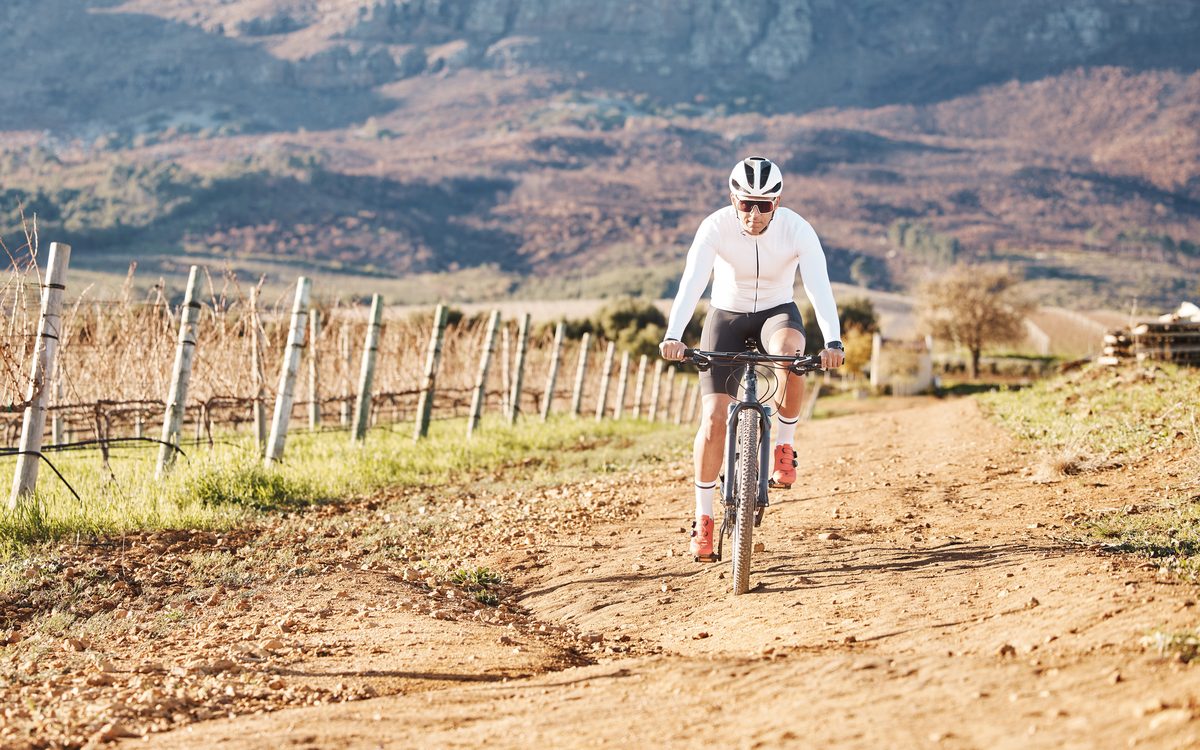
Emporia, Kansas, at the start of Unbound Gravel: riders lined up for 200 miles of Flint Hills gravel, the event that returned in 2026 for its 20th anniversary edition. On a smaller scale, a Saturday group ride somewhere turns off the pavement onto a farm road just to see where it goes. Gravel cycling (also called gravel riding or gravel racing) is riding and racing on unpaved roads, usually on drop-bar bikes with wide tires.
Gravel Cycling guides: what do you need?
New to gravel cycling? Start with the first card. Everything here is general education, not medical advice.
History & Origins of Gravel Cycling
Riding bikes on unpaved roads is as old as cycling, but gravel as its own sport is young and grew from the American Midwest. In 2005 Trans Iowa, a long self-supported ride on rural roads, was founded by Jeff Kerkove and Mark Stevenson. The next year, in Emporia, Kansas, the first Dirty Kanza 200 started 34 riders on a 200-mile loop through the Flint Hills (BikeRadar). That race grew into the sport’s best-known event: it was bought by Life Time in 2018, renamed Unbound Gravel in 2020, and drew more than 5,000 riders by 2024 (BikeRadar).
For years gravel racing ran through private organizers. That changed when the UCI, cycling’s world governing body, sanctioned an official gravel series and world championships, with the first championships held in the Veneto region of Italy in October 2022 (UCI). Gravel is still not an Olympic or Paralympic discipline. Who “invented” gravel is a matter of debate: people have always ridden dirt roads, and we only list the documented starting points of today’s organized events.
- 2005: Trans Iowa is founded in Iowa.
- 2006: First Dirty Kanza 200 in Emporia, Kansas, with 34 starters.
- 2018: Life Time acquires the event.
- 2020: Dirty Kanza is rebranded Unbound Gravel.
- 2022: First UCI Gravel World Championships, in Veneto, Italy.
- 2024: More than 5,000 riders at Unbound; the world championships are held in Flanders, Belgium.
- 2026: First UCI Gravel World Championships outside Europe, in Nannup, Western Australia.
Recent Champions
Scope: this list covers the elite men’s and women’s UCI Gravel World Championships (every edition so far, five in total) and the 2026 Unbound Gravel 200, not every gravel race or age-group title.
| Year, venue | Elite men | Elite women |
|---|---|---|
| 2022, Veneto (Italy) | Gianni Vermeersch (BEL) | Pauline Ferrand-Prévot (FRA) |
| 2023, Veneto (Italy) | Matej Mohorič (SLO) | Katarzyna Niewiadoma (POL) |
| 2024, Flanders (Belgium) | Mathieu van der Poel (NED) | Marianne Vos (NED) |
| 2025, South Limburg (Netherlands) | Florian Vermeersch (BEL) | Lorena Wiebes (NED) |
| 2026, Nannup (Australia), 10-11 October | Magnus Bak Klaris (DEN), photo finish | Marianne Vos (NED) |
Source: UCI reports for 2022, 2023, 2024, 2025 (women), 2025 (men) and 2026.
Unbound Gravel 200 (Emporia, Kansas, May 30, 2026): men, Mads Würtz Schmidt (DEN), 9:14:51; women, Sofía Gómez Villafañe (ARG), 10:31:37, in a five-rider sprint (Cycling West race report).
Results verified through November 13, 2026. The latest completed event included is the 2026 UCI Gravel World Championships in Nannup (October 10-11, 2026).
Records & Milestones
Gravel courses and conditions differ so much that there are no comparable official records, so this table lists documented milestones instead.
| Milestone | Who or what | When | Source |
|---|---|---|---|
| First Dirty Kanza 200 (now Unbound) | 34 starters, Emporia, Kansas | 2006 | BikeRadar |
| First UCI Gravel World Championships | Veneto, Italy | October 2022 | UCI |
| Women’s elite title: first repeat winner | Marianne Vos (NED), 2024 and 2026 | 2026 | UCI |
| First worlds outside Europe | Nannup, Western Australia | October 2026 | UCI |
Source: BikeRadar and the UCI reports linked above. Records verified through November 13, 2026.
Legends of the Sport
Gravel is young, so these are athletes whose results shaped its recent history. They are listed in no particular order.
- Marianne Vos (NED): won the elite women’s UCI Gravel World Championships in 2024 and 2026, the first rider to win the title twice; the UCI counts the 2026 win as her 15th world title overall.
- Pauline Ferrand-Prévot (FRA): the first elite women’s gravel world champion, in 2022.
- Katarzyna Niewiadoma (POL): elite women’s gravel world champion in 2023.
- Lorena Wiebes (NED): elite women’s gravel world champion in 2025, winning the sprint ahead of Vos.
- Gianni Vermeersch (BEL): the first elite men’s gravel world champion, in 2022.
- Matej Mohorič (SLO): elite men’s gravel world champion in 2023 and bronze medallist in 2025.
- Mathieu van der Poel (NED): elite men’s gravel world champion in 2024, which the UCI called his 11th rainbow jersey.
- Florian Vermeersch (BEL): won the 2025 elite men’s title and finished second in 2026.
- Magnus Bak Klaris (DEN): the 2026 elite men’s gravel world champion.
Builders of the sport matter too: Trans Iowa founders Jeff Kerkove and Mark Stevenson, and the Dirty Kanza organizers, are part of the story but are not athletes.
How we keep this current: we re-check results after each major championship and update the date above. Spot an error? See our editorial policy.
This page covers what gravel is as a sport, how to get into it, the health issues that come with long rides far from help, and the gear that matters. For the whole sport, see our cycling hub.
Gravel cycling at a glance
| What it is | Long-distance riding and racing on gravel, dirt and mixed-surface roads, plus any paved links between them. |
|---|---|
| How it is won | Mass-start races where the first across the line wins in each category, and many events with no winner at all: riders race the course, a time goal or themselves. |
| Participants and levels | Everyone from first-time riders to professionals. At UCI gravel events, amateurs and pros race together, with age-group categories. |
| Where it is played | Rural gravel roads and tracks worldwide. UCI-qualifying events are held in 32 countries. |
| Governing bodies | The UCI runs the Gravel World Series and world championships; USA Cycling lists gravel among its event types in the US. Many popular events are run by private promoters. |
| Season | Events run through much of the year; the 2026 UCI world championships were scheduled for October. |
How gravel racing works
Gravel events are mass-start and long: the UCI’s 2026 world championship courses in Nannup, Western Australia, run 89 to 140.7 kilometres depending on category, with at least 80% of each course unpaved and up to 3,625 metres of climbing for elite men. Check each event’s rules on support, since many gravel events expect riders to be largely self-sufficient. The UCI Gravel World Series is a set of qualifying events: each race qualifies the top 25% of riders in every age group for the world championships, and amateurs and professionals share the course. For 2026, the UCI lists 47 qualifiers in 32 countries, 16 of them new. (A press summary reported 45; we use the UCI’s own page.)
The sport is looser than road racing. Some events are races with chip timing and categories; others are “rides” that welcome any pace. The bike is the other difference: gravel bikes have drop bars like a road bike but clearance for wider tires and relaxed geometry, and many riders also ride mountain bikes or cross bikes on the same roads.
Who rides gravel, and at what level
Beginners and club riders. The simplest start is a local group ride or a short event. USA Cycling’s first-time racer guide lists gravel among its event types, and says a first race is mostly about learning and having fun. See cycling race day and youth cycling.
Elite level. The UCI Gravel World Championships began in 2022. The fifth edition was scheduled for Nannup, Western Australia, on 10 and 11 October 2026, the first outside Europe, after the 2025 championships in South Limburg, the Netherlands, awarded 23 titles. See cycling leagues and associations.
Olympics and Paralympics. Gravel is not an Olympic or Paralympic sport. The UCI lists five Olympic cycling disciplines (road, track, mountain bike, BMX racing and BMX freestyle) and two Paralympic ones (road and track); gravel is on neither list. Check the official programme for the current Games.
Physical demands
Gravel is mostly an endurance sport: hours of steady aerobic riding with short climbs and surges. Loose surfaces make you work harder for the same speed and demand more from the arms, shoulders and core, which hold the bike steady. Handling skill counts for a lot on loose corners and washboard. On long events, eating and drinking become part of the effort. The American College of Sports Medicine’s 2016 guidelines suggest up to 90 grams of carbohydrate per hour for events over about 2.5 to 3 hours (a 2026 Journal of Nutrition review revisits this), and a 2026 review of the professional peloton says it remains unresolved whether more than 100 grams an hour improves performance. Practice your food and drink in training, never on race day.
Health and safety on gravel
This section is general information, not medical advice. If you are hurt, see a sports medicine doctor, physical therapist or athletic trainer.
Gravel is young, and the injury science has not caught up. A 2025 systematic review across competitive cycling disciplines (Fallon and colleagues, 44 studies) found no studies for gravel or cyclocross, so there are no gravel injury rates to quote. For other disciplines, the review found skin lacerations, abrasions and fractures were the most common injuries. Loose gravel can wash out a tire in corners and on descents, so falls on hard ground are the realistic risk.
- Helmet: wear a CPSC-compliant helmet (all those sold in the US since 1999 meet the standard) and replace it after a crash, as the CPSC advises. A 2017 meta-analysis (Olivier and Creighton) linked helmet use with lower odds of head injury.
- Concussion: follow the CDC HEADS UP steps: recognize the signs (headache, dizziness, confusion), remove the rider, and have a healthcare provider decide when to return. Call 911 for danger signs such as repeated vomiting, a seizure, or one pupil larger than the other.
- Remote riding: tell someone your route, carry a phone, a spare tube or plug kit, a pump and a first-aid kit. These are general safety habits, not sourced figures.
- Hydration and heat: the AAOS advises drinking regularly on long rides, about once an hour. Know where you can refill water before you need it.
- Saddle comfort: saddle sores are common on very long rides; a 2026 interview study of 20 competitive female cyclists found they were highly prevalent, linked to pressure and friction. Fit, clean shorts and chamois cream are everyday steps; persistent or painful sores deserve a clinician.
For more, read cycling injuries.
Training, recovery and nutrition pointers
Gravel training is mostly long rides built up gradually, with some climbing and a few tempo efforts. Test the bike, tires and bags on a few long rides before an event. Afterward, eat, rehydrate and sleep: the CDC recommends at least 7 hours for adults and 8 to 10 for teens. See our training, recovery and nutrition and supplements pages, plus the electrolyte powder guide and energy gels guide.
Gear for gravel
Start with a bike that has tire clearance and a helmet that fits. Beyond that, long events reward a few small items: a Giro Register MIPS helmet (the maker describes MIPS as a rotational-impact liner), a drink mix such as Skratch Labs Hydration Sport (the maker says it is NSF Certified for Sport) and a chamois cream like Chamois Butt’r for long days. See cycling gear for lights, helmets and more.

Giro Register MIPS Helmet
- MIPS rotational liner (maker)
- Universal adult fit (54-61 cm)
- Meets CPSC standard
$39.99 at Amazon, as of Nov 17, 2026 01:07 UTC
Check price on Amazon
Skratch Labs Hydration Sport Drink Mix
- 400 mg sodium per serving
- NSF Certified for Sport (maker)
- Mix in your bottle
$23.95 at Amazon, as of Nov 17, 2026 01:07 UTC
Check price on Amazon
Chamois Butt'r Original
- Chamois cream
- Non-greasy, rinses off (listing)
- 8 oz tube
Related sports and disciplines
Parent: cycling. Siblings: road cycling, track cycling and cyclocross. Neighbors: mountain biking, hiking and triathlon.
Gravel cycling FAQs
Is gravel cycling an Olympic sport?
No. The UCI’s Olympic cycling disciplines are road, track, mountain bike, BMX racing and BMX freestyle. Gravel has its own UCI world series and world championships. Check the official programme for the current Games.
What is the difference between gravel and road cycling?
Surface and style. Gravel events run mostly on unpaved roads with wider tires, while road racing is on pavement. Gravel events can also be more self-reliant; check each event’s rules.
How do I qualify for the gravel world championships?
Race a UCI Gravel World Series event; each one qualifies the top 25% of riders in every age group.
Do I need a gravel bike?
Not to start. A bike with enough tire clearance and good brakes works for many events; check the event rules.
Sources
- UCI: 2026 Gravelking UCI Gravel World Series
- UCI Gravel World Series: 2026 world championship courses, Nannup
- UCI: about the UCI and its disciplines
- USA Cycling: first-time racer guide
- SoCal Cycling: Unbound Gravel 2026
- Fallon et al. 2025, injury and illness across competitive cycling disciplines
- Morton et al. 2026, carbohydrate guidelines for endurance athletes and Wilson 2026, high-carbohydrate fueling in the peloton
- Burnie et al. 2026, female cyclists and saddle sores
- Olivier and Creighton 2017, bicycle injuries and helmet use
- AAOS OrthoInfo: bicycle safety
- CPSC: which helmet for which activity
- CDC HEADS UP: signs and symptoms
More on cycling: the rules and road etiquette, cycling wearables, our recovery tools guide, and every sport on our sports hub.