This article contains affiliate links: if you buy through them we may earn a commission, at no extra cost to you. Read our affiliate disclosure.
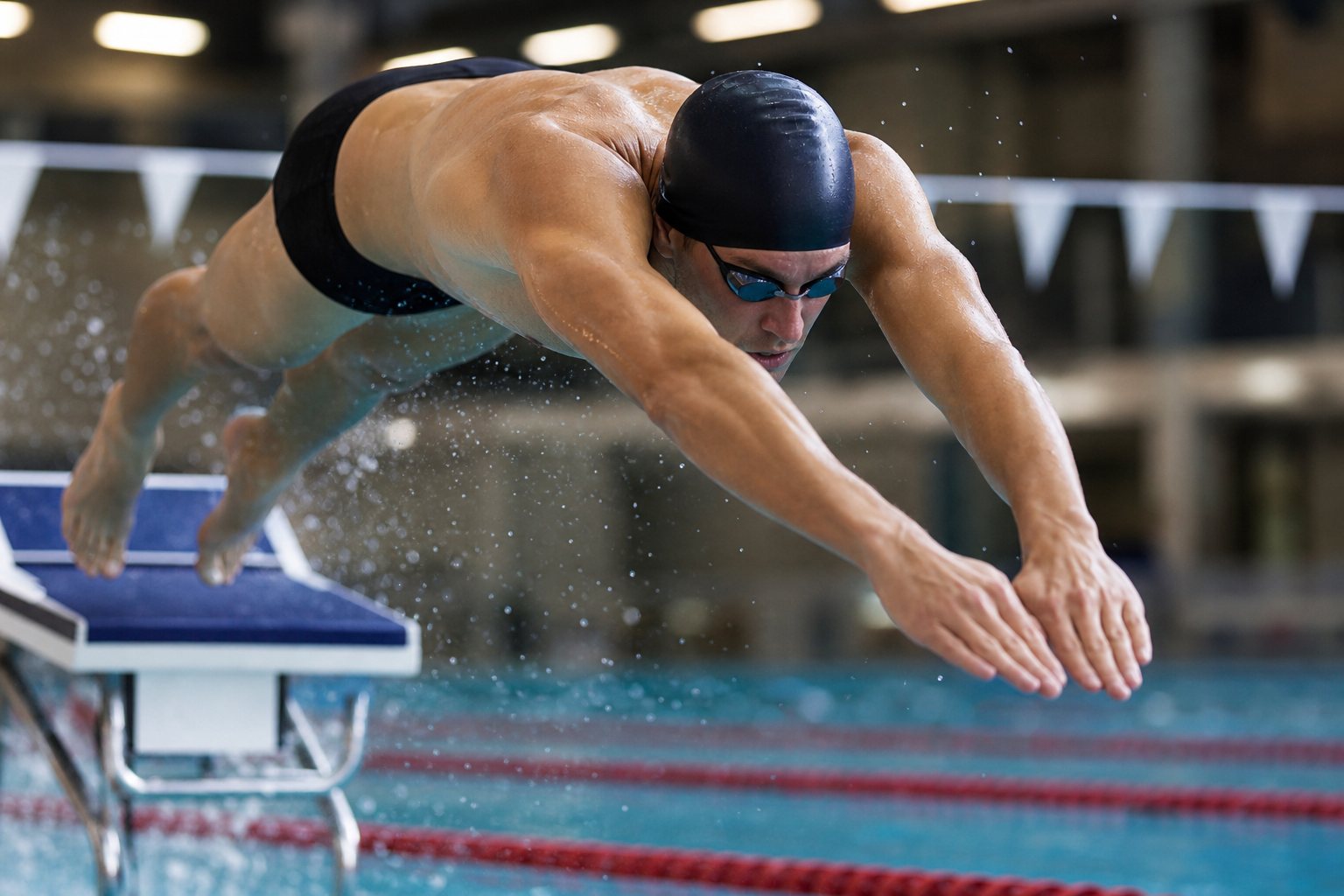
The pool deck at 6 a.m.: chlorine in the air, a row of swimmers in caps and goggles waiting for the first set, and on the far side a diver rehearsing a dive in the air with arms only. In the afternoon the same building might host a water polo scrimmage and an artistic swimming duet running through its music. In 1984, artistic swimming (then called synchronized swimming) made its Olympic debut in Los Angeles, and it returns to the city in 2028. Aquatics (also called aquatic sports or water sports) is the family of sports that happen in or on the water under one international federation, World Aquatics, which oversees six of them: swimming, diving, artistic swimming, water polo, open water swimming and high diving.
Aquatics guides: what do you need?
New to aquatics? Start with the first card. Everything here is general education, not medical advice.
This is the hub for the family. It explains each discipline in a few lines, shows where they stand for the 2028 Olympics, and covers what they share: shoulders that work overtime, the real risk of the water itself, and gear that stays in the chlorine. Then it sends you to the page for each sport.
History & Origins of the Aquatic Sports
Aquatics is a family of sports rather than one sport, and its history is the story of how the family came together under one federation. World Aquatics was founded as FINA in 1908 and renamed in December 2022. Today it oversees six sports: swimming, water polo, diving, artistic swimming, open water swimming and high diving (World Aquatics).
The Olympic dates show how the family grew. Swimming was in the first modern Games in 1896, water polo followed in 1900 as the Games’ first team sport, and diving in 1904. Synchronized swimming, now called artistic swimming, debuted at Los Angeles 1984, and the 10 km marathon swim joined in 2008. Women’s water polo has been Olympic since 2000. Water games and swimming are far older than any federation, but their early origin stories are scattered and hard to source, so this page covers documented federation and Olympic milestones only. Each sport has its own history on its own page: see swimming, diving, water polo and artistic swimming.
- 1896: Swimming is part of the first modern Olympics in Athens.
- 1900: Water polo debuts at the Olympics, the Games’ first team sport (LA28).
- 1904: Diving joins the Olympic programme.
- 1908: FINA, now World Aquatics, is founded.
- 1984: Synchronized swimming makes its Olympic debut in Los Angeles.
- 2000: Women’s water polo is added to the Olympics (NPR).
- 2008: Marathon (10 km open water) swimming debuts in Beijing.
- 2022: FINA is renamed World Aquatics.
- 2028: Los Angeles plans 41 swimming events, 8 diving events, duet and team artistic swimming, and 12-team water polo tournaments.
Legends of the Sport
Athletes who shaped the aquatic sports, from different eras and disciplines. This is not a ranking.
- Johnny Weissmuller (USA): in 1922 became the first man to swim 100 m freestyle in under a minute (World Aquatics).
- Mark Spitz (USA): won seven golds at Munich 1972, each in world-record time (Olympics.com).
- Michael Phelps (USA): 28 Olympic medals, 23 of them gold, including eight golds at Beijing 2008 (Olympics.com).
- Katie Ledecky (USA): nine Olympic golds and the first swimmer to win the same event, the 800 m freestyle, at seven straight World Championships (World Aquatics).
- Léon Marchand (FRA): four individual golds at Paris 2024 and the world records in the 200 m and 400 m individual medley (Olympics.com, World Aquatics).
- Quan Hongchan (CHN): defended her Olympic 10 m platform title at Paris 2024 and added the synchro 10 m gold with Chen Yuxi (Olympics.com).
- Rhiannan Iffland (AUS): five consecutive world titles in women’s high diving (World Aquatics).
- Iris Tio Casas (ESP): first artistic swimmer to win world titles in all four disciplines: solo, duet, mixed duet and team (World Aquatics).
Official results and records
We only list champions and records here after checking them on the official source. For the latest results, go to:
- World Aquatics
- Olympics.com (men’s platform)
- Olympics.com (men’s 3 m)
- Olympics.com (men’s synchro 10 m)
- World Aquatics Singapore 2025 final wrap
- Olympics.com Paris 2024
- Olympics.com Tokyo 2020
- NPR
How we keep this current: we re-check facts after each major championship and update this page. Spot an error? See our editorial policy.
Aquatics at a glance
| What it is | Six water sports under World Aquatics (founded as FINA in 1908, renamed in December 2022). |
|---|---|
| Swimming | Racing in four strokes. Olympic since 1896; 41 medal events planned for LA28 (as announced by World Aquatics). |
| Diving | Springboard (3 m) and platform (10 m), individual and synchronized. Olympic since 1904; 8 events at LA28. |
| Artistic swimming | Choreographed routines to music. Olympic since 1984; duet and team events at LA28. |
| Water polo | Seven-a-side team sport. Olympic since 1900; 12-team men’s and women’s tournaments at LA28. |
| Open water swimming | 10 km races in lakes, rivers and the ocean. Olympic marathon swimming since 2008. |
| High diving | Dives from 27 m (men) and 20 m (women) platforms. A World Aquatics discipline; we found no LA28 listing for it. |
| Governing bodies | World Aquatics (210 member federations); in the US, separate governing bodies for each sport, plus US Masters Swimming for adults. |
The disciplines in plain words
Swimming
Swimmers race head to head over freestyle, backstroke, breaststroke, butterfly or all four (the individual medley), in a 50-metre pool at the Olympics. Distances run from 50 m sprints to the 1,500 m. LA28 adds 50 m races in backstroke, breaststroke and butterfly. Our swimming hub covers strokes, rules, age-group and masters swimming, and injuries.
Diving
Divers flip and twist into the pool from a 3 m springboard or a 10 m platform, scored on execution and a degree-of-difficulty multiplier, and in synchro by how well two divers match. LA28 lists eight events at the Rose Bowl Aquatics Center. See our diving page.
Artistic swimming
Swimmers perform choreographed routines to music, judged on synchronization, execution, difficulty and artistic expression. LA28 notes that performers never touch the bottom of the pool or leave the water for more than 10 seconds. Since Paris 2024 the team event is a mixed competition that allows up to two men on an eight-person team. A page for this discipline is planned: artistic swimming.
Water polo
Two teams of seven try to throw a ball into the other’s net while treading water. Matches are four 8-minute quarters, possessions are limited to 28 seconds, and players handle the ball with one hand. LA28 describes it as the first team sport in the Olympics (1900), and both the men’s and women’s tournaments will have 12 teams. See our water polo hub.
Open water swimming and high diving
Open water races are 10 km in natural water, where incidental contact is allowed and finishes are often separated by hundredths of a second. LA28 lists men’s and women’s 10 km races at Belmont Shore. Water temperature is a safety issue: World Aquatics requires wetsuits below 18 °C (64.4 °F) and calls 16 °C (60.8 °F) the appropriate minimum safety standard. High diving uses much taller platforms (27 m for men and 20 m for women in World Aquatics events). See open water swimming, and for adaptive swimming para swimming.
Who plays and at what level
Youth and school. Swimming is a first sport for many children, and the American Academy of Pediatrics says it can be. In 2024, USA Swimming had 376,479 individual members, with the age 8 and under group the largest. In the 2024-25 school year the NFHS counted 138,303 girls and 119,102 boys in high school swimming and diving, making it the 9th and 10th most popular sport respectively. In California, water polo is a major high school sport, with about two-thirds of the 39,779 US high school players (boys and girls combined).
College. The NCAA runs combined swimming and diving championships; it adopted World Aquatics technical rules for diving. Water polo is a separate NCAA sport; UCLA won the 2025 men’s title 11-10 over USC, and USC won the 2026 women’s title 10-9 over California.
Adults. US Masters Swimming has nearly 60,000 members for ages 18 and up; competition is optional, and it offers adult learn-to-swim.
Olympic and Paralympic status, by edition. For LA28, the LA28 organizers list swimming, diving, artistic swimming, water polo and open water swimming. By our count of their event lists plus the 41 swimming events announced by World Aquatics, that is 55 medal events. Swimming is at the venue LA28 calls the 2028 Stadium, diving at the Rose Bowl Aquatics Center, water polo and artistic swimming at the Long Beach Aquatics Center, and open water at Belmont Shore. High diving is a World Aquatics discipline, and we found no LA28 listing; check the official programme for the current Games. Para swimming is a Paralympic sport; check the official programme for the current Games, and see our para swimming page.
Physical demands
Each sport asks for something different. Swimmers build aerobic endurance, shoulder and back strength and a strong kick. Divers need power for the takeoff, flexibility, body awareness and the nerve to repeat dives. Artistic swimmers need breath control and flexibility. Water polo players tread water with the “eggbeater” kick, sprint, throw overhead and wrestle in the water. Open water swimmers add pacing and navigation. Because water cools you quickly and supports your weight, it feels gentle, but the muscles and shoulders carry heavy training loads.
Health and safety for aquatic sports
This section is general information, not medical advice. If you are hurt, see a sports medicine doctor, physical therapist or athletic trainer. Safety rules for the water come first, with no product pitch attached.
The water itself
- Drowning is the big risk. The CDC reports about 4,000 fatal unintentional drownings a year in the US, roughly 11 a day, and drowning is the leading cause of death for children ages 1 to 4. Formal swimming lessons reduce the risk. The AAP’s 2026 policy statement recommends touch supervision of young children, life jackets, and notes that teens often overestimate their skills.
- Never swim alone, and use lifeguarded water. The American Academy of Orthopaedic Surgeons advises swimming only where there are lifeguards, checking the weather, and avoiding alcohol.
- Hypoxic blackout. USA Swimming, the American Red Cross and the YMCA of the USA warn against hyperventilating and prolonged breath-holding, which can cause swimmers to pass out underwater without warning, even in a pool. Do breath-hold drills only as a coach directs, with supervision.
- Never dive into shallow or murky water. AAOS reports more than 1,900 diving-related spinal cord injuries a year in the US, mostly leading to quadriplegia. Check depth, and swim away after a dive. Competitive diving has its own depth standards and coaching.
- Cold water. Open water swims need a plan for temperature, buddies and safety craft. World Aquatics’ rules on wetsuits and a 16 °C minimum apply to its events.
Injury patterns
- Across disciplines. At the 2015 World Championships, injuries and illnesses affected 12.9 per 100 athletes. The most common injuries were shoulder sprains and low-back muscle cramps (5.7% each), and the most common illnesses were respiratory (33.9%) and gastrointestinal (23.5%) infections. Injury incidence was highest in high diving, water polo and diving. The authors recommended focusing on out-of-competition overuse injuries.
- Swimmers: the shoulder. AAOS says shoulder pain from repetitive motion is the most common swimming injury. In a study of 80 elite swimmers aged 13 to 25, 91% reported shoulder pain, linked with hours and weekly mileage.
- Divers. In a four-season study of 63 Australian national-program divers, 70% to 85% had an injury each year, most in training rather than competition.
- Water polo. A study of collegiate players reported shoulder injuries as 20.6% and head and face injuries as 18.8%; concussion was the most common single diagnosis (11.4%).
- Swimmer’s ear. The CDC suggests ear plugs or a swim cap, drying the ears by tilting the head and towelling, and not putting cotton swabs in the ear.
Concussion applies in water polo, diving and any sport with a hard fall or ball contact. Follow the CDC’s HEADS UP rule: recognize and remove. An athlete who may have a concussion leaves the water for the day and sees a healthcare provider, who decides when to return. Call 911 for danger signs such as repeated vomiting or a seizure.
Training, recovery and nutrition pointers
Most aquatic athletes combine pool work, dryland strength and flexibility, and rest. Swimmers sweat in the water, so drink during practice. The ACSM suggests a carbohydrate-rich meal one to four hours before hard exercise, and the CDC recommends 9 to 12 hours of sleep for children ages 6 to 12, 8 to 10 for teens and at least 7 for adults. See our swimming training, recovery and nutrition and supplements pages, plus diving training and water polo training. Talk to a doctor or dietitian before taking supplements.
Gear
Aquatic gear lives in chlorine. Swimmers need a pair of goggles that fit, and a cap and ear plugs if their ears bother them. Divers keep a chamois for drying between dives. Water polo players wear a numbered cap and a suit made for the sport. Competition suits for swimmers must be approved by World Aquatics; USA Swimming restricts tech suits for ages 12 and under. For sport-by-sport lists see the gear pages for swimming, diving and water polo.
Picks to start: the Speedo Vanquisher 2.0 Mirrored goggles, Mack’s AquaBlock ear plugs (marketed as the official ear plugs of USA Swimming), the Flow Swim Chamois quick-dry towel and the KAP7 Turbo practice water polo cap.

Speedo Vanquisher 2.0 Mirrored Goggles
- Anti-fog, UV protection
- Interchangeable nosepieces
- Panoramic lens

Mack's AquaBlock Swimming Ear Plugs
- Reusable silicone
- Two pairs and a case
- Official ear plugs of USA Swimming (maker)
$6.99 at Amazon, as of Nov 17, 2026 01:07 UTC
Check price on Amazon
Flow Swim Chamois
- Made for swimming and diving
- Storage tube
- 13 x 17 in when wet
$12.95 at Amazon, as of Nov 17, 2026 01:07 UTC
Check price on Amazon
KAP7 Turbo No Number Water Polo Practice Cap
- Chlorine-resistant PBT
- No numbers
- Sold individually
Related sports and disciplines
Children of this hub: swimming, diving, water polo, open water swimming, artistic swimming and para swimming. Neighbours: triathlon, surfing and canoeing.
Aquatics FAQs
What sports are included in aquatics?
World Aquatics oversees six: swimming, diving, artistic swimming, water polo, open water swimming and high diving. Five are on the LA28 programme; we found no LA28 listing for high diving.
Which aquatic sports are in the Olympics?
Swimming (since 1896), water polo (1900), diving (1904), artistic swimming (1984) and marathon swimming (2008). All except high diving are on the LA28 pages. Check the official programme for the current Games.
Is swimming easy on the body?
It is low impact, but not injury-free. Shoulder pain from repetitive strokes is the most common swimming injury, according to AAOS, so build volume gradually and ask a coach about technique.
How can I make swimming safer for my child?
Enrol them in formal swimming lessons, keep them within arm’s reach when they are young, use life jackets in open water, and teach them never to swim alone. The CDC and AAP both stress lessons, supervision and CPR knowledge for families.
Can adults start competitive swimming or water polo?
Yes. US Masters Swimming welcomes adults 18 and up, whether they compete or not, and many clubs offer adult learn-to-swim. Ask a local aquatic club about adult water polo or diving programs.
Sources
- World Aquatics: About and World Aquatics: LA28 swimming events
- LA28: swimming, diving, artistic swimming, water polo, open water swimming
- World Aquatics: 16 °C open water threshold and World Aquatics: high diving
- NFHS participation 2024-25, US Masters Swimming, USA Swimming 2024 membership
- CDC drowning facts, AAP drowning prevention (2026), AAOS swimming injury prevention, CDC swimmer’s ear, CDC HEADS UP, CDC sleep
- Studies: injury and illness at FINA World Championships, elite swimmers’ shoulder pain, diver injuries, collegiate water polo injuries
- USA Swimming, Red Cross and YMCA: hypoxic blackout
Keep exploring: the swimming injuries page, our recovery tools guide, the foam roller guide and every other sport on our sports hub.