This article contains affiliate links: if you buy through them we may earn a commission, at no extra cost to you. Read our affiliate disclosure.
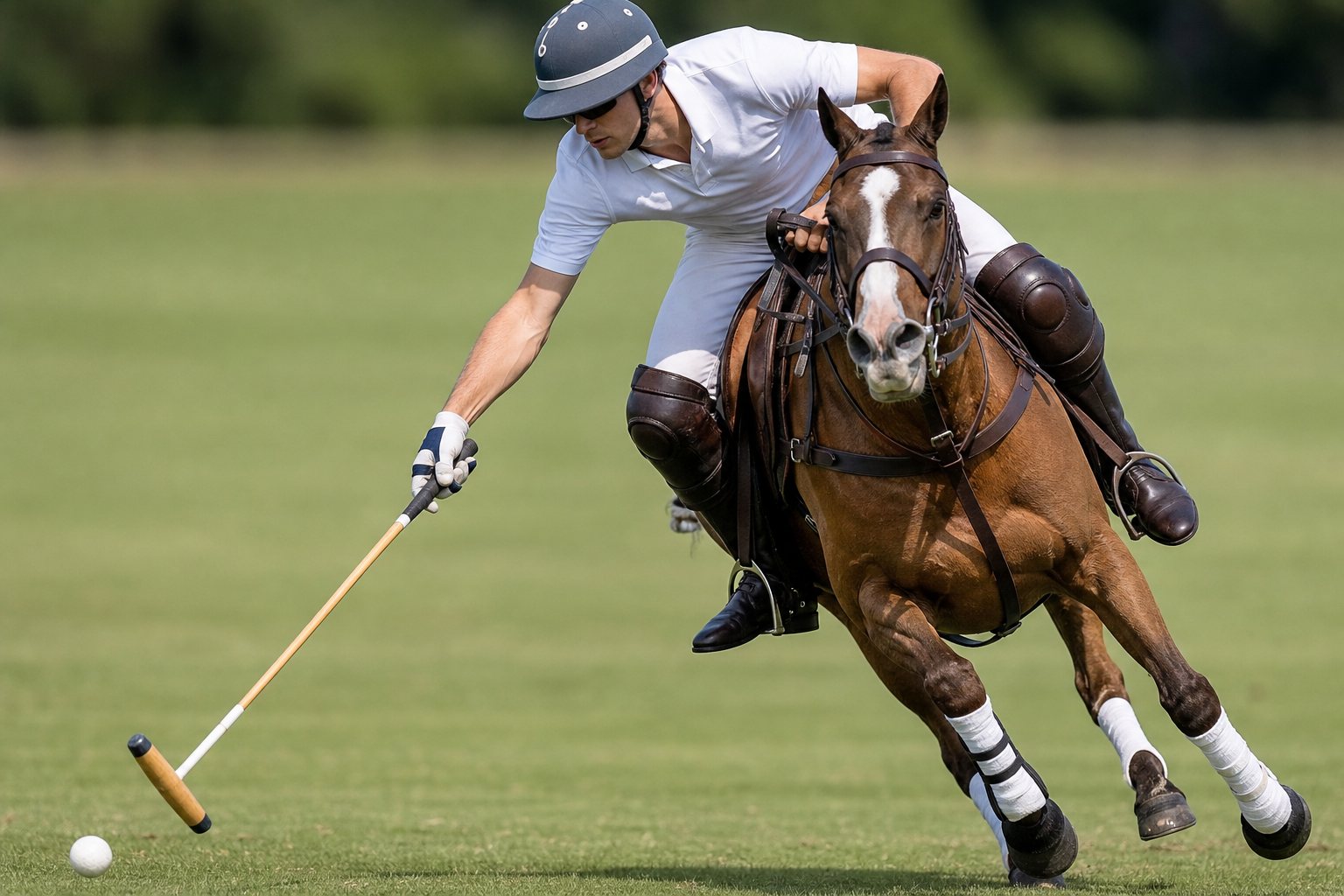
On a field in Palermo, Buenos Aires, four riders on each team gallop after a small white ball, swinging long mallets from the saddle. This is the Argentine Open, the closing event of Argentina’s polo Triple Crown (the Tortugas, Hurlingham and Palermo opens), played at the highest handicap level, 40 goals. Polo, called “the game of kings,” is a team sport on horseback in which players use a long-handled mallet to drive a ball through the other team’s goal.
Polo guides: what do you need?
New to polo? Start with the first card. Everything here is general education, not medical advice.
History & Origins of Polo
Polo is one of the oldest team sports on horseback. The Museum of Polo and Hall of Fame says it spread from Central Asian nomads into Persia, where it became a royal and military pursuit, and that Chinese ambassadors played a match against a team of the Japanese Emperor’s court in 821 (Museum of Polo). The modern game grew from Manipur in India: in 1859 Lieutenant Joe Sherer watched a match there and urged that the game be learned, which led British officers and tea planters to found the Silchar Polo Club.
From India polo travelled the British world and beyond. It reached England in 1869, Argentina in 1872 and Australia in 1874. In early 1876 the newspaper publisher James Gordon Bennett brought mallets, balls and the Hurlingham rules to New York, and the Westchester Polo Club, the first in the United States, was founded that year. Polo was an Olympic sport at five Games between 1900 and 1936 (Olympedia). Dates for the very earliest ancient games are approximate and we do not give exact years for them.
- 821: Chinese ambassadors play a match against a team fielded by the Japanese Emperor’s court (Museum of Polo).
- 1859: Silchar Polo Club is founded after Lt. Joe Sherer watches a match in Manipur.
- 1869: Polo reaches England.
- 1872: Polo reaches Argentina.
- 1876: James Gordon Bennett brings the Hurlingham rules to New York; Westchester Polo Club is founded.
- 1900: Polo is played at the Paris Games; Foxhunters Hurlingham (Great Britain) is listed as gold medallist by Olympedia.
- 1908: Olympic polo in London: Roehampton (GBR) gold (Olympedia).
- 1936: Last Olympic polo, in Berlin: Argentina gold, Great Britain silver, Mexico bronze (Olympedia).
- 1982: The Federation of International Polo (FIP), the worldwide governing body, is founded (FIP).
Official results and records
We do not publish a recent-champions or records table for polo, because we have not confirmed current results on an official results page. Official sources:
- Federation of International Polo: past events and World Championship
- United States Polo Association
- Olympedia: Olympic polo
Legends of the Sport
Players honoured by the Museum of Polo and Hall of Fame, from different eras. Descriptions are the museum’s, and this is not a ranking (Hall of Fame).
- Cecil Smith (inducted 1990): won the Monty Waterbury Cup first in 1930, won the U.S. Open five times and played for America against Mexico three times.
- Thomas Hitchcock Jr. (inducted 1990): described by the museum as one of the finest 10-goal players of all time.
- Devereux Milburn (inducted 1990): the British press once called him the best player in the world, according to the museum.
- Winston F. C. Guest (inducted 1991): won the Intercollegiate Championship in 1926 while at Yale.
- Gonzalo Pieres (inducted 2008): won the Argentine Open nine times.
- Carlos Gracida (inducted 2012): reached a 10-goal handicap in 1985 and held it for 15 years.
- Michael Azzaro (inducted 2013): won his first U.S. Open Championship in 1986 at age 21.
- Jeffrey Stuart Hall (inducted 2023): has won virtually every major U.S. tournament, per the museum.
How we keep this current: we re-check facts after each major championship and update this page. Spot an error? See our editorial policy.
This guide covers outdoor (field) polo and arena polo for people who are curious, for parents of a would-be young rider, and for players. It explains how the game is organized, how people get started, what research says about polo injuries, and the safety gear that matters. It is general information, not medical advice. Not to be confused with water polo.
Polo at a glance
| What it is | A mounted team sport. Players use a mallet to hit a ball toward the opposing goal; the horses are called ponies, and each player usually rides several during a game. |
|---|---|
| How it is won | The team with more goals wins. A goal counts when the ball crosses the line between the goal posts, no matter who or what knocked it through, even a horse. Teams switch ends after each goal. If the game is tied after the last chukker, there is a short break and then a sudden-death chukker where the first goal wins. |
| Participants and levels | Four players per team outdoors, three in arena polo. Players carry a handicap (a rating in goals); a team’s handicap is the sum of its players’. Levels run from low-goal club polo to the 40-goal Argentine Triple Crown. |
| Where | Outdoors on a grass field about 300 by 160 yards, “about the area of nine football fields,” with goal posts eight yards apart, and indoors in an arena. |
| Governing bodies | The United States Polo Association (USPA) in the U.S.; the Federation of International Polo (FIP) internationally; national bodies such as the Hurlingham Polo Association (England) and the Argentine Polo Association. |
| Season | Varies by country, club and level; ask your club or association for its calendar. |
How polo works
A game is divided into periods called chukkers. The Museum of Polo and Hall of Fame says an outdoor game has six chukkers (four in arena polo), each lasting seven minutes, with a bell at 6 1/2 minutes and a horn at the end. The USPA’s international rules, used in high-goal tournaments, say each period is a maximum of 7 1/2 minutes, and describe four chukkers in low and medium-goal games and six in high-goal ones, so check the conditions of the tournament you are watching or playing.
Ponies run about one to two miles per chukker and need frequent rest. At the highest levels a player ideally has a fresh pony every chukker, though many “double” on their best horses.
Handicaps
Each player has a handicap in goals, in the USPA scale from minus 2 up to 10; one club source gives minus 1 as the bottom. The number is a rating of ability. Adding the four players gives the team handicap, which is how tournaments are grouped: “low-goal,” “medium-goal” and “high-goal” polo, with the 40-goal level reserved for teams of four 10-goal players.
Safety rules built into the game
The museum says left-handed play has been banned for safety since the mid-1930s, and that the angle at which one rider may bump another is limited to 45 degrees or less, shrinking as horses go faster. Spectators are asked to stay back from sideboards and end lines.
Who plays polo, and at what level
Youth and school. The USPA runs an interscholastic program for high school students, who play teams in their region and across the country and can earn a varsity letter. The USPA says it offers six college scholarships a year for players who go on to play in college.
College. The USPA lists 41 established intercollegiate programs (15 men’s and 26 women’s teams) in four regions. College polo is played as arena polo, and the top teams qualify for a national championship that was first held in 1922, when Yale and Princeton were the only teams. The USPA runs more than 30 interscholastic and intercollegiate tournaments each season.
Club and professional. Club polo runs from low-goal to high-goal tournaments. Internationally, the FIP organizes national-team championships. In Argentina, the Triple Crown tournaments are the sport’s highest stage.
Olympics and Paralympics. Polo was on the Olympic programme at five Games, in 1900, 1908, 1920, 1924 and 1936, according to Olympedia, and it has not returned, not even as a demonstration sport. We found no sign of polo on the 2028 Los Angeles programme or the Paralympic programme. For the current Games, check the official programme at olympics.com and paralympic.org.
Physical demands
Polo-specific physiology research is thin. A 2023 review of the physiological requirements of equestrian riders (Best and colleagues) says equestrian sport is under-researched, and it estimates energy use and nutrition and hydration needs across disciplines. In plain terms, polo asks for balance and leg strength to stay in the saddle through hard turns, trunk control while swinging a mallet one-handed, and endurance across several chukkers in the sun, with sprints of effort when the play breaks away. Players also manage a second athlete, the pony, which sets the pace.
Health and safety for polo
If you are hurt, see a sports medicine doctor, physical therapist or athletic trainer. This section is general information.
What injury data shows
A 2026 study from the Hurlingham Polo Association in England reviewed accident reports from 26 clubs between 2018 and 2024 covering 236 injured players. The most common injury site was a limb (47.9%), followed by face or head (38.6%), and 12.1% of the face or head injuries involved the eyes. Injuries to the eyes were the most common reason players needed hospital treatment, whether from the stick, the ball or a fall. Because helmets are already mandatory, the authors recommend that sports glasses, goggles or face guards also be required. This is a single survey in one country, so use it as a guide, not a national rate.
For context, a CDC-authored study of U.S. emergency department visits for horse-related injuries from 2001 to 2003 estimated about 103,000 visits a year. Falling or being thrown was the main mechanism for riders, and being kicked for people on the ground. Horse sports share these hazards.
Helmets and concussion
Polo helmets with a chin strap are required, and the USPA has said its players’ helmets must meet NOCSAE ND050, the polo helmet standard, from May 1, 2021; check the current rule book before you buy. The CDC’s HEADS UP program says a person with a possible concussion should be removed from play for the day and cleared by a healthcare provider before returning. Headache, dizziness, confusion and balance problems are common signs, and danger signs like repeated vomiting or a seizure mean calling 911.
Heat and sun
Polo is a hot-weather sport. The CDC recommends shade, a hat, sunscreen and water for outdoor sports, and breaks between chukkers are a natural time to cool down.
Training, recovery and nutrition
Many new players learn to ride first and then add polo skills with a coach or club. Off the horse, balance, core and leg strength help, and mobility work for hips and shoulders suits the swing and the saddle. Our riding pages on training, recovery and nutrition apply. The CDC recommends at least seven hours of sleep for adults and 8 to 10 for teens. Supplements are a conversation with a doctor or dietitian, and drug-tested players should check products are certified for sport.
Gear
- Helmet: buy one that meets the standard in your association’s current rule book (the USPA names NOCSAE ND050), and have it fitted in person.
- Eye protection: the English study’s authors advocate making it compulsory, recommending sports glasses, goggles or a face guard. Ask a polo coach or eye doctor which is suitable; we have not verified a product made for polo.
- Knee guards, boots and gloves: the museum says kneepads protect knees during ride-offs and bumps. Gloves help you keep the reins.
- Sun and heat kit: sunscreen, a cooling towel and a water bottle for long outdoor days.

SSG Digital Riding Gloves
- Digital grip palm
- Grips when wet
- Machine washable

MISSION Max Plus Cooling Towel
- Microfiber, soak and wring
- UPF 50 (listing)
$22.99 at Amazon, as of Nov 17, 2026 01:07 UTC
Check price on Amazon
Blue Lizard Sport Mineral SPF 50
- Zinc oxide + titanium dioxide
- 80 minutes water resistant
- Fragrance-free
$8.97 at Amazon, as of Nov 17, 2026 01:07 UTC
Check price on AmazonRelated sports
- Horseback riding, with dressage, eventing and show jumping.
- Horse racing and rodeo.
- Water polo, a different sport with a similar name.
Polo FAQs
How long is a polo game?
Outdoors, the Museum of Polo describes six chukkers of seven minutes each, plus breaks, and arena polo four. Some tournaments use different periods, so check the tournament conditions.
What does “goal” mean in a handicap?
It is a rating of a player’s ability, from about minus 2 to 10 in the USPA scale. A team’s handicap is the sum of its four players, so a 40-goal team has four 10-goal players.
Is polo an Olympic sport?
Not now. It was at the Games of 1900, 1908, 1920, 1924 and 1936, and Olympedia lists no later appearances. Check the official programme for the current Games.
Do polo players have to wear helmets?
Yes. Helmets are required, and the USPA has said its players’ helmets must meet NOCSAE ND050. The English injury study found the head and face are still commonly injured and recommends eye protection too.
Can kids and college students play?
Yes. The USPA runs interscholastic programs for high school students and has 41 intercollegiate programs. Ask your nearest USPA club about lessons and arena polo.
Sources
- Museum of Polo and Hall of Fame, polo FAQs
- USPA, spectator guide; intercollegiate polo; interscholastic polo; polo helmet update
- Olympedia, polo at the Olympic Games
- Ken-Dror G et al. Traumatic injuries in polo players, Postgrad Med J 2026
- Thomas KE et al. Non-fatal horse related injuries treated in emergency departments in the United States, 2001-2003, Br J Sports Med 2006
- Best R et al. Physiological requirements of equestrian riders, Nutrients 2023
- CDC HEADS UP, response and signs; CDC sleep and sun safety
Keep exploring: the sports hub, the horseback riding injuries page for fall and head-injury safety, our recovery tools guide and the electrolyte powder guide.