This article contains affiliate links: if you buy through them we may earn a commission, at no extra cost to you. Read our affiliate disclosure.
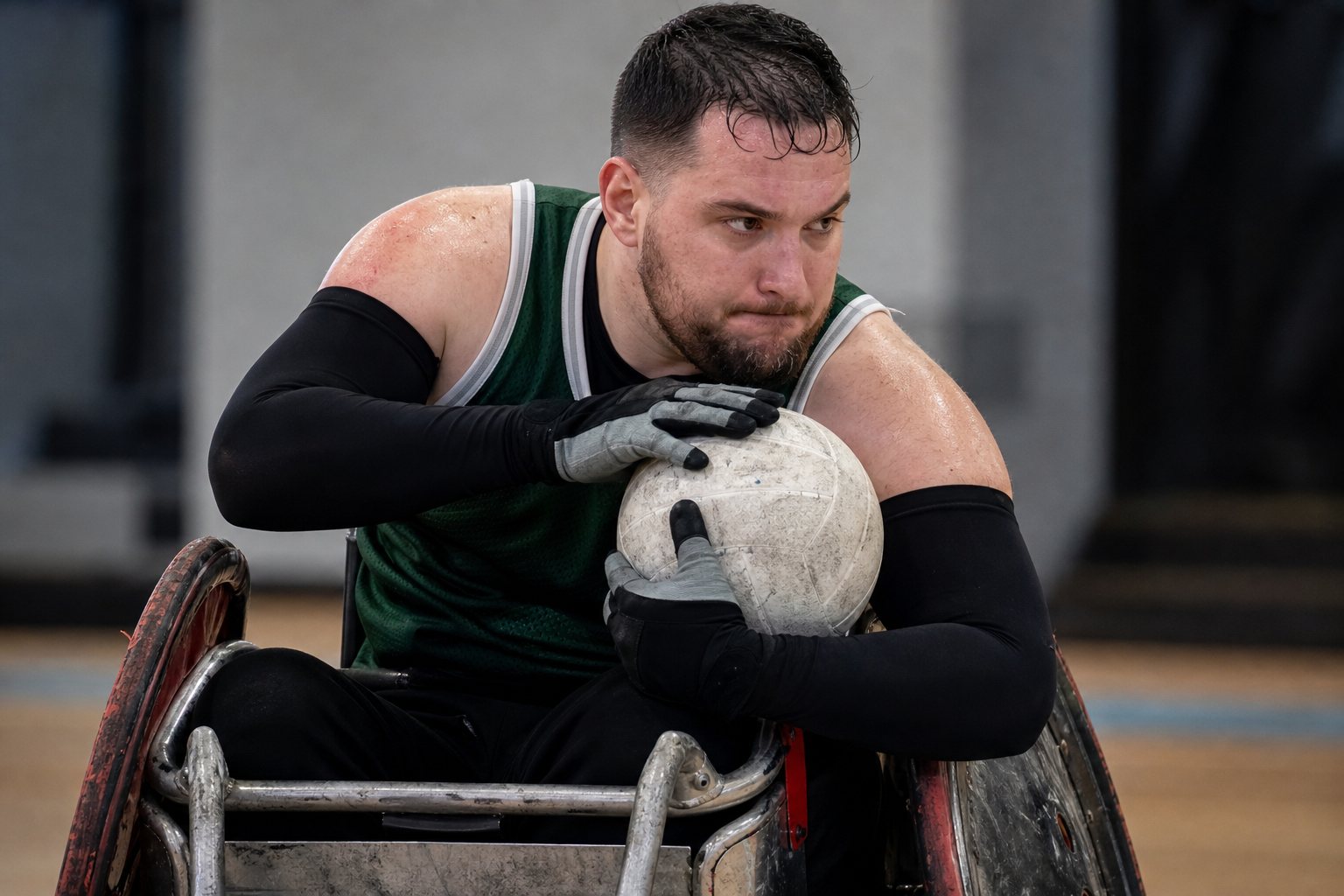
September 2, 2024, Champ-de-Mars Arena in Paris: chairs collide, players use them to block and hold, and a ball carrier with the ball on his lap works free to cross the goal line. Japan beat the United States 48-41 to win its first Paralympic gold in the sport, and the US took its third straight silver while extending its streak of Games with a medal to seven. Wheelchair rugby (also called quad rugby, and once nicknamed “murderball”) is a full-contact team sport for athletes with impairments in at least three limbs, played in sport-built manual wheelchairs on a basketball court.
Wheelchair Rugby guides: what do you need?
New to wheelchair rugby? Start with the first card. Everything here is general education, not medical advice.
History & Origins of Wheelchair Rugby
Wheelchair rugby began in 1977 in Canada, created by athletes with quadriplegia who wanted a fun, fair team sport similar to wheelchair basketball. Its early nickname was “murderball” because of its contact. It later spread to the United States. The International Paralympic Committee (IPC) page does not name individual founders, so we do not either (Paralympic.org).
International play grew in steps. The first international tournament took place in 1982 in North America, and the first with a non-North American nation in 1989. The sport was recognised as a sport for persons with disabilities in 1993 and by the IPC in 1994. Today players are grouped into seven classes from 0.5 to 3.5 according to their function.
- 1977: Invented in Canada by athletes with quadriplegia.
- 1982: First international tournament, in North America.
- 1989: First tournament with a non-North American nation.
- 1993: Recognised as a sport for persons with disabilities.
- 1994: Recognised by the IPC.
- 1996: Demonstration sport at the Atlanta Paralympics.
- 2000: Full medal sport at Sydney with eight teams; eight countries have competed at every Summer Games since.
Official results and records
We do not publish a recent-champions or records table for wheelchair rugby, because we have not confirmed results on an official results page. Official sources:
Legends of the Sport
Athletes named by the IPC on its wheelchair rugby page. This is not a ranking (Paralympic.org).
- Ryley Batt: listed by the IPC as the most successful athlete in the sport.
- Chuck Aoki and Mike Whitehead: United States and Canada players featured by the IPC.
- Daisuke Ikezaki and Katsuya Hashimoto: Japan players featured by the IPC.
- Sarah Adam (USA) and Alex Pantling (Great Britain): featured by the IPC, Pantling in a Paris 2024 photo.
How we keep this current: we re-check facts after each major championship. Spot an error? See our editorial policy.
This page covers how the game works, how players are grouped so every team has a fair mix, how the sport is organised, and what to know about shoulders, heat and safety. It is general information, not medical advice; personal questions belong with your own care team.
Wheelchair rugby at a glance
| What it is | A mixed-gender team sport with elements of rugby, basketball and handball, played in manual wheelchairs built for the sport. |
|---|---|
| How you score | Carry the ball across the opponent’s goal line with two wheels over the line and firm control of the ball. The team with the most goals when time runs out wins. |
| Players | Four per team on the court at a time; teams of up to twelve. Men and women play together. |
| Game | Four 8-minute quarters with the clock stopped at every whistle, so a game takes about an hour and a quarter. A team has 40 seconds to score once it has the ball. |
| Court | Indoors, on a basketball-sized court (28 m by 15 m), with goal lines marked by cones and a marked key area. |
| Classes | Seven sport classes, 0.5 to 3.5. The four players on court may add up to no more than 8.0 points. |
| Governing body | World Wheelchair Rugby (formerly IWRF) worldwide; the United States Wheelchair Rugby Association (USWRA) in the US. |
| Paralympics | Medal sport since Sydney 2000; on the Paris 2024 programme; confirmed for LA28 (one mixed event, 8 teams). |
How wheelchair rugby works
The ball looks and feels like a soft volleyball. The player in possession carries it on the lap and must keep it moving: it has to be bounced or passed regularly (the long-standing rule is every 10 seconds, and World Wheelchair Rugby’s January 2026 summary of rule changes lists a shorter 8-second dribble time, so check the current rulebook). The whole team has 40 seconds to score before the ball is turned over. There is no offside. Contact between chairs is allowed and is a big part of strategy, because players use their chairs to block and hold opponents.
The USOPC notes that each sport class has a distinct profile and that athletes in each class often play specific roles on the court, so a good roster is built like a puzzle. Each side gets timeouts, and the rules have been revised for the cycle running through the 2028 Paralympics (timeouts, penalty times and inbound time were among the changes).
Sport classes and the 8.0 limit
Classification exists so that athletes compete against others with a similar effect of impairment on the sport. In wheelchair rugby each athlete is assessed through a physical check, a technical check of ball and chair skills, and observation during real games, then given one of seven classes: 0.5, 1.0, 1.5, 2.0, 2.5, 3.0 or 3.5. A lower number means a greater effect of impairment on the sport; a score of 4.0 or more is not eligible. The four players on the floor can total no more than 8.0 points, and women are given a bonus. Under the January 2026 rules a team may add 0.5 for each woman classed 0.5 to 1.5 and 1.0 for each woman classed 2.0 to 3.5 on the court. To be eligible, players need an impairment that affects the arms and legs; the USOPC describes it as a mobility-related disability in at least three limbs, such as tetraplegia.
For a spectator or a beginner, this means a team made up only of the highest-class players is not allowed. Every lineup needs a mix of classes.
The chairs
Players compete in manual wheelchairs designed for the sport. The rules set details on equipment, such as how far apart the small wheels (casters) must sit on their axles, and World Wheelchair Rugby’s 2026 changes added that caster wheels must not emit light. Ask a club whether a team chair is available to try before you think about buying one.
Who plays it and at what level
The sport began in Winnipeg, Canada, in 1977, invented by athletes with quadriplegia who wanted an alternative to wheelchair basketball. It reached Minnesota in 1979, was recognised by the International Paralympic Committee in 1994, appeared as a demonstration sport at Atlanta 1996 and became a medal sport at Sydney 2000, where the United States won the first gold.
- Starting out: the USOPC suggests connecting with a local adaptive sports organisation that offers wheelchair rugby or a local wheelchair rugby club, and the USWRA website has “Join a Team” and “Start a Team” pages.
- Youth and school: we could not confirm a national youth or school programme. Ask the USWRA or your nearest club what is available for younger players.
- Club and national: US teams compete under the USWRA, and athletes seeking regional or national play need national classification, per the USOPC.
- International: World Wheelchair Rugby runs the world championships and the Paralympic qualification.
Paralympic status, edition by edition
Wheelchair rugby was a demonstration sport at Atlanta 1996 and has been a medal sport since Sydney 2000. At Paris 2024, Japan beat the US 48-41 in the gold-medal game and Australia beat Great Britain 50-48 for bronze. The IPC’s LA28 programme (15 to 27 August 2028) confirms wheelchair rugby with one mixed medal event, eight teams and 96 athlete places. For anything later, check the official programme for the current Games.
Physical demands
Wheelchair rugby is stop-and-start: the clock stops at every whistle, a possession lasts at most 40 seconds, and chairs push, turn and collide. The pushing and the contact load the shoulders, arms and upper back, which is why shoulder health comes up so often below. Athletes with a high-level spinal cord injury also have reduced sweating and blood-vessel control below the injury, which changes how they handle a warm gym (see the safety section). We did not find a published breakdown of the sport’s energy systems, so we leave it there rather than guess.
Health and safety for wheelchair rugby
These are general points, not a plan for any one person. Please see a sports medicine doctor, physical therapist or athletic trainer who works with wheelchair athletes.
Shoulders
Shoulders do double duty for wheelchair users: they push the chair all day and they play the sport. A 2026 survey of 61 US wheelchair rugby athletes in Assistive Technology reported high levels of shoulder pain on the Wheelchair User’s Shoulder Pain Index (average 56.08). In that survey, pain scores were lower among athletes who warmed up more often (r = -0.53) and who did shoulder strength training (r = -0.34), and higher among power-wheelchair users. This is a snapshot, not proof of cause, but it points toward warm-ups and shoulder conditioning being worth discussing with a clinician. A small Brazilian MRI study of ten tetraplegic quad rugby players and ten non-athletes found shoulder tendon and joint changes in both groups and suggested that sport may even be protective for some findings.
Heat and temperature
A review of cooling for athletes with spinal cord injury notes that those with high-level lesions (tetraplegia) have a greater risk of heat illness than those with lower-level lesions at a given intensity, because of reduced sweating and blood-vessel control below the injury. The review says cooling strategies, such as ice vests, may help even in moderate temperatures (around 21 degrees C), but evidence is thin and each athlete should work out a plan with their medical team. Water and electrolyte drinks within reach are a simple start.
Autonomic dysreflexia
Athletes with spinal cord injuries at the T6 level or above (and some with injuries at T10 or above) can get autonomic dysreflexia, a sudden, dangerous rise in blood pressure often triggered by something below the injury, such as a full bladder or a tight strap. The Christopher and Dana Reeve Foundation calls it a medical emergency. Warning signs include a pounding headache, sweating, flushing and blurred vision. Teammates, coaches and staff should know the athlete’s plan; the foundation’s guidance is to sit upright, loosen anything tight, check for triggers and call 911 if blood pressure stays high or no trigger is found.
Falls, head impacts and concussion
Chairs collide in this sport, and any fall or head impact deserves attention. The Concussion in Para Sport Group’s position statement says concussion is common in para athletes, that the “remove, rest, reconsider, refer” steps apply, and that return to sport has to be decided case by case. The CDC’s HEADS UP guidance adds the basics: anyone who may have a concussion should stop playing and be checked by a healthcare provider before going back. Call 911 for danger signs such as repeated vomiting or a seizure.
Training, recovery and nutrition pointers
Pushing technique, chair skills and ball handling are best learned at a team practice with experienced players. Between practices, the shoulder survey above points toward warm-ups and shoulder strength work, planned with a clinician who knows wheelchair athletes, plus sleep and easy movement. Our general guides cover the basics, but they were written for standing athletes: see rugby training, rugby recovery and rugby nutrition and supplements with that in mind. Supplements follow the rule used across this site: check with a doctor or dietitian first, and look for third-party testing for sport.
Gear
- The sport chair: custom-fitted for the athlete and class, and regulated by the rules (for example, the caster spacing). Try a team chair before you buy, and get fitting help from a coach or therapist.
- The ball: an official IWRF game ball that looks much like a soft-touch volleyball.
- Gloves and straps: ask your team and your clinician what suits your chair, your hands and your class.
- Cooling and hydration: a water bottle you can reach from the chair and an electrolyte drink for long, hot days.
Three simple extras, none of them sport-specific: a THERABAND resistance band kit for light shoulder warm-ups your clinician approves, a Nalgene 32 oz bottle for the bench, and Nuun Sport electrolyte tablets for hot days (the maker says it holds an Informed Choice certification; check the label and your own needs). More ideas in our resistance band guide and electrolyte guide.

THERABAND Resistance Band Beginner Kit
- 3 latex bands
- Yellow, red, green
- For light strength work
$11.99 at Amazon, as of Nov 17, 2026 01:07 UTC
Check price on Amazon
Nalgene Sustain 32 oz Bottle
- 32 oz, wide mouth
- BPA-free Tritan
- Fits most bottle cages

Nuun Sport Electrolyte Tablets
- 300 mg sodium per tablet
- 1 g sugar
- Informed Choice (maker)
Related sports and disciplines
- Rugby: the standing game that gave wheelchair rugby its name, though the rules and the bodies that run them are different.
- Wheelchair basketball: another Paralympic court sport in sport chairs, with its own classification.
- Sitting volleyball and goalball: more Paralympic team sports.
Wheelchair rugby FAQs
Who can play wheelchair rugby?
Athletes with an impairment that affects the arms and legs, such as a spinal cord injury causing tetraplegia, who meet the minimum criteria and can be classified. The USOPC describes a mobility-related disability in at least three limbs. Men and women play on the same teams.
How do the point classes work?
Each athlete is rated from 0.5 to 3.5 according to how their impairment affects playing the sport. The four players on the court add up to 8.0 or less, with an extra allowance for women under the 2026 rules.
Is wheelchair rugby in the Paralympics?
Yes. It has been a medal sport since Sydney 2000, was on the Paris 2024 programme and is confirmed for LA28 with one mixed event and eight teams. Check the official programme for the current Games.
Where can I try it in the US?
Start with the USWRA’s “Join a Team” page, a local adaptive sports organisation or a club listed on the US Paralympics club finder (uspara.us/findaclub), which the USOPC overview points to. Most teams are happy to let a newcomer try a sport chair at practice.
Sources
- IPC: Introduction to wheelchair rugby
- World Wheelchair Rugby (IWRF): Classification Rules, January 2021
- World Wheelchair Rugby: Summary of rule changes, January 2026
- World Wheelchair Rugby: the sport
- IPC: LA28 medal event programme and athlete quotas
- Team USA: Paris 2024 gold-medal contest
- Rider et al. 2026, shoulder pain in wheelchair rugby athletes (PubMed)
- Shoulder injuries in tetraplegic athletes, Spinal Cord 2015 (PubMed)
- Cooling athletes with a spinal cord injury, Sports Medicine 2015 (PubMed)
- Concussion in para sport: position statement (PubMed)
- Christopher and Dana Reeve Foundation: autonomic dysreflexia
- CDC HEADS UP
Keep exploring: the rugby hub, rugby injuries (written for standing rugby), our recovery tools guide, massage guns, and every other sport on our sports hub.