This article contains affiliate links: if you buy through them we may earn a commission, at no extra cost to you. Read our affiliate disclosure.
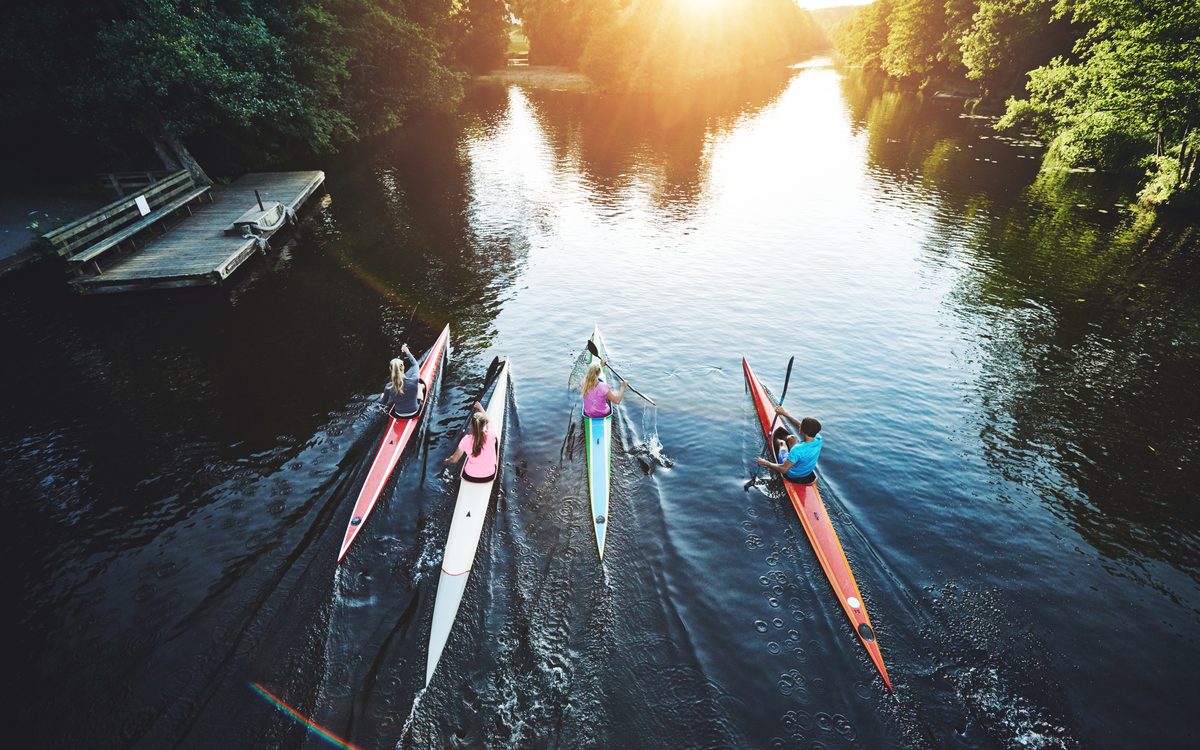
Nine boats sit on a flat, still lake, bows on a line, paddles poised. A horn, and a 200 metre sprint is over in well under a minute. At the Tokyo Games in 2021, Nevin Harrison of the United States won the first Olympic women’s C-1 200 m, a race that had only just joined the program. Canoe sprint, also called flatwater racing or “flatwater,” is a straight-line race in kayaks and canoes over 200, 500 or 1000 metres on calm water, where the first boat across the line wins.
Canoe Sprint guides: what do you need?
New to canoe sprint? Start with the first card. Everything here is general education, not medical advice.
History & Origins of Canoe Sprint
Paddling boats are far older than any sport, but racing in light recreational canoes took shape in Britain in the 1860s. The Scottish traveller John “Rob Roy” MacGregor popularised the pastime with his book about a canoe trip, and in 1866 he founded The Canoe Club, now the Royal Canoe Club. Its members held what is described as the first modern canoeing competition in 1867. We treat these early dates as commonly cited rather than firmly settled.
The international organisation came later. On January 19, 1924, delegates from Denmark, Germany, Austria and Sweden founded the Internationale Repräsentantenschaft Kanusport in Copenhagen, the forerunner of today’s International Canoe Federation (Paddle Worldwide), which now uses the name Paddle Worldwide. Canoeing was a demonstration event at the 1924 Olympics and a full men’s medal sport at Berlin 1936. Women were first allowed to race at the Olympics in 1948. Since then the program has grown and changed, with 200 m races added in 2012 and, at Tokyo 2020 (held in 2021), equal numbers of men’s and women’s events. Details on the current program are on the canoe sprint page.
- 1866: The Canoe Club is founded in London by John MacGregor (commonly cited).
- 1924: International body founded in Copenhagen on January 19; canoeing is shown as a demonstration sport at the Paris Olympics.
- 1936: Canoeing becomes a medal sport at the Berlin Olympics, men only.
- 1938: First world championships, in Vaxholm, Sweden.
- 1948: Women race at the Olympics for the first time (K-1 500 m).
- 2012: The 200 m distance joins the Olympic program.
- 2021: Tokyo 2020: equal men’s and women’s events; Nevin Harrison (USA) wins the first Olympic women’s C-1 200 m.
- 2028: Los Angeles will host ten sprint medal events at Marine Stadium, Long Beach.
Notable Athletes of Canoe Sprint
Contemporary athletes listed alphabetically, not ranked. We have left out earlier-era names we could not confirm to an official source.
- Lisa Carrington (NZL): won the women’s K-1 500 m, K-2 500 m and K-4 500 m at Paris 2024.
- Josef Dostál (CZE): Paris 2024 men’s K-1 1000 m champion.
- Martin Fuksa (CZE): won the men’s C-1 1000 m at Paris 2024 and at the 2025 World Championships.
- Nevin Harrison (USA): the first Olympic women’s C-1 200 m champion (Tokyo 2020) and silver medallist by 0.01 s at Paris 2024.
- Bálint Kopasz (HUN): bronze at Paris 2024 and 2025 world champion over 1000 m.
- Liudmyla Luzan (UKR): four world titles at Milan 2025.
- Anna Puławska (POL): won the K-1 500 m and, with Martyna Klatt, the K-2 500 m in Milan.
- Katie Vincent (CAN): Paris 2024 women’s C-1 200 m champion.
Official results and records
We only list champions and records here after checking them on the official source. For the latest results, go to:
How we keep this current: we re-check facts after each major championship and update this page. Spot an error? See our editorial policy.
It is the other side of canoeing from canoe slalom, which is run on whitewater. This page covers how sprint racing works, who races, what the sport asks of the body, and how to stay healthy on the water.
Canoe sprint at a glance
| What it is | Flatwater straight-line racing in single, double and four-person boats. |
|---|---|
| How it is won | First boat across the finish line, through heats, semifinals and finals. |
| Boats and paddles | Kayaks (K1, K2, K4): seated, double-bladed paddle. Canoes (C1, C2): kneeling, single-bladed paddle. Sprint kayaks steer with a small rudder. |
| Distances | 200 m, 500 m and 1000 m are the ICF’s official distances (ICF rules, 2025). |
| Course | Up to nine lanes, each at least 9 m wide, straight and free of obstacles. Olympic races have eight boats. |
| Governing bodies | The International Canoe Federation (now using the name Paddle Worldwide); ACA Paddlesports in the United States. |
| Olympic events | Ten at LA28: men’s C-1 1000 m, C-2 500 m, K-1 1000 m, K-2 500 m, K-4 500 m; women’s C-1 200 m, C-2 500 m, K-1 500 m, K-2 500 m, K-4 500 m. |
How it works
Each boat has its own lane. At international events, lanes are drawn at random in the first heats and later rounds give the fastest boats the middle lanes. A first false start earns a warning. The rules also fix the equipment: ICF 2025 rules set maximum boat lengths (520 cm for a K1 or C1, 650 cm for doubles) and minimum weights (12 kg for a K1, 14 kg for a C1, 18 kg for a K2, 20 kg for a C2, 30 kg for a K4 or C4). A boat must stay afloat when it is full of water, the paddler may not be attached to the boat, and the paddle may not be attached either. Kayaks and canoes are different crafts: in sprint canoes the paddler kneels on one knee with the other foot forward, while in kayaks the paddler sits, and a rudder steers.
A sprint is mostly power and rhythm: in a four-person boat, the crew’s timing matters as much as its strength.
Who plays it and at what level
Many paddlers start at a local club. ACA Paddlesports, the US national governing body for Olympic and Paralympic paddlesports, runs sprint selection procedures for the World Championships, World Cups, Pan American Championships and Junior and U23 events, plus Olympic Hopes Regatta trials and the ACA Sprint National Championships. The ICF also holds Junior and Under-23 World Championships.
Olympic and Paralympic status (as of 2026). Sprint canoeing and kayaking was first held at the 1924 Paris Games and became a full medal sport at Berlin 1936. Women first raced in 1948 (K-1 500 m), the 200 m distance was added in 2012, and Tokyo 2020 was the first Games with equal numbers of men’s and women’s events. For LA28, Paddle Worldwide reports 10 sprint medal events (listed above), with a sprint quota of 236 athletes, 118 men and 118 women, raced at Marine Stadium in Long Beach on 25 to 29 July 2028. The ICF’s bid to add a 5000 m event was unsuccessful. The Paralympic discipline, paracanoe, is separate: see our para canoe page; ACA lists paracanoe on 24 to 26 August 2028.
What it demands of the body
A 2025 systematic review of flat-water kayaking research found that performance is strongly linked to maximal oxygen uptake, aerobic and anaerobic thresholds, peak aerobic and anaerobic capacity and upper-body and lower-body strength and power. In a study of 24 national-level men, the power they could produce at maximal oxygen uptake was the strongest single predictor of a 500 m ergometer time. International-level medallist kayakers in another study had a mean maximal oxygen uptake of about 58 mL/min/kg and peak blood lactate near 12 mmol/L for men. Plainly: it takes a big aerobic engine, upper-body and trunk strength, and tolerance for hard effort.
Health and safety
This is general information, not medical advice. If you are hurt, see a sports medicine doctor, physical therapist or athletic trainer. More in our canoeing injuries guide.
Injury patterns. A 2025 survey of 140 Chinese elite adolescent flat-water paddlers (89 kayakers, 51 canoeists) recorded 207 injuries in the past year. For kayakers the most common site was the lower back, then the shoulder, wrist and knee; for canoeists, the shoulder, then the lower back, back and knee. The kayak injury rate was 0.90 per 1,000 training hours, and female canoeists had a higher rate than male canoeists (1.51 versus 0.47 per 1,000 hours). This was a self-report survey from one country, so use it as a guide, not a forecast.
Water safety. Racing boats tip easily. The US Coast Guard’s 2024 boating statistics list 21 canoe drownings among 25 canoe deaths, and none of the drowned victims was wearing a life jacket. The Coast Guard’s boater’s guide calls for one wearable life jacket per person on recreational boats. Ask your club what is required in racing and practice. Learn how to get back into your boat, stay with the boat if you capsize and know the water temperature. The National Weather Service warns that water under 70 F can quickly sap muscle control. Check with your club about its rules on life jackets, chase boats and cold-water protection.
Sun, heat and storms. Practices are on open water. Use shade, water, sunscreen as the American Academy of Dermatology describes, and leave the water for lightning, following NATA’s lightning guidance.
Training, recovery and nutrition pointers
Most paddlers split time between the water, the gym and the ergometer. A paddling ergometer lets paddlers work on power and intervals indoors; a small study of eight weeks of high-intensity interval training in national-level kayakers reported better 200 m and 1000 m times. See canoeing training, recovery and nutrition and supplements for the basics.
Gear
Racing boats and paddles are specialist equipment: the ICF’s rules fix their length and weight, and clubs usually lend boats to beginners, so ask before you buy. What every paddler needs is safety gear. Wear a life jacket that is approved for your use and fits snugly, check it for wear, and carry a whistle on your jacket where you can reach it hands-free. After practice, a foam roller helps with tight lats and hips; recovery tools are for comfort, not treatment.

Onyx MoveVent Dynamic Paddle Vest
- USCG and Transport Canada approved
- Mesh lower back for high seats
- Adjustable shoulders

Fox 40 Classic Whistle
- Pea-less, three chambers
- 115 dB
- Wear it on your life jacket

TriggerPoint GRID 1.0 Foam Roller
- 13 x 5 inch
- Multi-density
- Hollow core keeps its shape
Related sports and disciplines
- Canoeing, the parent sport, and its gear page.
- Canoe slalom, the whitewater discipline.
- Kayaking, rowing and para canoe.
Canoe sprint FAQs
What is the difference between canoe sprint and slalom?
Sprint is a straight-line race on flat water, decided by speed. Slalom is timed through gates on a whitewater course, with penalties for touching or missing gates.
What is the difference between a canoe and a kayak?
In a kayak you sit and use a double-bladed paddle. In a canoe you kneel and use a single blade.
Which canoe sprint events are in the Olympics?
Ten for LA28, five for men and five for women, listed in the table above.
How do I get started?
Find a local paddling club, many of which lend boats. ACA Paddlesports is the national governing body.
What injuries are most common?
In one survey of adolescent flat-water paddlers, the lower back and shoulder were most often injured. A coach or sports medicine professional can check technique and training load.
Sources
- ICF / Paddle Worldwide, Canoe sprint; Canoe sprint and canoe slalom programme and quotas confirmed for LA28.
- ICF, Canoe Sprint Competition Rules 2025.
- ACA Paddlesports, Sprint and LA28 ticketing guide.
- Epidemiological characteristics of injuries among elite adolescent flat-water kayak and canoe athletes (2025).
- Physiological and physical determinants of flat-water kayaking (2025); aerobic contributors to 500 m sprint kayak performance (2026); power, lactate and VO2max in international kayakers and rowers (2025); HIIT in flatwater kayakers (2025).
- US Coast Guard, Recreational Boating Statistics 2024; National Weather Service, hazards of cold water.
- NATA, lightning safety and exertional heat illness; American Academy of Dermatology, how to apply sunscreen.
- Axios, Nevin Harrison wins first Olympic women’s canoe 200 m.
Keep exploring: the canoeing hub, canoeing injuries, our recovery tools guide, foam rollers and the sports hub.