This article contains affiliate links: if you buy through them we may earn a commission, at no extra cost to you. Read our affiliate disclosure.
Copacabana Beach, Rio de Janeiro, September 2016: the first Paralympic triathlon in history started in the sea, with three men’s and three women’s medal events on the programme. The first Paralympic champion was Germany’s Martin Schulz, in the men’s PT4 class, and the United States topped the medal table with two golds, one silver and one bronze. Para triathlon (also written paratriathlon or para-triathlon) is triathlon for athletes with a physical or vision impairment: a 750 m swim, a 20 km bike and a 5 km run, raced back to back, using handcycles, racing wheelchairs, prostheses, tandems and guides as the athlete’s class allows.
Para Triathlon guides: what do you need?
New to para triathlon? Start with the first card. Everything here is general education, not medical advice.
History & Origins of Para Triathlon
Triathlon is run by World Triathlon, which adopted para triathlon in 1989. As participation grew, athletes were sorted into competition classes by 1996, which led to the first World Championship. Since 2009 the standard race has been a 750 m swim, a 20 km bike and a 5 km run (Paralympic.org).
Para triathlon made its Paralympic debut at Rio 2016 with six events, three for men and three for women. Tokyo 2020 had eight medal events and Los Angeles 2028 is set to have 12. Classes use letter codes: PTWC for wheelchair athletes, PTS for standing, and PTVI for athletes with a vision impairment.
- 1989: World Triathlon adopts para triathlon.
- 1996: Athletes are sorted into competition classes; first World Championship follows.
- 2009: Race distances set at 750 m, 20 km and 5 km.
- 2016: Paralympic debut at Rio, six events.
- 2021: Tokyo 2020 (held 2021) has eight medal events.
- 2024: Paris Paralympics.
- 2028: Los Angeles is set to have 12 events.
Official results and records
We list official sources instead of repeating results we have not checked ourselves:
- Paralympic.org: Para triathlon (results, medals, athlete profiles)
- Paralympic Games results
- World Triathlon (World Championships and World Series results)
Notable Athletes of Para Triathlon
Athletes from the sport’s Paralympic era. This is not a ranking.
- Grace Norman (USA): first female Paralympic champion in the sport (Rio 2016, PT4, aged 18), silver at Tokyo 2020 and gold in PTS5 at Paris 2024 (profile).
- Jetze Plat (NED): three Paralympic golds; at Paris 2024 he became the first Para triathlete to win three straight men’s titles (Paralympic.org).
- Lauren Parker (AUS): silver at Tokyo 2020, then PTWC gold at Paris 2024 plus a road race cycling gold the same Games (profile).
- Alexis Hanquinquant (FRA): PTS4 athlete, Paris 2024 Paralympic gold and a three-time world champion (profile).
- Daniel Molina (ESP): won a Paralympic title at Paris 2024, two decades after competing in Para swimming at Athens 2004.
How we keep this current: we re-check facts after each major championship and update this page. Spot an error? See our editorial policy.
This page explains the nine sport classes in plain words, how the race and the transitions work, who can start and how to be classified, the Paralympic status, and the health points that matter in open water and heat. For the standard sport, see our triathlon guide.
Para triathlon at a glance
| What it is | Swim, bike, run, one after another, for athletes with eligible impairments. |
|---|---|
| How it is won | Fastest total time including the two transitions. PTWC and PTVI athletes compete in combined events using an interval start system by class. Men and women race separately. |
| Distances | 750 m swim, 20 km bike, 5 km run: a sprint format, half the Olympic distance. |
| Classes | PTWC1-2 (wheelchair users), PTS2-5 (standing, physical impairments) and PTVI1-3 (vision impairment): nine classes in all. |
| Governing body | World Triathlon (international); USA Triathlon in the US, which runs national classification. |
| Paralympic status | Paralympic sport since Rio 2016 (six medal events). The IPC’s LA28 programme (announced 3 June 2025) lists 12 Para triathlon medal events and 120 athlete places, one more medal event than Paris 2024. |
How Para triathlon works
The race is a standard triathlon at sprint distance, with equipment and help rules that vary by class. Paralympic.org describes the format as half the Olympic distance, and World Triathlon describes it as a continuous race with a racing wheelchair for PTWC athletes on the run.
The three class groups
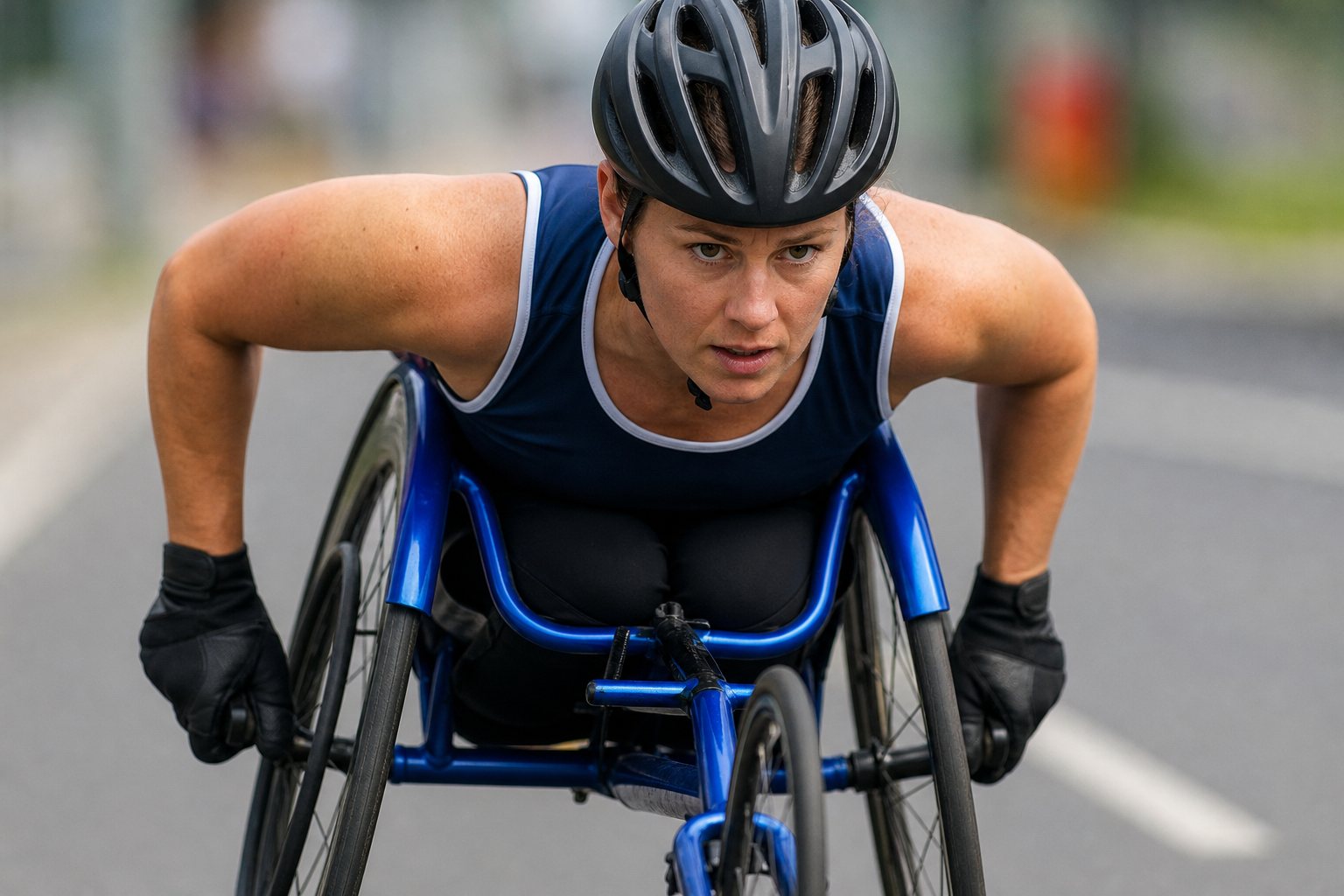
- PTWC1 and PTWC2: athletes who use a wheelchair. They ride a recumbent handcycle and run in a racing wheelchair; PTWC1 covers the most impaired athletes. Both classes share one medal event.
- PTS2 to PTS5: standing athletes with impairments such as limb deficiency, hypertonia, ataxia, athetosis, or impaired muscle power or range of movement. PTS2 is the most severe and PTS5 the mildest, and each class has its own medal event. Athletes with limb loss may use approved prostheses or other supportive devices on the bike and run, and bikes can be modified (for example pedal shape, single-hand brake and gear levers, or handlebar position).
- PTVI1 to PTVI3: athletes with a vision impairment, from totally blind (PTVI1) to less severely partially sighted (PTVI3). They ride a tandem with a pilot and run with a guide. The guide must be the same nationality and gender, and may not lead the athlete by more than 0.5 m in the swim. All PTVI classes share one medal event.
Transitions: the “fourth discipline”
Paralympic.org calls the transitions a key part of the race that can significantly affect total time. Depending on class, athletes may receive help leaving the water, collecting equipment, being lifted into a chair or onto a bike, changing out of the wetsuit and parking the bike afterward. Handlers assist PTWC athletes in the transition area; they train as a team and build trusted relationships with the athlete.
Who races Para triathlon, and at what level
First race and club. You do not need to be classified to race. USA Triathlon says unclassified athletes can still compete in its certified races in adaptive divisions; classification is only required for World Triathlon competitions. New athletes can email USA Triathlon’s Para team at [email protected] for guidance.
How classification works in the US. For physical impairments, you register for an event that offers classification, receive an appointment, have your doctor complete the Physical Impairment Medical Diagnostic Form and bring it, along with all your racing equipment, to the appointment. Classifiers assign a sport class, observe you racing, and a panel finalizes your national class. For vision impairments no in-person classification is offered nationally: an ophthalmologist completes the Visual Impairment Medical Diagnostic Form, and USA Triathlon reports your national class.
Elite and Paralympic. Tokyo 2020 was the second Paralympic appearance. At LA28 the IPC lists 12 Para triathlon medal events: six men’s and six women’s, with 120 athlete places. The Games run 15-27 August 2028. Qualification details change between Games, so check the official programme for the current Games.
For youth, school and college, we did not find a current official Para pathway to report; youth Para participation is growing, but ask USA Triathlon ([email protected]) about minors before planning.
Physical demands
Para triathlon is an endurance sport: three disciplines back to back, with a transition at each change. The muscle groups change with the class: a PTWC athlete swims with the arms and shoulders, handcycles with the arms and trunk, then pushes a racing chair, so almost everything comes from the upper body; a PTS athlete may race with one leg or one arm; a PTVI athlete adds coordination with a pilot and guide. Swim skill, transition practice and upper-body endurance matter in every class. Because training volume is high in three sports, a coach who understands your class helps you spread the load. See triathlon training for the standard base.
Health and safety for Para triathlon
This is general information, not medical advice. For anything specific to your body or your impairment, see a sports medicine doctor, physical therapist or athletic trainer who works with Para athletes.
What surveillance shows: illness stands out
At the Paris 2024 Paralympics, a British Journal of Sports Medicine study monitored 4,450 athletes over 14 days. The highest illness incidence was in triathlon, 18.2 per 1,000 athlete days, compared with other sports, and illness was more common in female athletes than male athletes (10.6 versus 6.6 per 1,000 athlete days overall). The overall injury incidence was 8.6 per 1,000 athlete days, and triathlon was not among the three sports with the highest injury rates. The study does not give causes in the abstract, so we do not claim one. The practical take-away is to take illness seriously around travel and race week: sleep, hygiene and a plan with your team doctor.
Open water and the swim
Practice open-water swimming with a buddy or on a supervised course before racing, and practise exits with your handlers if you need help leaving the water. USA Triathlon competition rules set water-temperature limits for wetsuits, and race directors set the details for each event. Never swim alone in open water; this is a rule of thumb across triathlon and not a Para-specific research finding.
Heat, sweating and spinal cord injury
Sweat and thermal responses can be impaired after a spinal cord injury, depending on the lesion, according to an exploratory study of elite athletes with spinal cord injury. PTWC athletes with a spinal cord injury should plan for cooling, fluids and shade with their own medical team. Athletes with an injury at or above T6 can also have autonomic dysreflexia, a potentially life-threatening rise in blood pressure; the IPC bans deliberately inducing it. Learn your warning signs and emergency plan before hard training.
Bike crashes and head injuries
Wear a helmet that fits on every ride. If anyone hits their head, use the CDC’s HEADS UP steps: recognize the signs, remove the athlete from activity, and have a healthcare provider decide when to return. Call 911 for danger signs such as repeated vomiting, a seizure or a worsening headache. Handcycles sit low and fast, so ride groups should agree on the plan in advance.
Training, recovery and nutrition pointers
Build each discipline gradually, add a brick session (bike then run) once a week or so as your coach advises, and rehearse transitions with your handlers or guide. Pages for the standard sport: triathlon training, recovery and nutrition and supplements. For recovery tools see the recovery guide. Para triathletes are subject to anti-doping rules, so check any supplement with your federation before use.
Gear for Para triathlon
The expensive, class-specific equipment (handcycles, racing wheelchairs, prostheses, tandems) is regulated by the international federation and is fitted by specialists, so talk to your classifier and coach before buying. USA Triathlon says to bring all your racing equipment to your classification appointment. The everyday kit below is common to all classes, though fit and features matter more than brand:
- Tri suit: one suit for the whole race saves a change in transition.
- Elastic laces: no-tie laces speed up the run shoes in T2; check they work with your prosthesis or footwear.
- Multisport watch: tracks swim, bike and run; some activity profiles suit wheelchair use, so check the maker’s list for your sport.

Zoot Core Tri Tank Racesuit (Men's)
- Sleeveless, chamois pad
- Pockets, UPF 50+
- Check fit with your equipment

Lock Laces Elastic No-Tie Laces
- 48 in, stretch to 72 in
- One size, kids and adults
- Check fit with your footwear

Garmin Forerunner 570
- GPS, AMOLED, 42 or 47 mm
- Garmin Coach triathlon plans
- Check wheelchair profiles with the maker
$449.99 at Amazon, as of Nov 17, 2026 01:07 UTC
Check price on AmazonRelated sports and disciplines
Parent sport: triathlon, with its gear and rules pages. Each leg has its own page: Para swimming, Para cycling (the handcycle and tandem groups) and Para athletics. Also see Para rowing.
Para triathlon FAQs
How long is a Para triathlon?
750 m of swimming, 20 km of cycling and 5 km of running, half the Olympic distance. The same distances are used at the Paralympic Games.
Is Para triathlon in the Paralympics?
Yes, since Rio 2016. The IPC’s LA28 programme lists 12 Para triathlon medal events. Check the official programme for the current Games.
What do PTWC, PTS and PTVI mean?
PTWC is for wheelchair users (handcycle and racing chair), PTS for standing athletes with physical impairments, and PTVI for athletes with a vision impairment (tandem and guide). The number is the class within the group.
Do I need to be classified to race?
Not to enter USA Triathlon certified races in adaptive divisions. Classification is required for World Triathlon competitions.
Who can be a guide or handler?
PTVI guides must be the same nationality and gender as the athlete and stay with them throughout the race. Handlers assist PTWC athletes in transition, and the best ones train as a team with the athlete.
Sources
- Paralympic.org: 10 things to know about Para triathlon
- Paralympic.org: Welcome to Para triathlon
- IPC: LA28 Paralympic medal event programme and athlete quotas
- World Triathlon: Para categories
- USA Triathlon: Para classification
- British Journal of Sports Medicine: Injury and illness at the Paris 2024 Paralympic Games
- How elite athletes with a spinal cord injury sweat during exercise (PubMed)
- Autonomic dysreflexia following spinal cord injury (PubMed)
- USA Triathlon: competition rules
- CDC HEADS UP: respond to a concussion
Keep exploring: triathlon injuries, best wearables for triathlon, the heart rate monitor guide and every other sport on our sports hub.