This article contains affiliate links: if you buy through them we may earn a commission, at no extra cost to you. Read our affiliate disclosure.
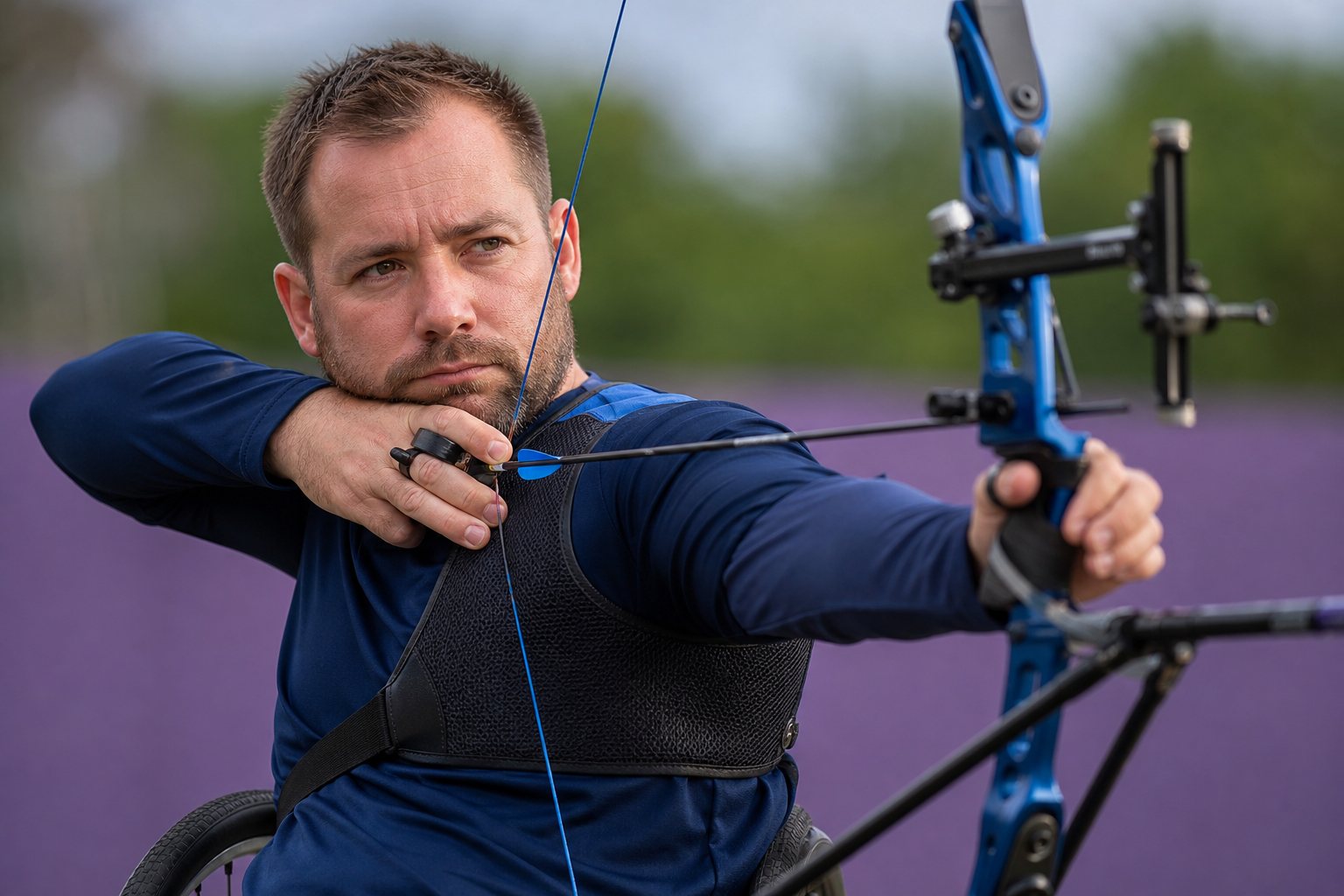
A quiet line of archers on a wide green field: some stand, some sit on stools, some shoot from wheelchairs, and one rests the bow on a custom support, waiting for the signal. The only sound is the thud of arrows in a target 70 meters away. This is the same sport that began at the 1948 Stoke Mandeville Games and has been on the Paralympic programme since Rome 1960. Para archery (also called adaptive archery or archery for athletes with a disability) is target archery for people with a physical or visual impairment, with the same bows, the same targets and the same scoring as the Olympic sport.
Para Archery guides: what do you need?
New to para archery? Start with the first card. Everything here is general education, not medical advice.
History & Origins of Para Archery
Para archery is at the roots of the Paralympic movement. In 1948 Dr Ludwig Guttmann used archery in the rehabilitation of injured veterans at Stoke Mandeville Hospital in the United Kingdom and organized the first Stoke Mandeville Games, the forerunner of the Paralympics, with archery as a competition (World Archery; Paralympic.org). Para archery made its Paralympic debut at Rome 1960, with 83 athletes from 15 countries in eight medal events. At Paris 2024, 137 athletes from 47 countries competed in nine medal events, in recurve open, compound open and W1 classes (Paralympic.org).
- 1948: Stoke Mandeville Games, with archery for wheelchair users.
- 1960: Para archery debuts at the Rome Paralympics.
- 1992: At Barcelona, Spain’s Antonio Rebollo wins silver in the men’s recurve team event.
- 2024: Paris Paralympics: nine medal events; Harvinder Singh wins India’s first Para archery gold.
- 2028: Los Angeles will be archery’s 18th consecutive Paralympic appearance.
Notable Para Archery Athletes
- Margaret Harriman (South Africa): competed at the Paralympics from 1960 to 1972 and won seven golds, the most by any Para archery athlete per Paralympic.org.
- Neroli Fairhall (New Zealand): competed at the Paralympics in 1980, 1988 and 2000, and was the first athlete to compete at both the Olympics (1984) and the Paralympics.
- Antonio Rebollo (Spain): won Paralympic silver in 1992, weeks after lighting the Olympic cauldron with a flaming arrow.
- Zarah Nemati (Iran): competed at both the Olympics and Paralympics at Rio 2016.
- Harvinder Singh (India): won India’s first Para archery Paralympic gold at Paris 2024.
Source: Paralympic.org archery, read November 13, 2026. This list is not a ranking.
Official results and records
We did not confirm a recent champions table on an official results page. See:
- Paralympic.org: archery results and history
- World Archery: World Para Archery Championships results.
How we keep this current: we re-check facts after each major championship and update this page. Spot an error? See our editorial policy.
This page is a plain-language guide for new archers, parents, coaches and curious fans: how the sport works, what “classification” means, how to get started, and how to stay healthy. It is general information, not medical advice. If you have a medical condition or an impairment, a sports medicine doctor, physical therapist or athletic trainer who knows your situation should guide your training.
Para archery at a glance
| What it is | Target archery for athletes with a physical or visual impairment, shot standing, seated on a stool or from a wheelchair. |
|---|---|
| How it is won | Arrows are scored on a ten-ring target. A 72-arrow ranking round seeds the bracket; matches are then head to head. Events are individual or mixed team. |
| Bows and distances | Recurve: 122 cm target at 70 m. Compound: 80 cm target at 50 m. W1 archers: 80 cm target at 50 m (IPC). |
| Competition classes | Open (recurve and compound), W1, and visual impairment (VI1 and VI2/3), according to World Archery. |
| Where it is played | Outdoor fields and indoor ranges, from club level to World Para Archery events and the Paralympic Games. |
| Governing body | World Archery worldwide (headquartered in Lausanne); USA Archery in the United States. |
| Season | Indoor and outdoor seasons, year-round at club level; the Paralympic Games come every four years. |
How para archery works
An archer draws, aims, and releases at a target face. Each of the ten scoring rings is worth points, so a perfect arrow scores 10. In competition the athlete first shoots a ranking round of 72 arrows, and that score decides who meets whom in the elimination matches. According to the IPC, para competition allows 30 seconds per arrow, compared with 20 seconds in the standard Olympic format, which gives archers who need extra time to set up a little more room.
The divisions you will see
- Recurve Open: the familiar Olympic-style bow, shot at 70 meters. Archers with an impairment of the upper or lower body, or one side, can shoot standing, on a stool or from a wheelchair.
- Compound Open: a bow with pulleys (cams), sights with magnification and a mechanical release aid, shot at 50 meters. The rules for the Open divisions are very close to able-bodied archery.
- W1: for archers with more severe impairments, usually affecting both sides of the body and the trunk. W1 archers use a recurve or compound bow, but with limits such as draw weight and sight magnification, and the two bow types compete together (World Archery).
- Visual impairment (VI1 and VI2/3): VI1 archers, who are blind or almost blind, shoot with blindfolds; VI2/3 archers shoot without them, according to World Archery.
What “classification” is for
Classification is how the sport confirms that an athlete has an eligible impairment and decides which assistive devices that athlete may use. It is not meant to label anybody. World Archery describes a structured, confidential process in which two classifiers (always two at international level) test strength and range of movement, and, for visual impairment, acuity and field tests plus observation while shooting. Pain is not scored. The result is a classification card that lists the athlete’s class and the equipment allowed. An athlete found not eligible (NE) cannot compete in para archery, though some NE archers are approved to use assistive equipment in able-bodied events.
Who plays it and at what level
Getting started. Many people begin at a local archery club or an adaptive sports organization that lends equipment. In the United States, the route to national events runs through USA Archery: you become a member and get a national classification. USA Archery asks for a medical intake form signed by a physician within the past 12 months, plus a photo, at least 30 days before the event; you bring every assistive device you use (wheelchair, stool, release, braces) to the classification appointment, where classifiers test range of movement, flexibility, strength and balance. Check the current process with USA Archery before you register, because forms and schedules change.
Club and national level. USA Archery runs para events within its national tournament schedule, and Move United (the adaptive sports organization) holds a national event as well. Para archers may also shoot in able-bodied events where the rules and their classification card allow it.
Paralympic Games. According to the IPC, archery has been on the Paralympic programme since the first Games, Rome 1960, where 83 athletes from 15 countries competed in eight medal events. At Paris 2024 there were 137 athletes (75 men and 62 women) from 47 countries in nine medal events, and the IPC says the United States has won the most golds (22). For the next Games, the IPC confirmed Para archery among the 22 sports of the LA28 Paralympic programme (announced 30 January 2023), and its June 2025 quota announcement lists nine medal events (three men’s, three women’s, three mixed) and 140 athlete places, the same as Paris 2024. The Games run 15 to 27 August 2028, and LA28 states that the schedule can change, so check the official programme for the current Games before you plan a trip.
Physical demands
Archery looks still, but it is not easy on the body. Every arrow asks for a steady stance or seated position, a controlled draw and a repeatable release, and a ranking round is 72 of them, so shoulders, upper back and hands are working for a long session. A study of 200 elite adolescent archers at a European championship found that 43.5% reported shoulder pain during training, a reminder that the upper body does the repeated work. For seated archers the trunk and any supported position matter as well, which is why the classification card lists the devices an archer may use. Each athlete’s training plan depends on the impairment, so work with a coach and a clinician who understand it.
Health and safety for para archery
Para sport injury research is still thin. A 2024 systematic review in Sports Health found 64 studies on health problems in para sports, with reported injury rates ranging widely from 0 to 91 per 1,000 athlete days depending on the sport and the impairment, and only three studies on whether prevention measures work. The Paris 2024 Paralympic surveillance study (4,450 athletes monitored over 14 days) found an overall injury incidence of 8.6 per 1,000 athlete days; this page does not claim a figure for archery alone because we could not confirm one.
Hands, fingers and arms
For archery in general, a US emergency-department study using the national injury surveillance database (NEISS, 2013 to 2022) counted roughly 43,000 archery-related musculoskeletal injuries, most often to the fingers and hands, with lacerations the most common diagnosis. The authors suggested that reinforced gloves, finger tabs and forearm guards are worth using. An arm guard keeps the bowstring off the forearm, and a tab or glove protects the drawing fingers. Athletes who use a mechanical release or a custom support should have it checked by their coach or classifier so it fits and works safely.
Shoulders and overuse
Wheelchair users already rely on their shoulders for daily life, and archery adds repeated drawing. In a one-year study of 102 Brazilian para athletes in four sports (not archery), the shoulder complex, followed by the ankle and knee, carried the greatest injury burden, so keep an eye on shoulder fatigue in your own sessions. Stop and tell a coach about pain that does not settle, tingling, or weakness. A sports medicine doctor, physical therapist or athletic trainer can look at it; this page cannot diagnose anything.
Other things to plan for
- Sun and heat: outdoor ranges mean hours standing or sitting in the sun. Plan shade, water and sunscreen, and know that some impairments change how the body handles heat; ask your clinician.
- Skin and pressure: long sessions in a chair or on a stool can stress the skin. Check your seating and shift position between ends.
- Falls and head injuries: if anyone hits their head (for example in a transfer or a chair tip), the CDC HEADS UP guidance is to stop, watch for signs such as headache, dizziness or confusion, and have a healthcare provider decide when it is safe to return. Call 911 for danger signs such as repeated vomiting, a seizure or one pupil larger than the other.
Training, recovery and nutrition pointers
Archery improves with form work and many repetitions, so most programs mix shooting with shoulder and trunk strength, balance and mobility work that fits the athlete. Start with the general plans on our archery training page, then adapt them with your coach and clinician. For recovery, see archery recovery, and for food and hydration read archery nutrition and supplements, keeping in mind that some impairments change nutrition and hydration needs. Sleep is the base of it all: the CDC recommends at least 7 hours for adults and 8 to 10 for teens.
Gear
Competition bows, releases and supports for para archery are fitted to the athlete, and what is allowed is listed on the classification card. Do not buy specialized equipment before talking with your coach and, for competition, your classifier. The items below are common starters that fit many archers.
- Arm guard: protects the bow arm from string slap.
- Finger tab or glove: protects the drawing fingers. The US study above lists tabs and reinforced gloves among the safety gear to consider.
- Resistance bands: light bands are a common way to warm up and build shoulder endurance away from the range. Ask your clinician which exercises suit you.

SAS 8" Archery Armguard
- 8-inch, vented
- 3 quick-buckle straps
- One size
$10.99 at Amazon, as of Nov 17, 2026 01:07 UTC
Check price on Amazon
SAS Ambidextrous Suede Leather Finger Tab
- Double-layer leather
- Adjustable ledge and strap
- Ambidextrous

THERABAND Resistance Band Beginner Kit
- 3 latex bands
- Yellow, red, green
- For light strength work
$11.99 at Amazon, as of Nov 17, 2026 01:07 UTC
Check price on AmazonRelated sports and disciplines
Para archery is the adaptive side of archery, and the Olympic sport shares its bows and targets. Other shooting sports are covered on our Para shooting page. For more adaptive sports, see Para badminton, Para canoe and Para taekwondo.
Para archery FAQs
Is archery a Paralympic sport?
Yes. According to the IPC, archery has been on the Paralympic programme since the first Games in Rome in 1960, and it is one of the 22 sports confirmed for LA28 in August 2028.
Do para archers use the same bows as Olympic archers?
Mostly. Recurve archers use a standard recurve bow shot at 70 meters, and compound and W1 archers use a compound bow at 50 meters. W1 archers have limits such as draw weight and sight magnification. Assistive devices must be approved on the classification card.
What are W1, Open and VI?
These are competition classes used by World Archery. Open covers archers who shoot recurve or compound from a wheelchair, stool or standing; W1 is for archers with more severe impairments affecting both sides of the body and the trunk; VI is for blind and low-vision archers (VI1 shoot blindfolded, VI2/3 do not).
How do I get classified in the United States?
USA Archery asks you to send its medical intake form, signed by a physician within the past 12 months, with a photo at least 30 days before the event, and then attend an appointment with your equipment. You also need a USA Archery membership to compete in sanctioned events. Confirm the current steps on the USA Archery site.
Can I try it without buying anything?
Often yes. Many clubs and adaptive sports organizations lend bows and basic gear to beginners. Ask the club about adaptive options before you buy anything.
Sources
- IPC: Para archery
- IPC: LA28 medal event programme and athlete quotas
- World Archery: Archery confirmed for LA28 Paralympics
- World Archery: Para archery classification explained
- USA Archery: Para archery classification
- Archery-related musculoskeletal injuries (NEISS 2013 to 2022), PubMed
- Injuries and persistent pain in elite adolescent archers, PubMed
- Sports-related health problems in para sports: systematic review, PubMed
- Injuries and illnesses in Para athletes: one-year study, PubMed
- Injury and illness at the Paris 2024 Paralympic Games, British Journal of Sports Medicine (Europe PMC)
- CDC HEADS UP: signs and symptoms
- CDC: sleep
Keep exploring: the archery hub, archery injuries, archery gear, our recovery tools guide and the sports hub.